Many of majdal zoun’s buildings are now in ruins. The Shia population of the small town in southern Lebanon has fled, escaping Israeli air strikes. Its electricity has been cut off; the only lights are in a small command-post of the Israel Defence Forces (idf) who have occupied the town, 7km north of the border, and in a wide tunnel, 170m long, beneath the town’s centre.
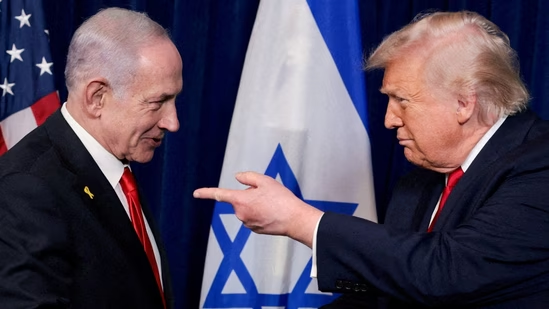
FILE PHOTO: U.S. President Donald Trump points his finger towards Israeli Prime Minister Benjamin Netanyahu as they shake hands during a press conference after meeting at Trump’s Mar-a-Lago club in Palm Beach, Florida, U.S., December 29, 2025. (REUTERS)
Stacked along the tunnel’s walls are rows of slender grey fuselages with small propellor engines, piles of triangular wings and cylindrical explosive charges. According to the idf, this is an assembly-line for Iranian-designed drone kits smuggled into the village and assembled there by Hizbullah, an Iran-backed Shia militia. The drones were then launched from various points in the village, guided by gps, to blow up targets in Israel. Israeli intelligence believes that the drones that in October 2024 hit an Israeli training base, killing four soldiers and damaging the coastal villa of Binyamin Netanyahu, Israel’s prime minister, were among them.
The Economist visited the drone factory accompanied by the idf, which is anxious to demonstrate the military capabilities that Hizbullah still retains. This factory was targeted by the Israeli air force in late 2024, but while the entrances were blocked by rubble, Hizbullah managed to continue launching drones from the village, and several other locations. Israel insists it needs to continue operating in southern Lebanon to destroy such threats to its people.
In theory, America, Iran, Israel, Lebanon and countries across the wider Middle East are all committed to peace. In reality, the stability of that peace is uncertain. Talks between representatives of America and Iran began in Switzerland on June 21st. These follow the signing last week of a memorandum of understanding (mou) between the two countries which, in theory, ends the blockade of the Strait of Hormuz, unfreezes Iranian assets and begins a 60-day period of negotiations over the future of Iran’s stockpile of enriched uranium. The 14-point document included, at Iran’s insistence, a commitment to a ceasefire in Lebanon.
On June 19th a Hizbullah drone hit an Israeli tank, killing four soldiers including a battalion commander. In response, Israel unleashed another wave of air strikes against what it says are Hizbullah targets, killing at least 47 Lebanese people. This led to Iranian threats to pull out of the talks with America, cueing renewed American demands for Israel to hold its fire.
The talks may have begun but among the many questions about the mou is the extent to which Israel, under Mr Netanyahu, will try to use the situation in Lebanon to undermine the prospect of a longer-term peace agreement. An idf officer in Majdal Zoun said that in his sector his troops had been observing the ceasefire since the signing of the mou, “even though we know that Hizbullah are operating all around”. In other areas near the border, especially to the east around the town of Nabatiyeh (pictured), Israeli forces continued attacking what they claim is a vast underground complex beneath the Ali Taher mountain ridge, overlooking Israel.
Mr Netanyahu’s office put out a bellicose statement saying Israel would “stay in the security zone [in Lebanon] as long as needed to protect the northern border” and that the prime minister had “directed the idf to respond powerfully to all attacks by Hizbullah”. Mr Netanyahu left it to the idf to notify the Israeli public that Israel had, in fact, accepted yet another ceasefire with Hizbullah.
For Israel and Lebanon this is a fraught moment. The ceasefire imposed by America means that Hizbullah will keep large parts of its arsenal, which so far the Lebanese army has been incapable of dismantling. If Hizbullah uses these drones again, Israel would respond with force, plunging it into yet another war in Lebanon.
But for Israel the concern is broader. The mou, as it is currently being interpreted in both Washington and Tehran, has empowered the Iranian regime to dictate terms in Lebanon, too. Israel fears this will tie its hands in defending its border and provide immunity to Hizbullah and other Iranian proxies. Over the past two and a half years Israel has fought on multiple fronts to inflict massive damage on Iran’s regional network. Now it fears many of those gains will be rolled back.
Meanwhile, America has been piling on public pressure. Mr Trump had already lambasted Mr Netanyahu for having “no fucking judgement”. On June 18th his vice-president, J.D. Vance, delivered a further broadside. The president, he said, “is the only head of state in the entire world who is sympathetic to the nation of Israel at this moment in time”. He reminded Israel of its dependence on American arms and cash and told its leaders to “to wake up and smell the reality of the situation that country is in”.
When Israel embarked on its numerous wars in the aftermath of Hamas’s attacks of October 7th, 2023, Mr Netanyahu refused the entreaties of the Biden administration and his own generals to offer any kind of diplomatic conclusion to the country’s war against Hamas in Gaza. His far-right coalition partners made no secret of their desire to destroy Gaza and build Israeli settlements in its territory. When Mr Trump returned to the White House in January 2025, he presented a plan to remove the 2m Palestinians from the Gaza Strip and build a mega-resort on the Mediterranean coast. Mr Netanyahu eagerly embraced this as his government’s strategy. Mr Trump has since changed course, pushing his 20-point plan for Gaza which includes Israel’s withdrawal. The splits between America and Israel over Iran have been even more profound.
Israel now faces a stark dilemma: pursuing what Mr Netanyahu says are its existential national interests could put it on a collision-course with Mr Trump. On a personal level, this is a triple blow for Mr Netanyahu who faces a difficult election, probably in October. His main selling-points to Israeli voters are that he has for decades worked to confront the existential threat presented by Iran; that since the calamity of October 2023, he has changed the balance of power in the region; and that he has a uniquely close relationship with Mr Trump.
All these claims are now in tatters and Mr Netanyahu’s hardline and ultra-religious ruling coalition is slumping in the polls. But this goes beyond Mr Netanyahu. Whatever the result of the election, Israel is now in a strategic bind which will test whoever occupies the prime minister’s office.