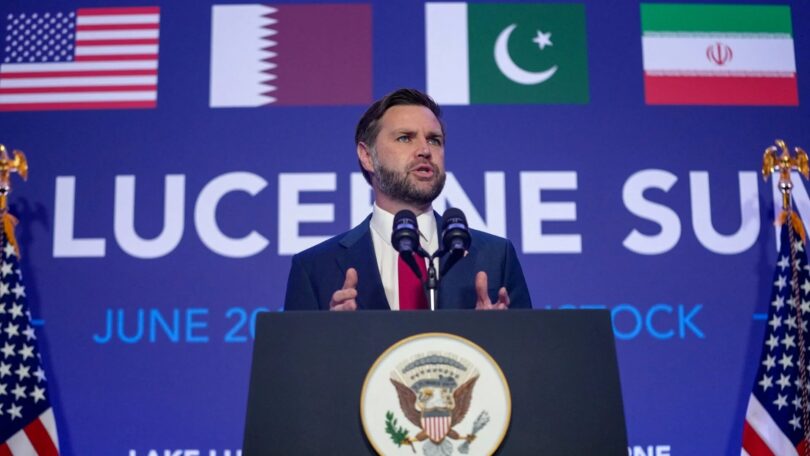
US suspends Iran sanctions after ‘good progress’ in talks
The US suspended sanctions against Iran on Monday as the two sparred over nuclear and weapons inspections during a day of talks that US Vice President JD Vance characterised as “good progress”.
US Treasury Secretary Scott Bessent announced it would be temporarily lifting sanctions until 21 August under a 60-day general licence that authorises Iranian oil production and sales. Any transactions during this period must be made in US dollars.
“In line with the ongoing productive talks in Switzerland, Iran has committed to free and open transit in the Strait of Hormuz and to permit International Atomic Energy Agency (IAEA) inspectors into their country,” Bessent wrote on X.
The lifting of sanctions will be a boon for Iran which used to produce around 4.6 million barrels of oil per day, exporting around 1.5 million barrels per day before the US imposed its own blockade to compete with Iran’s closure of the Strait of Hormuz.
The move has been framed by the US as a concession made in response to Iran opening up the Strait of Hormuz and allowing IAEA inspectors into the country but the Iranian government has cast doubt on that version of events.
IRNA, a state-run news agency reported that Iran’s foreign ministry spokesperson Esmail Baghaei said it did not negotiate over the nuclear issue and “no new commitments” had been made regarding inspections during talks.
Baghei added that any engagement with the agency would take place “under existing procedures set by Parliament and the Supreme National Security Council”.
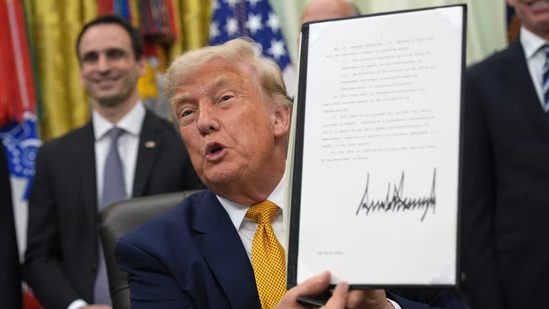
Shortly after that statement, US President Donald Trump chimed in on Truth Social saying: “Everybody is fully aware that Iran will agree to have Major Weapons Inspections in order to ensure ‘Nuclear Honesty’ long into the future.”
Iran stressed that any agreements to let inspectors in would not be made without parliamentary approval and the sign-off of the Supreme National Security Council.
Under the nuclear deal with Iran negotiated by Barack Obama, the IAEA had unprecedented continuous access to monitor Iran’s nuclear sites as well as uranium mines.
The US and Iran are holding talks in Switzerland under the auspices of the Islamabad Memorandum of Understanding (MOU) that was signed between the two countries bringing hostilities to a halt for a 60-day period to allow for “technical negotiations”.
Monday’s talks concluded the first High-Level Committee Meeting under the framework of the Islamabad MOU, with Pakistan’s Prime Minister Shehbaz Sharif hailing it a success and announcing that a roadmap towards a final deal within 60 days had been achieved during the summit.
Pakistan and Qatar are mediating the talks with Vance leading talks from the US end, while Iran’s chief negotiator is Mohammad Bagher Ghalibaf.
Diplomatic blitz
The first round of talks also kickstarted a flurry of diplomatic activity, with a number of top diplomats announcing trips in and around the region on the sidelines of the negotiations.
The US confirmed that its Secretary of State Marco Rubio would be attending the Gulf Cooperation Summit in Bahrain, a visit Middle East Eye first reported on 10 June. Rubio will also make stops in the UAE and Kuwait.
Bahrain, the UAE and Kuwait were some of the Gulf states that were hit hardest by Iran during the war, with the UAE taking the most hawkish position on the war and even carrying out strikes against Iran according to Trump.
The visit would be the first by a senior US official to the Gulf since the US and Israel attacked Iran on 28 February.

Read More »
Bahrain, which hosts the headquarters of the US Fifth Fleet in Manama, has been one of the countries most affected by the conflict, with the facility coming under attack during its early stages.
Beyond military infrastructure, Bahrain’s industrial sector has also sustained significant damage. The Financial Times reported that Amazon’s cloud computing operations in Bahrain were struck.
Oman, Qatar and Saudi Arabia took a softer approach and hedged their positions during the war, with public condemnations of Iran’s retaliatory attacks on the Gulf but Saudi Arabia at the same time pushing for talks between the US and Iran.
Oman became another focal point during the war, with the Trump administration increasingly irritated with its reluctance to publicly reject Iran’s position that it will continue to charge fees for passage through the Strait of Hormuz.
Trump even threatened to bomb Oman if it joined a framework to charge tolls in the strait. Oman is the only other country in the Gulf aside from Iran that can lay claim to the Strait of Hormuz.
After Monday’s talks, Iran’s chief negotiator Ghalibaf announced on his Telegram account that he would be traveling to Oman to discuss bilateral cooperation and joint efforts to “consolidate” the management of the Strait of Hormuz. Iranian Foreign Minister Abbas Araqchi will also be present during the visit.
Pakistan announced on Monday that Iran’s President Masoud Pezeshkian would visit Pakistan on Tuesday to continue discussing the negotiations.