Many countries preserve presidential material in state archives, and some notable 21st-century leaders can claim museums and monuments in their honour, such as the recent heads of Nigeria and South Africa. But America blends these two functions, with private donors paying for much of the construction through presidential “foundations”, and a government agency, the National Archives and Records Administration (NARA), caring for the records. Only America enshrines into law the right to a library for its head of state, highlighting how the country has granted the head of the executive branch, supposedly one of three equal branches of government, a somewhat regal aura.
The institution dates back to Franklin Delano Roosevelt’s administration. Until then presidents traditionally donated their papers, which were seen as their personal property, to the Library of Congress. In practice many records were simply “scattered to the winds”, says Mark Updegrove, who runs Lyndon Johnson’s library at the University of Texas.
The Presidential Libraries Act of 1955 authorised the federal government to preserve presidential papers and to “accept gifts or bequests of money” for their maintenance. Another law in 1978 made presidents’ papers the property of the government. (Though Donald Trump’s Office of Legal Counsel has argued that this act was unconstitutional—he wants to keep control over his papers—no court has yet agreed.) Annually the federal government pays around $100m to maintain all the libraries. But the cost of building them has been rising monumentally (see chart).
The Obama Presidential Centre is exceptional in several ways. It boasts of being the first “fully digital presidential library”: Mr Obama’s papers will be available to everyone online. The centre is also not subject to government oversight in the usual way. While NARA will maintain the digital archives and some physical papers and artefacts off-site, Mr Obama’s foundation will fund and manage the entire complex, running it like a private museum.
Valerie Jarrett, Mr Obama’s longtime adviser and the foundation’s chief executive, insists that this will help it preserve its “independence”, which may be code for defending against Mr Trump trying to tamper with its budget. (Mr Trump is the only living president, current or former, not invited to the dedication ceremony on June 18th.) But without any oversight from NARA, it also gives Mr Obama more latitude to shape the sort of legacy-building exhibitions that are mounted.
This tension between mythmaking and historical fact has played out in presidential libraries many times before. Richard Nixon helped curate his library’s original Watergate exhibition, which was later replaced with one that was more critical, after NARA took over the library and hired a professional director. Omissions are just as common as rosy portrayals: Ronald Reagan’s library initially failed to mention the Iran-Contra affair, a scandal of his presidency, and Johnson’s library largely avoided Vietnam for decades. Unsurprisingly, Mr Obama’s does not mention the record number of immigrants he deported.
Instead, libraries go heavy on the pomp. Reagan’s presents a decommissioned Air Force One, along with his limousines and a helicopter. Johnson’s features a life-size talking puppet of the president telling hokey jokes. Roosevelt’s preserves the cosy private study where he received visitors. Many of them, including Mr Obama’s and Mr Trump’s proposed library on a prime lot in Miami, offer visitors replicas of the Oval Office. The overall impression is hagiography, though that can change after the presidents’ deaths. Exhibits at Roosevelt’s, for instance, now feature his mistresses and uncomfortable questions about why he was so reluctant to accept Jewish refugees.
Mr Obama’s, befitting the man himself, is focused on culture as well as politics (Mr Obama releases annual lists of his favourite films, books and songs). Its grand interior feels like a contemporary-art museum, wreathed in dark wood and accented by bright paintings. A tour guide is quick to point out that Mr Obama chose the museum’s soundtrack, as well as the books on display in the “president’s reading room” in the on-site public library.
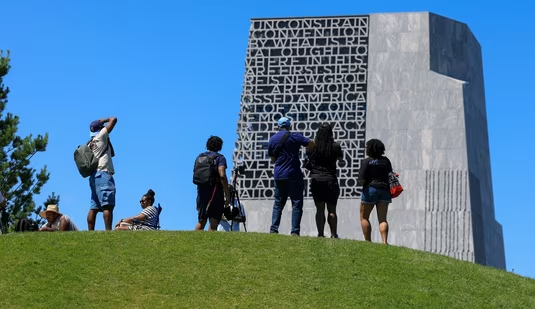
The huge price-tag reflects its deluxe amenities. The events and athletic facilities span around 60,000 square feet (5,500 square metres) and include a professional-size basketball court and practice areas. For the extensive grounds Michelle Obama insisted on designing a steep “sledding hill” for visitors, because she never had one when she was growing up nearby. Vegetable gardens, which also took root in Mr Obama’s White House, sprawl over the roof of the library.
Mr Obama’s fans will love the museum; his detractors will doubtless see it as they viewed his presidency: slick, facile and overproduced. The inverse is true of George W. Bush’s centre in Dallas. But take away the partisanship, and both museums represent the same deeply human impulse to get the last word and try to shape how future generations will view them.
Presidential libraries are only going to become more complicated affairs. With digital correspondence being sent across a growing array of apps, the boundary of what counts as personal and professional will be contested (as any cabinet member who has misused a Signal chat can attest). And if future presidents opt for the Obama model, with foundations running the spaces apart from government oversight of records, it will make for more partisan and puffy exhibitions. Will the nearly $1bn projects continue? It seems an odd use of resources for a supposedly down-to-earth civil servant. But fewer presidents are pretending to be that any more.
Correction (June 19th 2026): We erroneously used a Republican-red icon for Harry Truman on a version of the chart in this piece. Dewey feel bad? We do. Apologies.
For more on the latest books, films, TV shows, albums and controversies,sign up to Plot Twist, our weekly subscriber-only newsletter