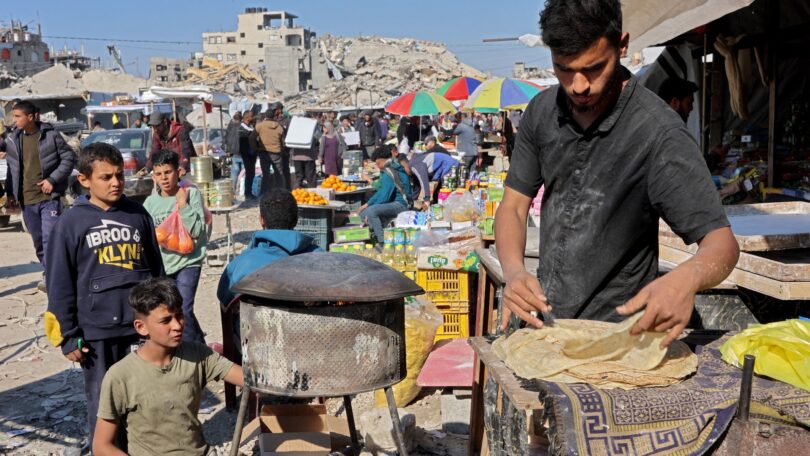
Palestinians in war-ravaged Gaza have accused the Bank of Palestine of freezing or closing their accounts without adequate explanation, leaving them unable to access salaries, aid and personal savings.
Several account holders told Middle East Eye they were unable to access funds needed to pay rent, buy essentials and support their families after discovering their accounts had been restricted or shut down.
They said they received little or no explanation from the bank and were given no clear pathway to challenge the decisions.
Due to the chronic liquidity shortage in Gaza and widespread deterioration of banknotes, many Palestinians rely heavily on banking applications and digital wallets to access and transfer money.
Ahmed Sardah told MEE that he was trying to transfer money through the bank’s mobile application when he discovered his account had been closed. He later learned that his PalPay and Jawwal Pay wallets had also been suspended.
CLICK FOLLOW: TO FOLLOW US
Sign up to get the latest insights and analysis on
Israel-Palestine, alongside Turkey Unpacked and other eSPORTY
Believing it was a technical error, Sardah contacted the Bank of Palestine. He said an employee informed him that his account had been “reserved by management”.
Sardah said the bank gave no warning before closing the account and rejected claims that it had exceeded transfer limits.
“Unfortunately, we are living in a war of destruction and constant bombardment, and on top of that, we are being strangled,” he told MEE.
‘We are living in a war of destruction and constant bombardment, and on top of that, we are being strangled’
– Ahmed Sardah, Gaza resident
“My life has completely stopped; I can’t even pay the rent, and I have monthly obligations. How am I supposed to meet them?”
Sardah said the bank gave no warning before closing the account and rejected claims that it had exceeded transfer limits.
Taghreed al-Daya lost her husband, four daughters and son in an Israeli air strike that targeted their apartment in Gaza City’s al-Sabra neighbourhood in July 2024.
Her eldest daughter, Raghad Banat, had an active account at the Bank of Palestine where she received her monthly salary. According to Daya, the account was closed immediately after her daughter’s death certificate was issued.
Daya said she completed the required inheritance procedures and obtained the necessary documents, but was told she would have to travel to Ramallah to continue the process, something she described as impossible from Gaza.
“I’m in Gaza. How am I supposed to get to Ramallah?” she told MEE. This is an impossible request.”
Lawyers join criticism
On 12 February, a group of lawyers in Gaza staged a protest against what they described as the Bank of Palestine’s freezing of accounts without legal justification.
The Palestinian Bar Association in Gaza later condemned the move, describing it as “dangerous and unjustified” and warning that it threatened families already struggling under the humanitarian conditions created by Israel’s war on Gaza.
In a statement, the association said it had received complaints from lawyers whose accounts had been closed without prior notice.
It said around 700 lawyers in Gaza had been affected as part of a wider group of nearly 2,000 suspended accounts.
She survived an Israeli raid that left babies decomposing. Now she awaits treatment
Read More »
The association said account holders received differing explanations, including requests to update customer information and allegations of “unfair use”.
Rami Abdo, the head of the Euro-Mediterranean Human Rights Monitor, accused the Bank of Palestine of periodically closing accounts based on recommendations transmitted through the Palestinian Monetary Authority and through internal risk-assessment procedures.
“The Bank of Palestine is exacerbating the problem by preventing citizens from challenging decisions, withdrawing funds or obtaining proof of compliance with regulations,” he told MEE.
According to Abdo, account closures occur regularly and can affect hundreds of accounts at a time.
The number of bank accounts in the Palestinian territories exceeds five million, according to the Association of Banks in Palestine.
Abdo alleged that accounts belonging to Palestinians killed during the war were closed after notification of their deaths, leaving families unable to access funds despite completing inheritance procedures.
“As soon as a martyr’s name is received, the bank checks if he has an account and closes it,” he said.
Bank rejects allegations
A source at the Bank of Palestine dismissed claims that thousands of accounts in Gaza had been frozen, describing them as false and baseless.
The source said that any action involving customer accounts is carried out in accordance with laws, regulations and instructions issued by the relevant authorities, and that no measures are taken arbitrarily or outside established legal and regulatory frameworks.
“Since its establishment, the Bank of Palestine has been proud of its national and economic role in serving Palestinians wherever they reside, especially the residents of the Gaza Strip,” the source said.
‘Since its establishment, the Bank of Palestine has been proud of its national and economic role in serving Palestinians wherever they reside, especially the residents of the Gaza Strip’
– Source, Bank of Palestine
“The bank continues to play its vital role in providing banking and financial services, enabling citizens and institutions to manage their financial affairs despite the exceptional circumstances and significant challenges facing the Strip,” they added.
The source also noted that the bank continues to provide banking and financial services in Gaza despite the challenges posed by the war and currently serves more than one million customers.
Responding to allegations concerning the accounts of deceased Palestinians, the source said such cases are handled according to legal inheritance procedures and judicial rulings designed to protect heirs’ rights and prevent unlawful access to funds.
The procedures apply equally in Gaza and the West Bank and are not linked to any exceptional circumstances, the source added.
MEE reached out to the Palestinian Monetary Authority for comment but did not receive a response by the time of publication.