
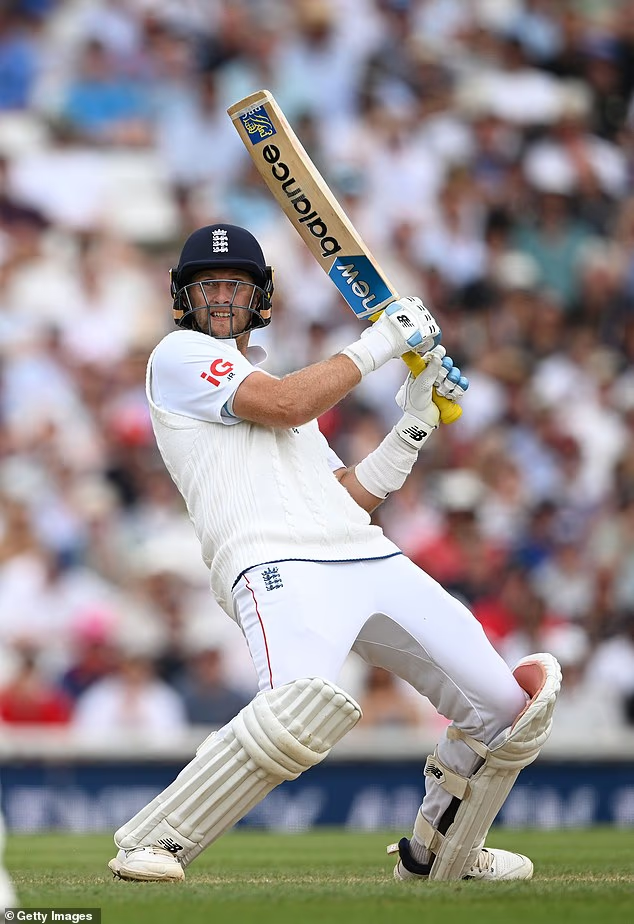
In deputising for Ben Stokes at the Oval this week, Joe Root extended his record number of appearances as England captain, but barring a fifth-day miracle he will hand back control of the team after suffering a record 27th defeat.
While Stokes was hitting 95 for Durham in a County Championship fixture at the other end of the country, Root was doing his best to delay the inevitable.
His innings had started in celebratory mood when, to roars of R-O-O-T from a Saturday full house, he became, via a couple of singles, only the second player in history behind Sachin Tendulkar to reach 14,000 Test runs.
However, this was a day of damage limitation rather than personal glory for Root. One which began with New Zealand 352 runs to the good, already well in front of the highest successful Test chase on this ground of 263.
It ended with him unbeaten on 75, and England a gargantuan 281 runs away from their notional victory target.
Only when he was playing second fiddle to Harry Brook in a rollicking stand of 97 for the fourth wicket – rekindling memories of last year’s efforts against India when another match without Stokes ended in a dramatically narrow defeat – was the gravity of the situation temporarily forgotten.
Root became, via a couple of singles, only the second player in history behind Sachin Tendulkar to reach 14,000 Test runs

New Zealand’s veteran seamer Matt Henry won lbw appeals against both Yorkshiremen – only for inside edges to reprieve Root on 44 and Brook on 53
Responding to a scoreboard of 40 for three, Brook counter-punched with a 33-ball 50. In one heady spell, 62 runs were plundered in seven overs, with Brook using his feet to throw the bowlers off their lengths, either charging down the pitch or rocking back to pull viciously.
With Root guiding and flicking into gaps in his typically unflustered manner at the other end, it looked a different game to the start of the innings when Kyle Jamieson dispatched Emilio Gay and Jacob Bethell in the same over and a restrained Ben Duckett toe-ended a pull to midwicket.
But the reintroduction of Matt Henry provided a stark warning of the fluctuating fortunes Test cricket offers. Exploiting the lateral movement on offer from a pitch that started green and has become increasingly straw-coloured as it has dried, New Zealand’s veteran seamer won lbw appeals against both Yorkshiremen – only for inside edges to reprieve Root on 44 and Brook on 53.
Those successful reviews might have embarrassed South African umpire Adrian Holdstock, but they also warned of the threat of Henry in these conditions.
Having taken five wickets in helping his side open up a three-figure advantage on first innings, Henry finally opened his account for the second when an edge found its way to first slip after taking a nick off wicketkeeper Tom Blundell, standing up to the stumps.
When James Rew’s error-strewn debut, including multiple dropped catches, concluded with his second dismissal within touching distance of the close of play, New Zealand were halfway there to setting up a series decider at Trent Bridge next week.
Earlier, New Zealand added 110 runs for their final seven wickets, dangling England a world-record-shaped carrot of 463 for victory in close to five sessions.
That target would arguably have been more modest but for a missed opportunity from the first ball of the fourth morning when Jofra Archer found the edge of Mitchell’s bat, only for the ball to burst through the grasp of England’s sole slip Harry Brook, diving to his right.

Statistically, Matthew Fisher did his chances of retention no harm, although his three late wickets were of the cheap variety
Undeterred, Archer bowled with considerable menace and impressive stamina for a player who until this week had been on a T20 diet in 2026, inducing thick nicks from Henry Nicholls and Glenn Phillips, New Zealand’s two centurions in this match, across eight overs that cost 23 runs.
The 31-year-old was not meant to play this match, but England’s plans changed when Stokes and Gus Atkinson were rendered un-selectable while under investigation by the Cricket Regulator for the early hours incident that followed the series-opening win over New Zealand at Lord’s.
It was to Archer’s immense credit that he remained England’s most potent weapon throughout this match, finishing with figures of five for 123, but whether he is asked to follow 36 overs here by going again in Nottingham may be influenced by the availability of others.
England are keen to name their third Test squad on Monday, but are shrouded in uncertainty. Stokes and Atkinson are expected to return, but Ollie Robinson, man of the match in the first Test, will undergo another fitness check on his knee niggle while the length of Jamie Smith’s paternity leave is yet to be established.
It means up to four changes could be made, three of them to a seam attack that wrapped up New Zealand’s second innings in a hurry after lunch.
Statistically, Matthew Fisher did his chances of retention no harm, although his three late wickets were of the cheap variety. First, he was the beneficiary of Mitchell’s over-exuberance when a ramp shot redirected a delivery into the stumps, and then, after the belated taking of the second new ball, Kyle Jamieson and Nathan Smith were added to the sacrifices of New Zealand losing four for 13 in the quest for quick runs.