TEN YEARS and six prime ministers after voting to quit the European Union, Britain has, to paraphrase Dean Acheson, lost a continent but not yet found a role. The referendum on June 23rd 2016, in which Britons voted for Brexit by 52% to 48%, has left them more divided, less influential and poorer than they would otherwise have been. The promise that Britain would “take back control” was a cruel joke. The country has been buffeted by global events. Brexiteers promised immigration would fall, but under Boris Johnson it soared.
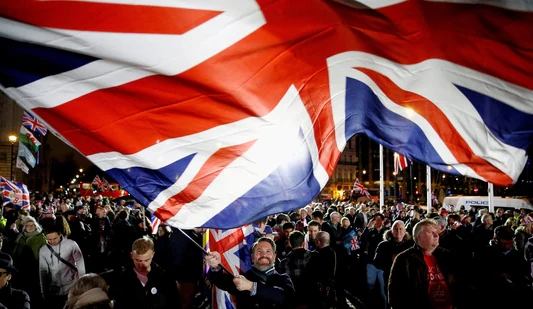
FILE PHOTO: A man waves a Union Jack flag on Brexit day in London, Britain, January 31, 2020. (REUTERS)
The next ten years should be brighter, but first Britons must accept the big lesson from Brexit: that trying to lay all their country’s woes on a single cause is magical thinking which only makes everything worse. They must not be tempted to make the same mistake all over again by imagining that rejoining the European Union is the answer to all their problems.
Read the rest of our cover package
Instead, national renewal means grappling with the many reasons why Britain is failing to live up to its potential. Policymaking is adrift, the state is inefficient and the private sector is weighed down by taxes and regulation. The country has mustered the leadership for a fresh start before, in the post-1945 invention of the welfare state and the reinvigoration under Margaret Thatcher. It must do so again.
As this newspaper warned at the time of the referendum, Brexit was a terrible blunder. Britain failed to make anything of the flexibility that Brexit brought. Dreams of a free-market Singapore-on-Thames have evaporated. Instead of deregulating, the state has become more intrusive, more inclined to meddle and, partly as a result, broke.
The hit to GDP has been at least 2.5% and probably much more. The distraction mattered, too. Officials and businesses have spent countless hours haranguing each other, first over how to “get Brexit done”—and then over how to mitigate the damage. On the world stage, Britain has been diminished.
Worse, the doomed search for silver bullets continues. The populist right is still obsessed with immigration, the populist left with curbing the evils of capitalism. Now centrists are seizing on evidence of buyer’s remorse—57% of Britons see Brexit as a mistake; just 30% still think it was right—to argue that Britain should strive to rejoin the EU. That would be a recipe for another decade lost to rowing over Europe.
Britain needs to focus on the future. The world looks very different from how it did a decade ago. Amid war and pestilence, geopolitics has come storming back. Artificial intelligence looks poised to upend pretty much everything, from work to warfare. Yet government policy is plagued by the ailments that have taken hold during Britain’s lost decade.
Defence is a good example. NATO allies reckon Russia could attack as soon as 2030. Looking to Asia and resentful of Europe, America is increasingly semi-detached. Britain has the instincts and experience to take a leading role in mustering Europe’s defences, just as it played a vital part in helping Ukraine. Only 8% of Britons are opposed to defence co-operation with other Europeans, according to Ipsos: 60% are in favour.
Sir Keir Starmer, the prime minister, says all the right things, but has been hopeless about finding the resources to match his rhetoric. On June 11th the defence secretary, John Healey, resigned after the government broke yet another promise to spend more. Britain looks weak—and hence a target for Russia. Its wavering negates one of the country’s main potential attractions for partners across the English Channel.
The government is also squandering Britain’s advantages in AI. Britain will never match America’s dominance—which has security implications, too. But it has strengths in basic research, innovative startups, tech talent and creative policies. These could help boost productivity in a moribund economy.
Alas, the sums businesses are investing in AI infrastructure and institutions are piddling. One reason is a net-zero policy that ends up limiting the production and consumption of energy, throttling the construction of data centres. Another is hostility towards American tech firms, including Palantir, which can work with law enforcement and health care.
Nobody said that solving these problems would be easy. Unfortunately, against the backdrop of covid-19 and wars, it has only got harder. Debt as a share of GDP is 94%, a level not seen since the 1960s. The budget deficit is 4.3%. And Britain’s government debt is the most expensive to service in the G7.
Closer relations with the EU, Britain’s main trading partner, could help. The government has been right to seek to remove barriers to trade in food, aiming to align rules and sometimes being prepared to pay a price to take part in desirable EU programmes, such as the Erasmus student-exchange scheme. This involves continual negotiation with the EU, as it has over years for Switzerland.
But the relationship must not become an all-consuming distraction. Britain is not yet ready to rejoin the EU. Nigel Farage, arch-Eurosceptic, could be prime minister within a few years. The EU would be wary of a country without a settled majority for membership. Britain must manage outside the club, as it has in finance or farming, a rare Brexit success story.
The ten-year itch
The pro-growth policies Britain needs are not a mystery. More Britons, especially the young, need to get off benefits and into work; the labour market is over-regulated; energy must be cheaper; government decisions are subject to too many veto-points, especially in planning; power must be devolved from Westminster; and so on. But each policy involves someone, somewhere giving something up.
Brexit imbued voters with the fantasy that they can escape hard choices. Someone else will take the pain, be they foreigners or the super-rich, while Britons pocket all the gains. That world never existed and, despite ten bad years, British voters are still in denial. It increasingly looks as if they will need a Thatcher-style shaking to awaken them.
For subscribers only: to see how we design each week’s cover, sign up to our weekly Cover Story newsletter.