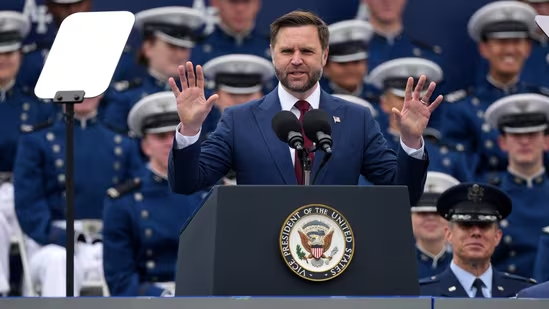
WASHINGTON—This wasn’t the book tour that JD Vance planned.
What started as a gantlet of promotional interviews this week for his new book ended with the vice president becoming the face of the tentative peace agreement with Iran, for better or worse.
In interview after interview, Vance was pressed about the agreement, making him the lead public defender of an accord that has come under fierce criticism from hawkish Republican lawmakers.
Vance, whose new book “Communion” details how he restored his faith in God, told Americans to “have a little bit of faith” in President Trump.
“The idea that he is going to strike a deal that’s bad for the American people, it’s preposterous,” Vance said of Trump in remarks to reporters Thursday at a White House briefing. “He believes in this deal. He is going to see it to completion. And if the Iranians don’t comply, we still have every single tool and point of leverage that we have today.”
It is a risky position for Vance, a potential presidential candidate who built his national profile warning against foreign entanglements. If the agreement falls apart and the region plunges once more into war, the vice president owns the fallout—both political and economic.
“This is his deal. It’s not the president’s deal,” said Brian Kilmeade on Fox & Friends, who questioned whether Vance was “the right person to bring this conflict to an end.”
The administration has faced criticism in recent days because the preliminary agreement offers a financial lifeline to Tehran and sacrifices a major point of leverage over Iran. Now, Vance and the president’s senior advisers have roughly two months to negotiate the thorny details with the Islamic Republic, including a plan to prevent the country from developing a nuclear weapon. Vance was appointed by Trump to be the highest-ranking negotiator on the deal.
Almost as soon as Trump announced that he had reached the preliminary deal, Republicans made Vance the owner. Sen. Lindsey Graham (R., S.C.) on Sunday on social media, described Vance as “the architect of the deal” when he called for a congressional briefing. Vance may take part in negotiations as soon as this weekend in Switzerland.
Republican critics described the deal as out of step with Trump’s goals, blaming his advisers but not the president. “President Trump has pursued peace through strength,” said Sen. Roger Wicker (R., Miss.), the chairman of the Senate Armed Services Committee. “I hope the intermediaries working on this deal are not undermining that objective.”
The vice president acknowledged some of the criticism when he said that some of the agreements were verbal and not in writing. “There’s a lot of discussion, the MOU, the gentlemen’s agreements, the final deal—words don’t matter, ladies and gentlemen, we’re about verification,” he told reporters. One example is the disposal of Iran’s stockpile of enriched uranium, which Vance said Iran agreed to do, but which isn’t in the 14-point memorandum.
Israeli officials also criticized the deal; Vance shot back that they need to “wake and smell the reality” that they are isolated internationally. “If I was in the cabinet of the Israeli government, I might not be attacking the only powerful ally that I have anywhere left in the entire world,” he said.
The deal paves a path for Tehran to see sanctions lifted, sell oil again and get money for rebuilding its economy—all potential issues for Republican hawks. “History demonstrates giving billions of dollars to theocratic lunatics who want to kill you is an exceptionally bad idea,” said potential 2028 contender Sen. Ted Cruz (R., Texas), who questioned if Trump was getting good advice.
Trump himself appeared to set up Vance to take the fall should the next 60 days not produce an agreement that the president can accept. “If it works out, I’m going to take the credit. If it doesn’t work out, I’m blaming JD,” he said Wednesday. “You better be careful, JD!”
Vance laughed that off during the White House briefing. “I think the president was joking as he often does.”
Trump wasted no time taking credit for the deal after Europeans praised the agreement at the annual Group of Seven meeting. The president added his signature to a printout at the Palace of Versailles, the same spot where the peace treaty to end World War I was signed. Vance was originally supposed to sign it in person with the Iranians.
Sen. Chris Coons (D., Del.) laughed out loud when asked how much responsibility Vance carries for the deal. “I think he’s been saddled with trying to sell it now, which is profoundly ironic, given that he was the isolationist of the core Trump team.”
Vance’s message on Thursday was that it wouldn’t matter if Tehran didn’t honor its commitments or even if a final deal was ultimately struck—because the U.S. had already won.
“We have all of the cards,” Vance said. “If the Iranians want the benefit of the bargain they have to give us the things that are necessary to get those benefits.”
Write to Natalie Andrews at natalie.andrews@wsj.com, Lindsay Wise at lindsay.wise@wsj.com and Vera Bergengruen at vera.bergengruen@wsj.com