
Far beyond military outcomes, some wars have the capacity to reshape the region. Iraq’s invasion of Kuwait in 1990 reorganised the Arab regional order around the American security umbrella, while the 2003 US invasion of Iraq unleashed a wave of sectarian conflict that defined the Middle East for nearly two decades.
The recent US-Israeli war against Iran may play a similar role. It has exposed the limits of Washington’s ability to guarantee security for its Gulf partners, and pushed several regional powers to explore new forms of coordination in an increasingly volatile environment.
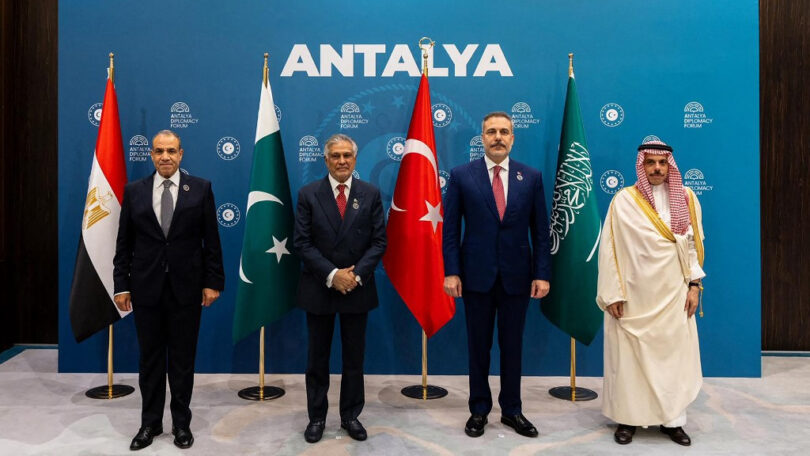
Signs of growing alignment have emerged among Saudi Arabia, Turkey, Egypt and Pakistan. Their increasingly coordinated positions on regional crises stand in contrast to the growing ties linking Israel, the United Arab Emirates, India, Greece, Cyprus and Ethiopia.
One of the most significant lessons of the war on Iran has been the exposure of the security formula that governed the Gulf for decades.
Over the years, the US has invested heavily in a network of military bases, early-warning systems and missile-defence capabilities across the region, presenting itself as the guarantor of Gulf security.
CLICK FOLLOW: TO FOLLOW US
Sign up to get the latest insights and analysis on
Israel-Palestine, alongside Turkey Unpacked and other eSPORTY
Yet the war demonstrated that the American military presence does not necessarily shield host countries from the consequences of regional conflict. Instead, it can expose them to its economic and security costs: Iranian strikes on Qatar, for example, temporarily wiped out nearly a fifth of the country’s liquefied natural gas export capacity.
This does not mean that the Gulf states are preparing to decouple from Washington; such an option is unrealistic in the foreseeable future. But Gulf governments are increasingly seeking additional security arrangements to reduce their exclusive reliance on the US.
Political and security cooperation
Coordination among Riyadh, Ankara, Cairo and Islamabad is among the most notable developments in this regard. Saudi Arabia provides financial resources, Turkey an advanced defence industrial base, Egypt military and geographic weight, and Pakistan political, military and nuclear capabilities. Together, these assets provide a foundation for closer political and security cooperation.
Still, describing this emerging alignment as a coherent alliance would be premature. Relations among these states carry a legacy of rivalry and mistrust, and their strategic priorities do not always converge.
The region suffers from high levels of mutual distrust, and policies are often driven by crisis management and short-term calculations
Recent years have witnessed tensions between Saudi Arabia and Turkey over the 2017 blockade of Qatar, and between Egypt and Turkey after the military overthrow of former Egyptian president Mohamed Morsi in 2013, in addition to the Libya crisis.
At the same time, Israel appears to be constructing a new network of partnerships inspired by the “periphery doctrine” it pursued during the mid-20th century, when it sought to encircle the Arab world through partnerships with powers located on its periphery.
The contemporary version of this doctrine is broader in scope and more sophisticated in its tools, extending from the Horn of Africa to the Eastern Mediterranean and the Indian Ocean, while combining security, technological and economic interests.
The UAE has become one of the central pillars of this network. Since the signing of the Abraham Accords in 2020, relations between Abu Dhabi and Tel Aviv have expanded into maritime security, technology and infrastructure.
India has emerged as another key component through the I2U2 grouping, formalising an alliance among India, Israel, the UAE and the US. At the same time, the planned India-Middle East-Europe Economic Corridor project aligns closely with Israel’s ambition to transform its ports into a transit hub linking Asia and Europe.
Already, India is a major buyer of Israeli weapons: between 2020 and 2024, India accounted for approximately 34 percent of Israel’s arms exports, making it the largest single importer during that period, according to the Stockholm International Peace Research Institute.
Network of partnerships
Greece and Cyprus constitute the western flank of this network. Since the deterioration of Turkish-Israeli relations following Israel’s deadly 2010 raid of the Mavi Marmara, a ship participating in a Gaza aid flotilla, Israel has cultivated strategic partnerships with both countries in energy and maritime security. Over time, these relationships evolved into a mechanism for balancing Turkish influence in the Eastern Mediterranean, while linking the region to economic initiatives extending towards the UAE and India.
Further south, Ethiopia and Somaliland are also playing a role in this evolving geopolitical landscape. Ethiopia continues to seek access to the sea, while Somaliland pursues international recognition for its separatist project. Houthi attacks during the Gaza war prompted Israel to increase its focus on this region to secure shipping lanes and counter threats emanating from the southern Red Sea.
The myth of Gulf exceptionalism and US protection is over
Read More »
This has created a convergence of Ethiopian, Emirati and Israeli interests in the Red Sea and Horn of Africa, all aimed at reshaping the balance of power in this region – a development that Cairo, Riyadh and Ankara view as a challenge to their own strategic interests.
Despite these developments, it would be misleading to describe the region as moving towards two rigid, opposing blocs. The historical experiences of the Middle East show that building stable alliances has always been a daunting task. The region suffers from high levels of mutual distrust, and policies are often driven by crisis management and short-term calculations, rather than long-term partnerships.
Egypt, for example, cannot ignore the importance of Emirati investments and economic support, even as it deepens coordination with Saudi Arabia. It also continues to regard peace with Israel as a strategic choice.
Turkey, meanwhile, has rebuilt strong political and economic ties with the UAE, and has little incentive to jeopardise them.
What is emerging in the Middle East, therefore, is less a system of rigid alliances than a network of flexible and overlapping partnerships. States may cooperate in one arena but compete in another. They may align on security issues, while pursuing conflicting economic or political agendas elsewhere.
The war on Iran may not produce new alliances in the traditional sense. But it is accelerating an ongoing process of regional realignment, and pushing Middle Eastern powers to search for new security arrangements, at a time when old certainties are fading – and competition over security, resources, maritime routes, energy and supply chains is becoming increasingly intense.
The views expressed in this article belong to the author and do not necessarily reflect the editorial policy of Middle East Eye.