Will Australian sport ever have its Len Bias moment?
Today marks the 40th anniversary of one of the darkest days in American sport after Bias died in tragic circumstances just days after the greatest night of his life.
The name ‘Len Bias’ probably doesn’t ring a bell for most Aussie sports stars, but they all should be aware of his story.
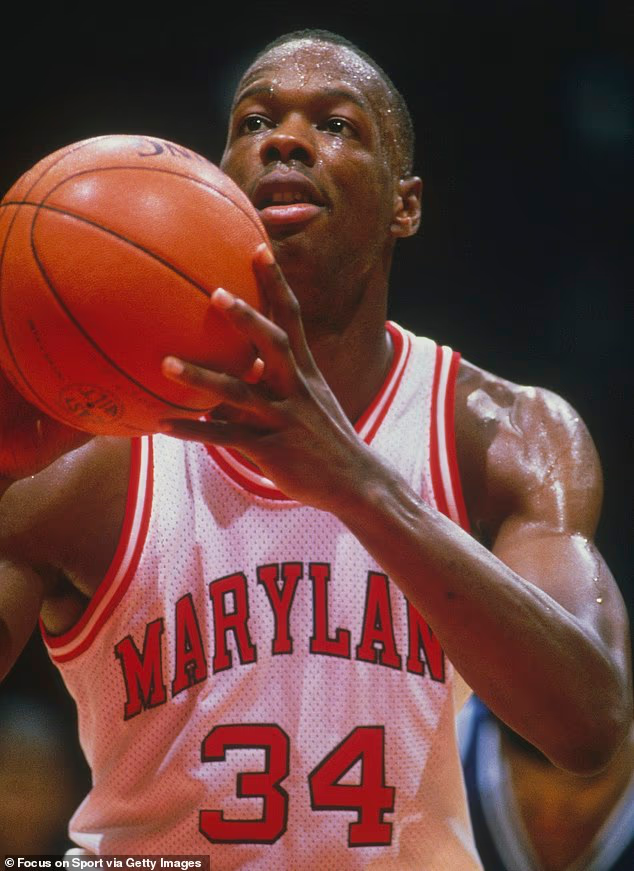
In the mid-1980s Bias was called by many ‘the next Michael Jordan’ after a stunning college basketball career in which he was a two-time ACC Player of the Year.
Known for his incredible leaping ability, physicality, and versatility, he often drew comparisons to Jordan, who was born in the same year – 1963.
After his stellar college career, he was selected by the Boston Celtics as the second overall pick in the 1986 NBA draft on June 17.
Len Bias was tipped to be the next Michael Jordan before he died after taking cocaine

Bias celebrates after being picked up by the Boston Celtics in the 1986 NBA draft. Two days later he would be dead

Bias with a Boston Celtics jacket after being selected in the first round of the 1986 NBA draft
‘I haven’t been this excited to play with someone since Cedric Maxwell,’ Celtics superstar Larry Bird said shortly after the draft. ‘Len Bias has that kind of talent.’
Many called it Boston president Red Auerbach’s most brilliant coup of his long career, and Bias was the man to take the Celtics dynasty forward.
After the draft, Bias went back to the University of Maryland college campus and in the early hours on June 19, he had cocaine in his dormitory suite to celebrate his NBA selection.
Bias then suffered a seizure and collapsed while talking with teammate Terry Long.
Attempts by the emergency medical team to restart his heart and breathing were unsuccessful and Bias was pronounced dead at 8.55am of a cardiac arrhythmia related to cocaine use.
It is unknown whether that night was the first time the 22-year-old had tried cocaine, but those closest to him suspected he never had it before.
Maryland’s chief medical examiner said the cocaine had ‘interrupted the normal electrical control of his heartbeat, resulting in the sudden onset of seizures and cardiac arrest’.
‘It’s the cruelest thing I’ve ever heard,’ then-Celtics star Bird told Sports Illustrated.

Bias went back to his college dorm to celebrate his NBA selection and took cocaine which led to his death at just 22

Bias’ casket leaves the University of Maryland. Upwards of 11,000 people attended to pay their respects
Former NBA player Marquis Daniels said of Bias: ‘When I hear Len Bias’s name I think of a great player who didn’t get a chance to live out his dream.’
Dr Ross Walker, an expert in the field of preventative cardiology with seven published books, told Daily Mail: ‘If you have a genetic predisposition to heart arrhythmias which he (Bias) probably had, and they’re not that uncommon, and you use cocaine, it can really irritate the electrics in the heart and set off an arrhythmia which can kill you.’
Bias was just 22 and had the world at his feet before one line of cocaine took him out.
Could a similar situation occur in Australian sport?
Some of our athletes, over the years, have certainly put their hands up to be candidates.
Cocaine use, or possession, in the National Rugby League (NRL) has surfaced regularly surfaced, with some high-profile police investigations, positive drug tests, and headline-grabbing integrity scandals.
In 2021, Brisbane Broncos star Reece Walsh was arrested and formally charged by Queensland Police for cocaine possession. He pleaded guilty in the Southport Magistrates Court.
Cronulla Sharks fullback Ben Barba was released from his contract and banned for 12 matches after returning a positive test for cocaine following the club’s 2016 grand final victory.

Former NRL star Ben Barba (left) celebrates after the 2016 grand final win. Days later he failed a drug test and was sacked by Cronulla

NRL stars and Test players Kevin Proctor and Jesse Bromwich are filmed using cocaine in a Canberra nightclub in 2017
In 2017, ONE News reported that 12 NRL players tested positive for cocaine following the various ‘Mad Monday’ celebrations at the end of that season.
In the same year, Kevin Proctor and Jesse Bromwich were caught on camera using banknotes to ingest cocaine, hours after playing a Test match.
Canterbury star Josh Addo-Carr was sacked in 2024 after he returned a positive result to cocaine at a roadside police drug test.
The AFL is no stranger to similar incidents.
In 2024, Melbourne Demons player Joel Smith received a career-ending four-year and three-month ban for five anti-doping rule violations, including trafficking and match-day possession of cocaine.
In 2023, Carlton recruit Elijah Hollands was handed a two-match suspension and a club-imposed fine after pleading guilty to cocaine possession at a casino.
There’s no point in listing all the cocaine scandals for both footy codes because this column would go on forever.
And we’re not even mentioning all the incidents where players were caught on camera in possession of a suspicious ‘white substance’.

Reece Walsh was arrested by police on the Gold Coast after being found in possession of cocaine in 2021 and he pleaded guilty

Celtics coach K.C. Jones (left) with Celtics first draft choice Len Bias on June 17, 1986

Carlton recruit Elijah Hollands arrives at court to face drug charges and he pleaded guilty to cocaine possession
These elite footballers feel invincible, probably not knowing how vulnerable they could be.
According to the Alcohol and Drug Foundation, between 2001 and 2021, there were 884 confirmed cocaine-related deaths in Australia.
The number of fatalities has increased substantially since 2011, and the demographic most at risk are males in their 30s with no prior history of chronic substance use problems.
When asked about the danger even an elite athlete puts themselves in when snorting cocaine, Dr Walker told Daily Mail: ‘There’s always a risk. They think they’re invincible and they’re not.’
‘What cocaine is, is a severe vasoconstrictor which clamps down on the arteries. Anything that does that in predisposed people can lead to a rupture of the plaque and a heart attack or a cardiac arrest,’ Dr Walker said.
‘Most people get away with it, but the predisposed people can have a problem.
‘They (footballers) think because they’re sportspeople that they’re healthier than other people. No, they’re fitter. It doesn’t make them healthier.’
At the time of the Bromwich and Proctor incident, Kangaroos coach Mal Meninga told the Courier Mail: ‘Call me harsh, call me old-fashioned, but the game needs a stronger stance. The NRL’s drugs policy is too lenient because players keep doing it.’

NBA Hall of Famer Charles Barkley (right) said the Bias incident scared him stiff when it came to cocaine use

Dr Ross Walker, an expert in the field of preventative cardiology, says just because footballers are fit, it doesn’t mean they can’t die after using cocaine

LA Lakers superstar Magic Johnson said the Bias incident should be taught at every high school, college, and in the NBA
‘We need a real deterrent. The first offence [should be] you don’t play the game for 12 weeks and if you do it again, you should be deregistered,’ Meninga said.
The NRL’s Illicit and Hazardous Drugs Policy operates on a welfare-first model focused on rehabilitation alongside deterrence, managed by an independent third-party provider.
It screens for substances like cocaine, amphetamines, cannabis, and opiates, with penalties escalating for repeated offences.
The first offense results in a suspended fine, mandatory counselling, and a targeted monitoring program.
The second offense carries a 12-match ban, potential contract termination, and continued intensive treatment while for a third offense referrals are made directly to the NRL to determine deregistration or severe disciplinary action.
The AFL policy is similar and it could be argued they’re soft, given just how serious cocaine use is and the possibility of death is real.
The footy codes spend so much time educating players about drugs, but the deterrents don’t seem to work.
Maybe they should just show players the Len Bias case?
It worked for Hall of Famer Charles Barkley.
‘It scared me into not trying it even once, not going anywhere near it,’ Barkley said in 2006.
Fellow Hall of Famer Magic Johnson once said: ‘I don’t think the subject of the tragedy of Len Bias comes up enough. Too many people have forgotten. It should be talked about every year at every high school, every college, and definitely the NBA season, especially for the rookies.’
BostonMan Magazine’s Matt Ribaudo wrote earlier this year: ‘Bias would have been the greatest basketball player that ever played.’