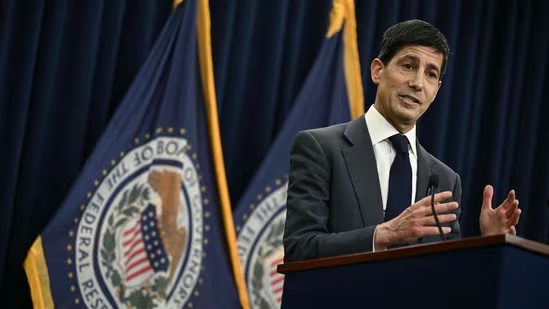
The US Federal Reserve kept interest rates unchanged at its latest meeting. Fed Chair Kevin Warsh followed expectations by leaving rates steady. However, several unexpected signals from the meeting created uncertainty about the future path of interest rates. Investors were left guessing about whether the Fed could raise rates, cut rates, or keep them unchanged in the coming months.
Financial markets reacted negatively to the Fed’s message. Major U.S. stock indexes fell after the policy announcement and during Warsh’s press conference. The meeting showed that while rates stayed the same, the Fed’s future plans remain unclear.
Top 5 takeaways from the Fed meeting
1. Fed kept interest rates unchanged
The Federal Reserve voted to keep its benchmark interest rate between 3.5% and 3.75%. There were no disagreements (dissents) among policymakers on this decision. This means borrowing costs and lending rates will stay at current levels for now.
2. Fed officials are becoming more cautious about rate cuts
Even though rates were left unchanged, the Fed’s projections showed a more hawkish outlook. Policymakers were split 9-9 between those expecting rates to stay the same or be cut and those expecting at least one rate hike. The median projection in the Fed’s “dot plot” pointed to a 0.25 percentage point rate increase later this year, as stated by a CNBC report. This suggests some officials are worried inflation could remain a problem.
3. Kevin Warsh did not submit his own rate forecast
Before the meeting, many investors wondered whether Fed Chair Kevin Warsh would submit a forecast in the Fed’s dot plot, Warsh confirmed that he did not submit a projection. He said other policymakers should continue providing forecasts, but he personally chose not to participate, as cited by CNBC. Warsh has long criticized detailed forward guidance because he believes it can limit the Fed’s future flexibility.
4. Warsh signaled major changes at the Fed
Warsh announced the creation of five new task forces to review how the Fed operates. One task force will study Fed communications. Another will review the Fed’s balance sheet. A third group will examine the data sources the Fed uses to make decisions. Another task force will focus on productivity and jobs.
Also read: How will Fed’s June interest rate decision affect your finances? Here’s what you need to know
A fifth group will study artificial intelligence and other major technologies. The task forces will also review the Fed’s overall approach to controlling inflation. The move shows Warsh wants to reshape how the central bank works.
5. Inflation remains the Fed’s top priority
During his press conference, Warsh repeatedly stressed the importance of “price stability”. He used the phrase around a dozen times. Warsh said the Fed has an “unambiguous and unanimous” commitment to bringing inflation under control, as noted by CNBC. His comments sounded more hawkish than many investors expected. Markets reacted quickly to the inflation-focused message. The 2-year Treasury yield, which is sensitive to Fed policy expectations, jumped 14.4 basis points.
Fed introduced a much shorter policy statement
Warsh also began changing how the Fed communicates with the public. The post-meeting statement was cut down to 130 words, as noted by a CNBC report. Previous Fed statements often exceeded 300 words. Investors usually analyzed those longer statements closely for policy clues. The new version was shorter, simpler and contained less boilerplate language. The change appears to be part of Warsh’s effort to make Fed communication more direct.
Markets reacted negatively after the meeting
Investors were left uncertain about the future direction of interest rates. Major U.S. stock indexes fell after the Fed announcement and during Warsh’s press conference. The combination of a hawkish dot plot and strong focus on inflation made markets nervous.
Therefore, the Fed kept rates unchanged, but a hawkish outlook, strong focus on inflation, major reform plans, and Warsh’s new communication style signaled that U.S. monetary policy may be entering a very different phase.