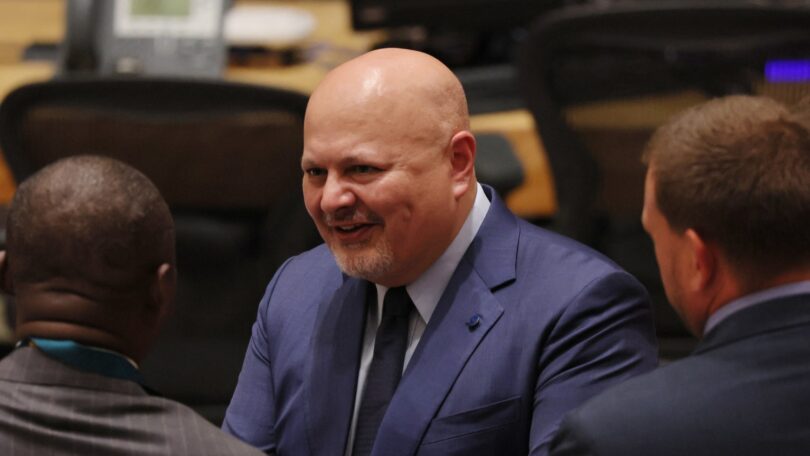
Member states of the International Criminal Court are due to convene in New York on 24 July for a consequential vote on the disciplinary proceedings involving Prosecutor Karim Khan, Middle East Eye can reveal.
Multiple diplomatic sources have confirmed that the Bureau of the Assembly of States Parties (ASP), the governing body of the court, decided on Wednesday the date and place of the special session to allow the 125 members of the ICC to vote on misconduct allegations facing the prosecutor.
The bureau, a political body, suspended Khan on 8 June by a qualified majority after disregarding a judicial panel’s opinion that found no evidence of misconduct against him.
The ASP is the competent decision-maker on voting on a final determination of the misconduct allegations and whether to remove him from office. States are asked to vote on whether Khan committed serious misconduct, less serious misconduct or no misconduct at all.
In its confidential decision, seen by MEE, a two-thirds majority of bureau members present and voting recommended a finding of “serious misconduct”, paving the way for a vote at the larger ASP which first needs to uphold the decision, then vote on whether to remove the prosecutor.
CLICK FOLLOW: TO FOLLOW US
Sign up to get the latest insights and analysis on
Israel-Palestine, alongside Turkey Unpacked and other eSPORTY
According to the ASP’s current rules, any finding of misconduct would require the approval of a two-thirds majority of the states present and voting at the ASP.
If the ASP votes to find serious misconduct, it would then hold a second vote on whether to remove the prosecutor.
A vote to remove Khan would require an absolute majority of the 125-member ASP (63 votes).
5,000 pages of evidence
Allegations of sexual misconduct, which Khan has strenuously denied, emerged in May 2024. The complainant refused to cooperate with the ICC’s own investigative body, prompting the ASP to commission an outsourced UN-led investigation.
Both the complainant and Khan cooperated with the UN investigation.
For more than a year, UN investigators were tasked with gathering and weighing evidence against Khan to enable the panel of judges appointed by the bureau to provide authoritative legal advice on whether the prosecutor had committed misconduct, applying the standard of proof “beyond reasonable doubt”.
ICC states should respect judges’ report on prosecutor, says Norway’s deputy foreign minister
Read More »
On 11 December, they submitted their 150-page report and 5,000 pages of evidence to the panel. The judges then spent nearly three months examining the OIOS probe until they reached their conclusion in March.
In a report seen by MEE, the panel concluded unanimously that the facts presented in the UN investigation “do not establish misconduct or breach of duty under the relevant framework”.
The investigation has left the court in an unprecedented state of limbo amid uncertainty about Khan’s future and media leaks about the allegations he faced.
Legal experts have warned that the bureau’s disregard for the judges’ opinion risks politicising the misconduct probe.
The allegations against Khan have unfolded in parallel with a campaign by the US and its allies to disrupt his office’s efforts to pursue a war crimes investigation into Israeli officials over the genocide in Gaza.
Khan, a British barrister, was elected in February 2021 by the ASP as the ICC’s chief prosecutor. He is the third person to hold that position since the court’s founding in 2002.
His office has since investigated serious international crimes allegedly committed by state leaders from across the world, including seeking arrest warrants for Russia’s Vladimir Putin, Israel’s Benjamin Netanyahu, Myanmar’s junta leaders and the Taliban in Afghanistan.
His work has prompted retaliatory US sanctions by the Trump administration in February 2025, as well as a trial in absentia and an arrest warrant issued by Russian courts. The US, Russia and Israel are not members of the court, but it has jurisdiction over crimes committed by their nationals on the territory of ICC member states.
The sanctions were later expanded to target two deputy prosecutors and eight ICC judges involved in the Palestine and Afghanistan investigations, the UN special rapporteur on Palestine, as well as Palestinian NGOs that provided evidence to the court.