For 30 years, the Gulf monarchies rested their security on a single assumption: that the United States would keep them safe.
The war that US President Donald Trump and Israel waged against Iran has buried that assumption.
The American bases scattered across the Gulf did not shield states from a conflict they never chose. They made it a target. Iran could not easily reach Tel Aviv or Washington, so it struck the softer prizes within range, and the Gulf absorbed the blows.
This was the old bargain exposed for what it had become.
Trump proved he could start a war, but he could not end one. His impatience, his appetite for flattery and his constant swing between the Israel lobby and the Gulf lobby left him incapable of the patient bargaining a settlement demanded.
CLICK FOLLOW: TO FOLLOW US
Sign up to get the latest insights and analysis on
Israel-Palestine, alongside Turkey Unpacked and other eSPORTY
He emboldened an Iran that the Gulf had spent years learning to manage, and he handed his partners more danger than they had before. The protector had become the source of the threat.
For nearly three years, it was Israel that broke the regional peace, and the Gulf that paid to repair it. This time, it was America that did the breaking
It is worth remembering what these states are to Washington.
The Gulf monarchies are net contributors to American power. They host the fleets, buy the weapons, fund the bases, provide trillions in foreign direct investment, and lend the United States the look of a regional hegemon it can no longer afford to be.
For nearly three years, it was Israel that broke the regional peace, and the Gulf that paid to repair it. This time, it was America that did the breaking. And once again the bill landed in Riyadh, Doha and Abu Dhabi.
As during the Arab Spring, the Gulf had to step in and take responsibility for its own region, as America was found wanting once again.
Filling the vacuum
The response did not arrive all at once, nor did it come from a single capital. At first, the Gulf spoke in different voices, with positions scattered across a continuum.
Oman sought to tame Iran through diplomatic multilateralism. In Abu Dhabi, Sheikh Mohammed bin Zayed, president of the United Arab Emirates, took the opposite line, lobbying his neighbours to join a military campaign that would reset deterrence against Tehran. Saudi Arabia and Qatar refused. Neither would become a junior partner in someone else’s vision for the region, least of all Israel’s.
When the hawkish approach failed to deliver, a quieter strategy rose in its place. Sheikh Tahnoon bin Zayed, the UAE’s national security adviser and tireless networker, had long argued that entanglement, not confrontation, was the surest route to stability. Riyadh and Doha already believed it.
How the Iran war broke the ambitions of ‘Little Sparta’
Read More »
The language of deterrence gave way to the language of engagement and interdependence, mindful of who they were up against.
Iran is built to absorb punishment almost without limit. The Gulf proved it could weather the conflict, but it could not bomb its way back to deterrence against an adversary designed to endure.
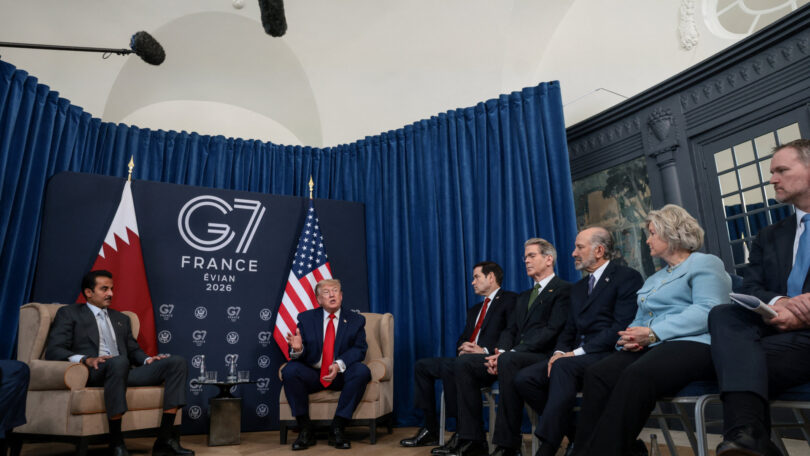
Qatar became the hinge: Doha speaks to Washington and to Tehran, and it can claim a measure of trust in both.
When an early round of Islamabad talks collapsed, Qatar kept the process breathing, albeit quietly and in the shadows. Its jets shuttled between Doha and Tehran. Qatari Prime Minister Sheikh Mohammed bin Abdulrahman Al Thani worked the phones with the Trump administration.
Rather than chase a grand bargain still out of reach, Doha pursued its diplomacy of small steps. The memorandum of understanding now on the table is modest, and it will take weeks, perhaps months, to grow into anything larger.
But it eases pressure on shipping lanes and supply chains and delivers the one thing the region had lacked: diplomatic momentum in a nearly frozen conflict.
That momentum required Muslim states to pull in the same direction. Pakistan, Turkey, Saudi Arabia and Qatar each played a part in convincing an impatient president that diplomacy, slow and unglamorous as it looked, was the only way out of the quagmire.
Israel worked to wreck it. Each time the talks gained ground, Israel escalated in Lebanon. Information operations targeted Qatar and Pakistan.
For a president with a short attention span, weaponised narratives spun by extensive and loud pro-Israel networks could swing his mood. What ultimately blunted these efforts was Gulf unity. For once, the Gulf’s “big three” spoke as one.
Abu Dhabi’s late turn toward pragmatism meant that Saudi Arabia, Qatar and the UAE were no longer running rival foreign policies and Israel’s traditional divide-and-rule tactic found nothing left to divide.
Reshaping the order
This is the lesson the Gulf cannot afford to forget. The region is a single security system, whether its rulers like it or not. An attack on one Gulf state is an attack on all of them.
Their economies, their waterways and their people are too entangled for any one of them to thrive while a neighbour burns. They are prisoners of geography, and geography unites sometimes more than clashing interests and values can divide.
That truth points to an uncomfortable conclusion. The Gulf needs a working relationship with Iran, and deterrence alone will never produce one. Deterrence has to be paired with financial and commercial interdependence.
The Gulf needs a working relationship with Iran, and deterrence alone will never produce one
A united Gulf, dense with economic ties to Tehran, is the most credible warning the Revolutionary Guard could receive. An attack on the Gulf would become an attack on Iran’s own lifelines.
It is also the surest way to keep Washington invested, and here the argument turns to money. A peace that lifts sanctions would open Iran to reconstruction, and reconstruction offers a market that both the Trump administration and the Trump Organization could be interested in.
While the Gulf can be the gateway, American firms stand to profit from it too. Sell diplomacy to Trump as a peace that pays, and he might finally tune out the heckling from Tel Aviv.
The lessons for the Gulf Cooperation Council are that pooling capabilities, networks and leverage can shape the regional order, even against Israeli illusions of hegemony.
A coalition of the willing that speaks with one voice when it matters, and keeps its quarrels private when faced with external pressure, can take responsibility for regional peace and security, even while the superpower sleeps and the two regional pariah states, Israel and Iran, blindly pursue their self-interests.
For most of its modern history, the Gulf has waited for others to decide its fate. Washington, Tehran and Tel Aviv have each taken a turn. The war has shown both the cost of that dependence and the reward of acting together.
The only question left is whether the Gulf is ready to shape the order around it collectively or be shaped by it acting unilaterally.
The views expressed in this article belong to the author and do not necessarily reflect the editorial policy of Middle East Eye.