US-Iran LIVE updates: Trump has dismissed reports that Washington would provide USD 300 million to Tehran under the newly announced peace agreement as “fake news.”
US-Iran war LIVE: The United States and Iran are set to formally sign an interim agreement aimed at ending months of conflict, with both sides presenting the deal as a diplomatic success. While key details of the arrangement are still emerging, the memorandum of understanding is expected to pave the way for 60 days of negotiations focused on Iran’s nuclear programme and other outstanding issues. The full text of the agreement has not yet been made public.
Top points of US-Iran war news from last 24 hours
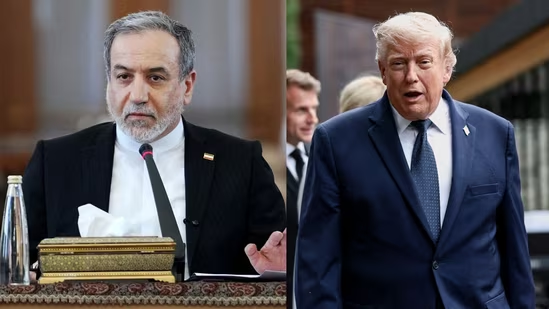
1. Even as US and Iran inch closer to a deal to end months of conflict, Iran foreign minister Abbas Araghchi struck a cautious tone, saying: “We have a history of broken commitments… a history of agreements being torn up. All of this is present in our minds.”
2. Oil prices extended losses on Tuesday, as markets weighed prospects for resumption of supply through the key Strait of Hormuz against shaky physical market drivers and a lack of details from a preliminary deal to end the Iran war.
3.Even as Iran and US signed the MoU virtually, raising hopes for a final deal to end months of conflict, US intelligence agencies have ‘serious’ doubts over Iran’s willingness to make the nuclear concessions, Axios reported.
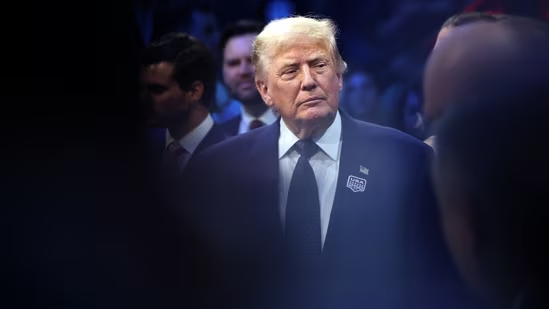
4. Trump has dismissed reports that Washington would provide USD 300 million to Tehran under the newly announced peace agreement as “fake news.”
5. The United States and Iran have reached an interim agreement aimed at ending the conflict, with President Donald Trump saying the deal prevents Tehran from obtaining a nuclear weapon, news agency Reuters reported. The memorandum extends the fragile ceasefire announced in April by another 60 days to create space for negotiations on a permanent settlement.
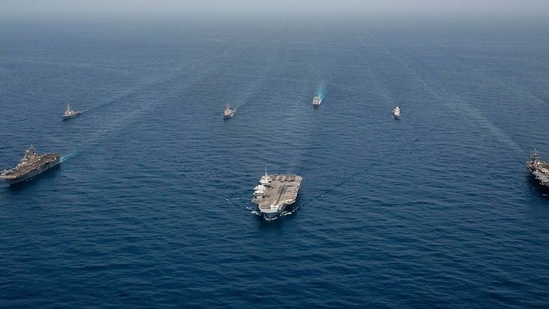
6. Under the agreement, Washington will lift its blockade on Iranian ports, while Iran will restore the movement of oil tankers and commercial shipping through the Strait of Hormuz.
7. A senior US official said Iran will be allowed to resume oil exports immediately after the agreement is signed, supported by banking, transport and insurance arrangements.
8. Israel has distanced itself from both the April ceasefire and the latest US-Iran understanding, raising questions over the durability of the truce.
9. US Vice President JD Vance suggested Israel and Lebanon are covered by the agreement, while Israeli Prime Minister Benjamin Netanyahu maintained that Israel is not bound by its terms.
10. Although both sides say the Strait of Hormuz will reopen from Friday, shipping companies remain cautious and are waiting to see whether the ceasefire holds before fully resuming operations.
…Read More
Top points of US-Iran war news from last 24 hours
1. Even as US and Iran inch closer to a deal to end months of conflict, Iran foreign minister Abbas Araghchi struck a cautious tone, saying: “We have a history of broken commitments… a history of agreements being torn up. All of this is present in our minds.”
2. Oil prices extended losses on Tuesday, as markets weighed prospects for resumption of supply through the key Strait of Hormuz against shaky physical market drivers and a lack of details from a preliminary deal to end the Iran war.
3.Even as Iran and US signed the MoU virtually, raising hopes for a final deal to end months of conflict, US intelligence agencies have ‘serious’ doubts over Iran’s willingness to make the nuclear concessions, Axios reported.
4. Trump has dismissed reports that Washington would provide USD 300 million to Tehran under the newly announced peace agreement as “fake news.”
5. The United States and Iran have reached an interim agreement aimed at ending the conflict, with President Donald Trump saying the deal prevents Tehran from obtaining a nuclear weapon, news agency Reuters reported. The memorandum extends the fragile ceasefire announced in April by another 60 days to create space for negotiations on a permanent settlement.
6. Under the agreement, Washington will lift its blockade on Iranian ports, while Iran will restore the movement of oil tankers and commercial shipping through the Strait of Hormuz.
7. A senior US official said Iran will be allowed to resume oil exports immediately after the agreement is signed, supported by banking, transport and insurance arrangements.
8. Israel has distanced itself from both the April ceasefire and the latest US-Iran understanding, raising questions over the durability of the truce.
9. US Vice President JD Vance suggested Israel and Lebanon are covered by the agreement, while Israeli Prime Minister Benjamin Netanyahu maintained that Israel is not bound by its terms.
10. Although both sides say the Strait of Hormuz will reopen from Friday, shipping companies remain cautious and are waiting to see whether the ceasefire holds before fully resuming operations.
Follow all the updates here:
Jun 17, 2026 7:41:09 AM IST
US-Iran war LIVE: Pope Leo hopes US-Iran peace deal will be definite end to war
US-Iran war LIVE: Pope Leo XIV welcomed an agreement between Iran and the US to reach a peace deal, expressing hope it will provide a definitive end to the war.
“There are still several points to be settled, but it’s always better to do so through dialogue and negotiation rather than returning to a state of war,” the pontiff said Tuesday, addressing reporters from his summer residence in Castel Gandolfo, near Rome.
The US and Iran are preparing to formally sign an interim peace deal in Switzerland on Friday. Still, questions remain on how quickly the Strait of Hormuz will be reopened.
Pope Leo hopes that after the signing, “we can move forward for the greater good to eliminate nuclear weapons, to seek the well-being of all peoples, and to find ways to resolve the economic and social problems that have arisen as a result of this.”
(Bloomberg)
Jun 17, 2026 7:29:49 AM IST
US-Iran war LIVE: US-Iran ceasefire agreement to be public soon, permanent truce still awaits negotiation
US-Iran war LIVE: Details began to emerge on Tuesday of the U.S. and Iran’s interim agreement to end the war in the Middle East, with U.S. President Donald Trump saying it will rule out a nuclear weapon for Tehran and a U.S. official saying it allows Iran to sell oil upon signing.
The memorandum of understanding signed this week, though yet to be made public, extends a tenuous ceasefire announced in April by another 60 days to allow the warring countries to negotiate a permanent truce.
Under the deal, the U.S. will end its blockade of Iran’s ports while Tehran will restore the passage of oil tankers and other maritime traffic through the Strait of Hormuz, which it has effectively blocked since the U.S. and Israel launched strikes on February 28.
The U.S. president said the agreement states clearly that Tehran will not have a nuclear weapon and the full text would be made public in a formal setting in a few days.
Jun 17, 2026 7:29:10 AM IST
US-Iran war LIVE: Oil prices tumble again on US-Iran deal
US-Iran war LIVE: Oil prices fell more than 5% on Tuesday, extending this week’s losses on hopes a U.S.-Iran deal to end the Middle East war will allow oil to flow through the Strait of Hormuz, while technology shares weighed on the S&P 500 and Nasdaq.
Details began to emerge of the U.S. and Iran’s interim deal, with U.S. President Donald Trump saying it will rule out a nuclear weapon for Tehran and a U.S. official saying it allows Iran to sell oil upon signing.
Brent crude futures fell $4.21, or 5.1%, to settle at $78.96 a barrel, while U.S. West Texas Intermediate (WTI) crude fell $4.70, or 5.8%, to $76.05.
(Reuters)
Jun 17, 2026 7:24:27 AM IST
US-Iran war LIVE: Oil holds near three-month low as Iran deal seen boosting supply
US-Iran war LIVE: Oil held near a three-month low on expectations that a US-Iran deal to reopen the Strait of Hormuz will unleash a wave of supply.
Brent traded below $80 a barrel, after sinking 15% over four days in the longest losing run this year, while West Texas Intermediate was near $77. The interim pact, which is due to be signed on Friday, offers Tehran broad financial incentives, including the right to sell its oil immediately.
Crude prices have retreated sharply in recent weeks as moves to end the war between Washington and Tehran are seen easing tightness in global energy markets. Producers, shippers and traders are now assessing whether the agreement will prove to be durable, and how long it will take for vessel transits of the Hormuz chokepoint to be revived in earnest.
“Most traders still believe US naval operations will likely be escorting for the first few weeks, and mine-sweeping ships will also be present, which will slow the flow of traffic,” said Dennis Kissler, senior vice president for trading at BOK Financial Securities Inc. “Still, the futures market is always looking in the distance, and for now the odds are increasing that oil will be moving.”
(Bloomberg)
Jun 17, 2026 7:19:04 AM IST
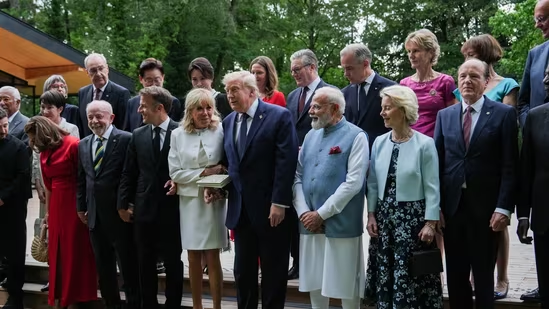
US-Iran war LIVE: G7 leaders back US-Iran deal, reaffirm support for Ukraine during summit in France
US-Iran war LIVE: Leaders of the Group of Seven (G7) nations on Wednesday signed a joint declaration, welcoming the peace deal between the US and Iran, and reaffirming their support for Ukraine. The G7 nations called for greater cooperation on Indo-Pacific security, energy resilience and supply chain stability at the 52nd G7 Summit in France.
In the statement on geopolitical issues, the G7 leaders pledged unwavering support for Ukraine’s sovereignty and territorial integrity, while committing to bolster Kyiv’s military and energy capabilities amid its ongoing conflict with Russia.
“We, the Leaders of the G7, stand united in our unwavering support for Ukraine in defending its freedom, sovereignty, and territorial integrity,” the declaration stated.
The leaders announced plans to increase the delivery of air defence systems, interceptors and long-range capabilities to Ukraine, while also considering measures to expand Ukraine’s domestic military production through licensing arrangements.
The declaration also committed additional support to strengthen Ukraine’s energy resilience ahead of the winter season and vowed to intensify pressure on Russia’s war economy through strengthened sanctions, including measures targeting the oil and gas sectors.
(ANI)