JOHANNESBURG (AP) — South Africa on Tuesday marks the 50th anniversary of the Soweto uprising when over 200 young people protesting against the apartheid education system were shot and killed by the police.
The events of June 16, 1976 — now commemorated annually as Youth Day — are considered a turning point in South Africa’s liberation struggle against white minority rule.
They ignited more demonstrations in various parts of the country, fueled more resistance against the apartheid system of segregation, and brought international attention to the racial oppression faced by Black people in South Africa.
Fifty years after the uprising, however, there are still concerns about the plight of young people in the country.
Survivors of the protests, experts and young South Africans have lamented the challenges facing the country’s youth including inequality, high unemployment, poverty and social problems such as drug and alcohol abuse.
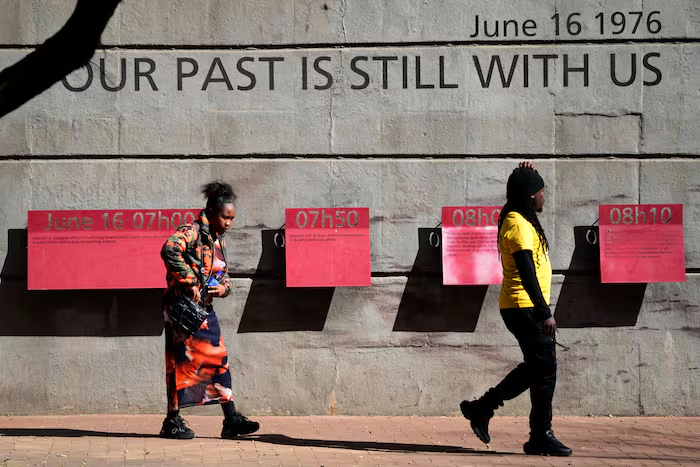
Soweto, one of the oldest townships in South Africa, bears symbols of the historic day which are frequently visited by local and international tourists.
These include a memorial named after Hector Pieterson, the boy whose lifeless body was seen being carried away by another student in an iconic photograph that came to symbolize the 1976 uprising.
Murals and billboards depicting protesting students can be found throughout the township, which is also home to the June 16 Memorial.
But for those who survived the protests, the symbols are a painful reminder of the day that changed their lives forever.
Seth Mazibuko, a survivor, remembers vividly how students fought back against the police, who were using tear gas to try and disperse the defiant demonstrators.
“They struggled with the tear gas because when they threw it our way, the wind would blow the gas back to them, so it was also affecting them,” said Mazibuko. “They then started sending the police dogs to us, we used stones to chase the dogs back to them.”
Mazibuko was detained for 18 months after his arrest and later imprisoned on Robben Island, where he served seven years alongside other political prisoners.
Fifty years after the uprising, South Africa has undergone significant changes but inequality, unemployment and poverty are among the most pressing challenges facing its “born free” generation — those born after the end of apartheid in 1994.
“I would say the issues of poverty and crime are the most pressing ones,” said Sima Poto, a 19-year-old visiting the June 16 Memorial. “It is poverty that is leading many of them into crime.”
Zola Mguli, a 29-year-old who works with the Southern African Alcohol Policy Alliance, an organization campaigning against alcohol and substance abuse, said he is grateful to belong to a generation that has grown up in freedom, even as significant challenges remain. “Things are not going as well as our forefathers hoped, there is still racism, alcoholism and other things we are battling with,” he said. “But if we, the youth, rise up, we can do better.”
Historian Noor Nieftagodien said the 1976 student protest movement was a traumatic and transformative moment that reshaped the anti-apartheid struggle, placing young people at the forefront of liberation politics.
“This was a generation that was young, gifted, and Black,” he said. “They wanted education.”
“The idea of Black power resonated with this new generation of young people,” Nieftagodien said. “Black consciousness was kind of electrifying; it inspired university students and then increasingly also students in high schools.”
He said that since June 16 was declared a public holiday after the end of apartheid, the significance of the event has diminished, overshadowed by celebratory events that, in his view, water down its political meaning.
“It has lost its meaning,” he said. “What has happened is that we’ve had the day marked with concerts, etc. I’m all for concerts. But, in fact, in so doing, the kind of celebrations that have been organized have been disinvested from politics, from a critical understanding of what happened.”
___
AP Africa news: https://apnews.com/hub/africa
Copyright 2026 The Associated Press. All rights reserved. This material may not be published, broadcast, rewritten or redistributed without permission.