Before Algeria had even kicked a ball at the 2026 World Cup, the team had already won over one US city.
In Lawrence, Kansas, a college town better known for the University of Kansas Jayhawks than for international football, the Algerian national team’s arrival has triggered an unexpected outpouring of affection.
The city’s relationship with the Algerian team, affectionately known as the Desert Foxes, began months before the tournament, when Lawrence was officially announced in February as Algeria’s base camp for the World Cup.
The team selected Rock Chalk Park as its training home, with city officials describing Lawrence as Algeria’s “home away from home” during the tournament.
That meant Algeria’s coaches, players and support staff would become temporary residents of the city while preparing for their group-stage matches.
CLICK FOLLOW: TO FOLLOW US
Sign up to get the latest insights and analysis on
Israel-Palestine, alongside Turkey Unpacked and other eSPORTY
The team is set to play two games at Kansas City Stadium, including its opener against defending champions Argentina on 16 June and another match against Austria on 27 June.
But what began as a logistical arrangement for the World Cup 2026 has morphed into something deeper.
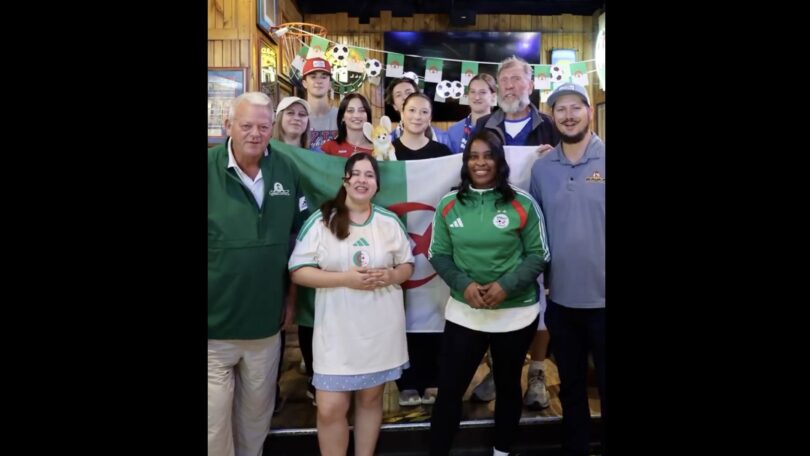
Over the past few days, videos and posts from Lawrence have shown Algerian flags flying, locals attempting chants, restaurants and shops welcoming supporters, and residents speaking with visible excitement about hosting the North African team.
🗣️ “We were singing viva Algeria. I got goosebumps…🥺” 🇺🇸🇩🇿
This Kansas local couldn’t help but get emotional at the experience with Algerian fans. 🫶🏼 pic.twitter.com/aoQlcmkD7K
— Dean Ammi (@AlgerianFooty) June 14, 2026
The phrase “Rock Chalk Algeria” – a play on the University of Kansas chant “Rock Chalk Jayhawk” – has spread across social media, capturing what many have described as one of the most wholesome subplots of the tournament.
🇺🇸❤️🇩🇿 « Nous sommes Algériennes dans le cœur » : la réaction d’étudiantes américaines plongées dans l’ambiance des Verts à Lawrence pic.twitter.com/vEgeHIAhsD
— LeLien (@LeLienofficiel) June 14, 2026
For many Algerians watching from home and across the diaspora, the scenes have been striking: a small Midwestern city, thousands of kilometres from Algiers, embracing their team not as strangers but as guests of honour.
Kansas is not usually imagined globally, or even domestically, as a centre of Arab, Muslim or North African life. But the Kansas City metro area and surrounding towns are home to scattered but longstanding Muslim, Arab and African communities, including Algerian families who have helped turn the team’s arrival into a broader community moment.
One recent account of the reception noted that the local Algerian community numbers in the thousands, with coffee shops, grocery stores and bakeries helping create spaces for fans to gather.
Local gatherings have sprung up across the metro area, including at Mediterranean markets and restaurants where Algerians, other Arab and Muslim residents, football fans, and curious locals have come together to celebrate the team.
Rock Chalk Algeria!
May we all find love and support the way the city of Lawrence and Algerians share ❤️❤️❤️ pic.twitter.com/JMUbiYMqIE
— Andrew Wiebe (@andrew_wiebe) June 14, 2026
The result has been a rare World Cup story that feels spontaneous rather than manufactured: part diaspora homecoming, part local festival, and part internet romance.
In Lawrence, Algerian players have been filmed touring University of Kansas facilities, trying out American football, basketball and baseball, and leaning into the Jayhawk culture around them.
A local report described the players kicking field goals, throwing American footballs, visiting Allen Fieldhouse and taking batting practice at Hoglund Ballpark.
Ibrahim Maza et Ramiz Zerrouki aperçus en trottinette électrique dans les rues de Kansas City ! 🛴🇺🇸 pic.twitter.com/ibybqTsG7D
— La Vague Verte ⭐️🇩🇿⭐️ (@la_vagueverte) June 14, 2026
The enthusiasm has not only come from Algerian fans. Kansas residents with no prior connection to the country have appeared in local and Algerian media praising the team and wishing it success.
A Kansas City bar named Johnny’s Tavern shared a video on its X account, welcoming the Algerian national team to Lawrence, Kansas.
For Algeria, the warmth is especially meaningful. The team returns to the World Cup led by figures including Riyad Mahrez, said to be one of the country’s greatest-ever players, and a new generation of talent that has brought renewed excitement to Algerian football.
A warm welcome in a hostile climate
What has made the Lawrence story travel so widely online is not only the football. It is the contrast.
This World Cup has opened under the shadow of US immigration restrictions and a political climate in which Muslims, Arabs, Africans, and other immigrant communities have repeatedly been cast as security threats by right-wing politicians and pundits.
Even before the tournament began, several World Cup-linked figures faced lengthy questioning, visa problems or outright entry denial in the US.
Somali referee Omar Abdulkadir Artan, who had been selected to officiate at the tournament, was denied entry into the US despite holding a valid visa.
Fifa said Artan would not be able to take part after a decision by US authorities, while US Customs and Border Protection cited unspecified “vetting concerns”. Artan would have been the first Somali official to referee at a World Cup.
Iraqi striker Aymen Hussein was questioned for nearly seven hours after arriving at Chicago’s O’Hare International Airport with Iraq’s World Cup delegation. He was eventually allowed into the country, but the team’s official photographer, Talal Salah, was denied entry after being held for more than 10 hours.
The head of the Palestinian Football Association, Jibril Rajoub, was also denied entry to the US despite his role within football’s international structures.
Those cases have fuelled criticism that a tournament marketed as a celebration of global unity is being hosted in an environment where access to that celebration is shaped by nationality, race, religion, and politics.
Against that backdrop, Lawrence’s embrace of Algeria has taken on a meaning beyond a feel-good local story.
For many online, the images from Kansas have offered a counterpoint to the suspicion and hostility that have marked other parts of the tournament: a reminder that ordinary people often respond to difference not with fear, but with curiosity, hospitality, and joy.
The Algeria-Kansas alliance only grows stronger and more wholesome 💚
This is the World Cup we love 🇩🇿 pic.twitter.com/IndzLt36Bg
— Men in Blazers (@MenInBlazers) June 11, 2026
It is not that Lawrence has erased the politics surrounding the World Cup. Rather, the city’s reception of Algeria has made those politics more visible.
In one part of the tournament, Muslim and Arab figures are being questioned, delayed or barred at airports. In another, an American city is hanging Algerian flags, learning Algerian chants and treating a North African team as its own.
That tension is precisely why the story has travelled.
World Cups often produce these unlikely attachments: a neutral city adopting a visiting team, a diaspora suddenly becoming visible, a local joke turning into a global meme. But in this case, the affection feels more pointed because it arrives at a moment when the language of exclusion has become increasingly normalised in American public life.
The people of Lawrence did not set out to make a political statement. Most appear simply excited that the world has arrived on their doorstep.
In a tournament already shaped by border controls, surveillance and suspicion, “Rock Chalk Algeria” has become shorthand for something softer and more generous: the idea that football can still create moments of recognition between people who might otherwise never meet.