IT IS ODD what people think a law can achieve. In 1930 the Soviet Union legally abolished unemployment. Everyone knows how well, under Stalin, that country then thrived. Another European dictator, Nicolae Ceausescu, decreed that every Romanian woman must produce five children. That worked just as well. Lawmakers in the American state of Indiana once tried to impose their own definition of the number pi, without troubling to ask any mathematicians for advice. All the way back to King Canute, simple-sounding decrees have often disappointed.
Photograph: Getty Images
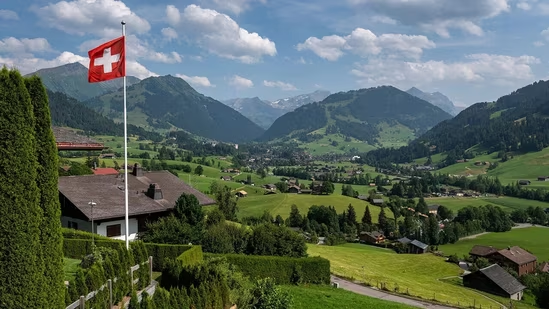
The citizens of Switzerland (population: just over 9m) should keep these examples in mind on June 14th. They are set to vote in a referendum, pushed by the country’s dominant, populist-right SVP party, on whether it should be illegal for Switzerland to contain more than 10m people. No other country has ever adopted such a cap. If polls are right, many voters are tempted: the result is too close to call. There is only one drawback: it is a terrible idea.
Switzerland, like most countries in Europe, is ageing. The fertility rate, at 1.3 babies per woman over a lifetime, is ultra-low. Without immigration, the population would naturally shrink fast. So this referendum is really about migration policy. Around 30% of the population are foreign-born, a level notably higher than in most countries. Many Swiss resent the presence of so many foreigners (largely Germans and Italians). They grumble about high property prices, damage to the Alpine environment, changes to Swiss culture, the spread of English and long queues for swimming baths, all of which the SVP blames on immigration.
The new law, were it to be enacted, would oblige the Swiss government to start imposing tight restrictions on immigration once the population crept towards the 10m-mark. In the popular imagination this would mean putting limits on asylum-seekers. In reality, Switzerland does not admit many. A hard cap would actually mean choking off the flow of foreign talent that invigorates the Swiss economy. From hospitals and drug firms to banks and insurers, the country’s ability to attract clever people makes it more productive and innovative. It consistently sits near the top of talent-magnet rankings.
A population cap would also disrupt Switzerland’s relationship with Europe. The country is a member of the Schengen area, a European free-movement zone that is home to 450m people. More important, its bilateral treaties with the EU include acceptance of the right of EU citizens to reside there, just as Swiss citizens can move anywhere in the EU. For Switzerland to renege on this agreement would mean renegotiating its relationship with the whole, wealthy continent in which it nestles. It would also deprive Swiss citizens of the freedom they currently enjoy to go and live in any one of 28 other European countries. It would be akin to a Brexit moment.
On current trends the 10m mark will be reached in 2041, according to Demografik, a think-tank in Basel. Blocking immigration to prevent that would require excluding a lot of highly skilled professionals, since they are the foreign workers Switzerland currently most recruits. Combine that with the wider effects of breaking up with the EU (a “guillotine clause” in the country’s agreement with the bloc makes it inevitable that ties are broadly severed) and the best guess is that the Swiss would inflict on themselves an economic loss of SFr500bn ($628bn) over 20 years. That’s big enough to cause pain in an economy of just $1.15trn.
The SVP has wooed even centrist Swiss voters by couching the referendum as partly an environmental measure. Immigrants occupy space, exhale carbon dioxide and occasionally drop litter. But the big threat to Switzerland’s mountaintop meadows and glaciers comes from climate change, something local population curbs will do nothing to solve.
It is reasonable for Swiss voters to wish to control the pace at which their society changes. But there are less crude ways of doing so. Switzerland could, without breaking EU agreements, regulate the inflow of migrants and favour the more skilled by requiring a higher minimum salary as a condition of admission. Easing restrictions on homebuilding would alleviate high house prices; barring the entry of foreign builders would not. Switzerland is rich partly because it is a hub for international business. It will struggle to remain so if it is closed to foreign brains. Voters should vote “no”.
Subscribers to The Economist can sign up to our Opinion newsletter, which brings together the best of our leaders, columns, guest essays and reader correspondence.