Raise a glass, savour the moment and briefly bask in the glory. It may not get any better than this.
For now, the way Scotland saw off Haiti is of secondary importance. They’ve done it. So, from Shetland to Southerness, let joy be unconfined.
When you’ve only previously won four games at a World Cup, with your last victory coming in 1990, a victory – any victory – is a cause for celebration.
Down the years, the national side has known no little abject failure and plenty glorious failure. Any deviation from those wearying narratives must be embraced.
What was this new sensation we felt at the weekend? A team playing beneath themselves yet prevailing? We could grow accustomed to this.
No need to put Haiti in the X-rated file along with Peru, Iran and Costa Rica. No need for the post-mortem and for so-called experts to suggest our game needs to adopt the grassroots model of Bhutan.
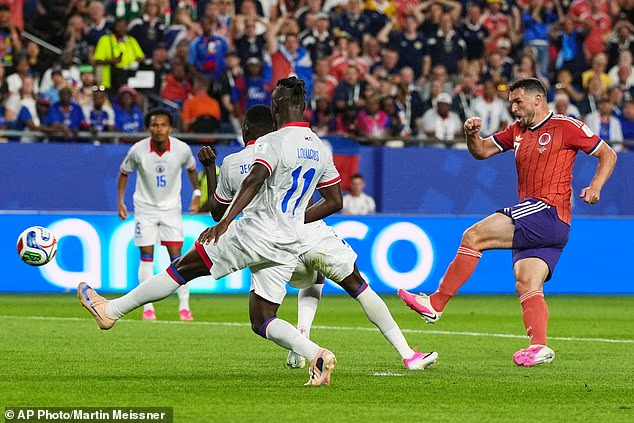
Midfielder John McGinn scores the deflected goal that earned Scotland a 1-0 win over Haiti

McGinn’s first-half strike earned Scotland their first victory at a World Cup finals since 1990

The Tartan Army celebrate a win that puts Scotland top of Group C after their opening game
In the seemingly interminable build-up to the match in Boston, all roads led back to France ’98 and that truly awful denouement against Morocco in St Etienne.
But just as relevant was Malaga in ’82. That was the backdrop to Scotland’s last opening-day win at a World Cup, a 5-2 triumph over New Zealand.
You’d need to go back to Dortmund in 1974 to find the only other one – a 2-0 win over Zaire.
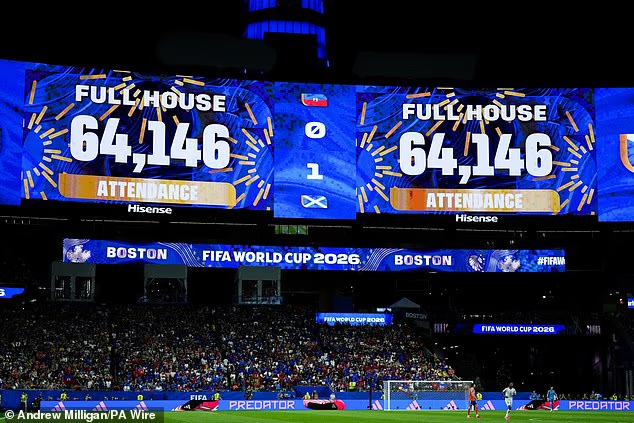
Just two wins in eight section openers stretching back to 1954. That was before Steve Clarke’s side walked out into the magnificent chaos of the Boston Stadium. So, credit where it’s due.
To suggest this was an ugly win would be an understatement. A game pockmarked by fouls – and not helped by the ineptitude of Algerian referee Mustapha Ghorbal – had no flow or rhythm to it. It was attritional and devoid of quality.
But when the six minutes of injury time were finally over and the Scotland fans roused themselves to bellow Freed From Desire, it was a beautiful scene. A match which was often tortuous yet a finale which will live forever.
As the convoy of cars and buses snaked away from the stadium, the naysayers were few.
Until this Friday, at least, Scotland lead the section. We’re presently looking down on Brazil and Morocco as well as Haiti. It’s a nice place to be.
Keep a clean sheet in either of the two remaining matches and they’ll be in the uncharted territory of a knock-out round. That would be footballing utopia.
In one sense, it’s tantalisingly close. In another, it feels a long way away.
Because for all there was much to commend Clarke’s players for – their grit, character and defensive organisation – it’s also correct to point out that they didn’t play particularly well.
Bluntly, had Frantzdy Pierrot not sent a late header wide, it would have been hard to begrudge Haiti a point.
Morocco will be a different proposition entirely in the same venue on Friday. Scotland are going to have to be too if they are to stand any chance of taking something.
Clarke’s players are entitled to feel good about themselves for a day or two. Nor, hopefully, will they be deluded by believing their performance was anything like the best version of themselves. A radical improvement is required.
Even at 9pm, it was warm within the ground yet the heat wasn’t nearly as intense as had been feared.
There was no mitigation, then, for the lack of intensity in their play. The tempo came and went throughout.
Friday’s game starts three hours earlier. It will be hotter. They’ll have to be far better at retaining the ball and resting on it. Otherwise, it has the makings of a long night.
It will be a different challenge and, accordingly, the manager will take a different approach. More cautious, you’d expect, with just one striker and five-men choking the midfield.
He got his team spot-on against Haiti. It was the shortcomings of certain individuals who made it an almighty slog.
Aside from Ryan Christie’s kith and kin, there would have been few arguments with the initial line-up.
The fact the Bournemouth man started on the bench in a 4-4-2 was absolutely no slight on him. The manager needed a bit of defensive assurance.
Given Haiti’s reputation for being physical and breaking at pace, Lewis Ferguson’s inclusion was a matter of common sense.
The Bologna man was the most effective player in the side. His work-rate was phenomenal, he made blocks and interceptions, he put his head where others would have feared to put their foot. He’d have slept well after that shift.
Clarke was strangely reluctant to also praise Ben Gannon-Doak in the aftermath, yet the Bournemouth winger’s contribution was undeniable.
Haiti could see that Scotland were at their most dangerous whenever he faced up Martin Experience. Doing something about it was a different matter.
Hugging the right touchline, he was a blur as he knocked the ball past his opponent, his pace making Experience look like a mannequin in a Princes Street window.
Gannon-Doak’s issues with injury scarcely need repeating. But when he’s fit and firing, he’s a terrifying proposition.
Andy Robertson was terrific on the left, the benefit of his lack of minutes in his final season with Liverpool becoming apparent.
John McGinn delivered. He was at the heart of most good things Scotland did with the ball. No player in the modern-day game is better at sucking opponents in and winning fouls.
His goal was fortuitous yet unforgettable. The first man to score at a World Cup for Scotland since Craig Burley against Norway in 1998, one mural in his hometown of Clydebank may not be enough.
Aaron Hickey struggled initially against the fabulous Ruben Providence, was booked, recovered and was replaced by Nathan Patterson.
Grant Hanley survived a handball claim. Jack Hendry survived losing his man at a cross ball. But both central defenders performed admirably. It said much that Angus Gunn wasn’t overworked.
The moment a nation had been dreaming of arrived on 28 minutes. Hanley’s ball over the top was killed by Che Adams. Just onside, he fed Gannon-Doak.
The winger smartly picked out Adams. His shot was beaten away by Johny Placida, but only as far as McGinn.
Lurking on the edge of the box, the Aston Villa captain took aim and, after seeing his strike take two deflections, spun away in celebration.
You hoped it would be the catalyst for a comfortable evening against a nation sitting 40 places below in the FIFA rankings.
Scotland, though, just had too many players stuck in third gear. Lawrence Shankland couldn’t do right for doing wrong.
Presumably, he only played the entire game because Adams will be the lone striker against Morocco. Adams, it must be said, wasn’t much better.
Despite hitting the post, McTominay toiled throughout. He looked short on energy, perhaps a consequence of the upset stomach which cost him a day’s training.
With none of Clarke’s five substitutes offering much composure, the final stages became a grind.
The manager claimed he wasn’t relieved when the whistle went. He must have been the only one. No one said this was going to be easy.