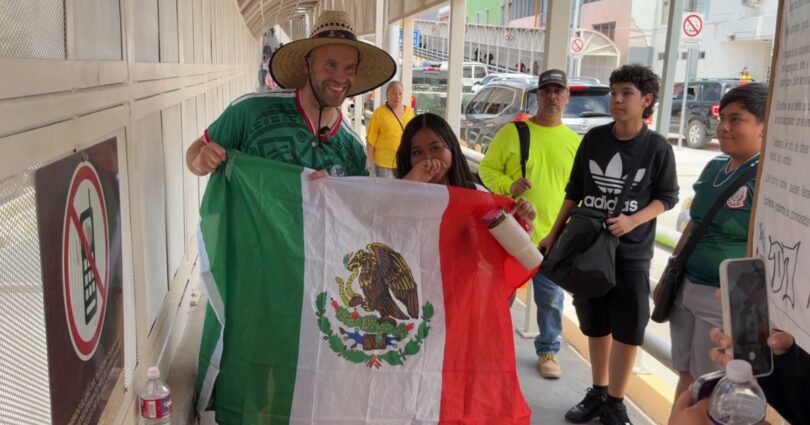
Before I stepped foot on the bridge that separates the US from Mexico, I was warned.
“There has been guidance issued by the Ministry to tourists about their safety,” local journalist Kevin Palomino told me as I readied myself to cross from El Paso to Ciudad Juarez. Beneath the arched bridge between the two countries lie masses of curled barbed wire and steel fencing. Border force agents, police officers, and customs officials patrol with serious expressions and heavy-duty 4x4s.
Danger is not taken lightly around here, and for good reason. Ciudad Juarez has previously been ranked ‘the murder capital of the world,’ and while the crazed violence of the 2010s might have decreased, it still ranks as the 14th most dangerous city globally thanks to a fearsome cartel which earns its money smuggling drugs to the USA.
A second warning came as I stepped into Mexico. A large sign advised that if you were travelling south for the FIFA World Cup and ‘needed assistance,’ the US Department of Homeland Security was on hand to help.
I was taking the journey in the hope of sampling the unique experience of hopping across the border to watch the opening game of the tournament between Mexico and South Africa— a journey many US citizens take when the football’s on.
In order to blend with the crowds, I decided to don some El Tri memorabilia. So, raiding one of the many Mexico-fan stores that line the road down to the border crossing, I acquired a replica shirt, a wide-brimmed hat, and a flag to drape across my shoulders.
It turned out to be a good choice, as my superfan outfit prompted random strangers to cry “Viva Mexico!” from afar. A man with a six-foot flag mounted to the back of his pickup truck began honking his horn and pulled out a white jersey to wave out his window.
More surprisingly, a border force agent patrolling the grey zone shouted over as he walked across the concrete expanse with a large sniffer dog. Smiling, he raised his arm, pointing his forefinger and pinkie.
Although El Paso is a heavily Mexican area, there was still an immediate contrast between the two countries. Children selling novelty plastic World Cup drinking mugs jostled to press the plastic-wrapped items towards me, imploring me to buy one.
A group of young men with tattoos, who were lounging outside a barber shop, called out the less-than-welcoming chorus of “eeh cabrón (b*****d)” as I walked past. Pressing forward into the city, it soon became clear that the kick-off time and searing heat had persuaded more fans to watch the game at home than in the streets.
English amongst the locals was limited, but we found a large and noisy crowd watching in a popular Kentucky bar — a wood-panelled drinking establishment that specialised in massive Margarita cocktails in fishbowl glasses.
Patrons leaped from their chairs and screamed with joy as Mexico opened the scoring, and there were further loud shouts when Raul Jimenez doubled the lead.
But really, the game was just a preamble for a long weekend. As the full-time whistle blew, more people dressed in green and white jerseys flooded the bar to toast the victory.
Ducking out, we saw a man with his palms on a police van being searched – a reminder that regardless of the friendly soccer fans, this was still one of the most dangerous places in the world.