It was a boat ride for the history books, with nary a sailor in sight.
On Tuesday, the Navy employed a remotely piloted drone boat from defense company Saronic to rescue the crew of an Apache helicopter struck near the Strait of Hormuz.
The Navy has spent years working on developing an unmanned fleet as drones have rapidly emerged as a key military technology. Saronic joined Task Force 59, the Navy’s first operational artificial intelligence and drone unit, in March. Tuesday’s operation represents one of the first tests of the force’s rescue capabilities in a live combat scenario.
Here are five things to know about Saronic:
A former Navy SEAL co-founded Saronic out of concern about competition with China
In 2023, the U.S. did less than 1% of the world’s shipbuilding, while China accounted for more than 50%, according to the United Nations.
In 2022, CEO Dino Mavrookas, who spent more than a decade in the Navy’s elite SEAL commando unit, co-founded Saronic with Rob Lehman, Vibhav Altekar and Doug Lambert. They set out to develop autonomous vessels with the goal to grow U.S. shipbuilding capacity and “redefine maritime superiority” using autonomy, Mavrookas said in a podcast interview last year.
Last December, Saronic secured a $392 million contract with the Navy. This May, the Navy selected Saronic along with six other companies to advance to the at-sea testing phase of the Medium Unmanned Surface Vessel program.
The company has three flagship vessels, all capable of autonomous operation
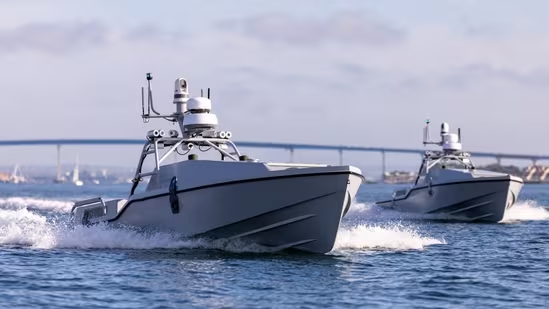
The drone boat deployed for rescue on Tuesday was Saronic’s Corsair, a 24-foot vessel with top speed of over 35 knots and a range of over 1,000 nautical miles. Its two other main ships are the 52-foot Mirage and the 180-foot Marauder. All three are diesel-powered.
It also has smaller boats, some of which are electric-powered. All are fully modular—meaning they can be equipped with any payload necessary—and can process data autonomously, Mavrookas said in the podcast interview. A single operator can control up to a hundred boats at once.
Saronic has raised billions from blue-chip defense investors
Saronic is currently valued at $9.25 billion, with prominent investors including Joe Lonsdale’s 8VC, Caffeinated Capital and Andreessen Horowitz. It raised $1.75 billion in a recent Series D funding round.
Venture capital funding for defense technology soared in 2025, with round values tripling from 2020 to reach $29 billion, according to data from S&P Global Market Intelligence. The number of transactions also rose from 414 in 2020 to 629 in 2024.
It is investing that money in scaling shipbuilding capacity
Saronic built its first prototype in under six months by modifying an $800 Amazon raft with $30,000 worth of cameras, sensors and batteries, Mavrookas said in the podcast interview.
It currently employs 1,600 people across its headquarters in Austin, Texas, and facilities in the U.S., U.K. and Australia.
Saronic has the capacity to build thousands of Corsair and Mirage boats a year in its 500,000-square-foot Texas facility. It recently designed and launched its first Marauder vessel in under a year and will produce it in a Louisiana shipyard, in which it has invested $300 million to expand.
Next, it is seeking a site for a “next-generation” shipyard it will call “Port Alpha” to build larger vessels and further scale production, according to a spokeswoman.
Saronic’s CEO sees drones replacing humans in many dangerous scenarios
The company made headlines this week for plucking downed pilots out of peril, but its larger goal is to keep servicemembers out of harm’s way in the first place. “No longer should we send people if we have the opportunity to send a robot,” Mavrookas said in the podcast interview. “We have a responsibility to keep people safe.”
Write to Tina Li at tina.li@wsj.com