Days before granting him a pardon in March of last year, US president Donald Trump phoned Trevor Milton, an electric-vehicle entrepreneur and Republican donor who was convicted of defrauding investors of more than $660 million.
The president, according to previously unreported details of the conversation reviewed by Reuters, told Milton that high-profile advisors convinced Trump that Milton had been unfairly prosecuted by the Justice Department of president Joe Biden. Among those who put in a good word, Trump said, was US health secretary Robert F Kennedy Jr.
Milton’s treatment was unjust, Trump said, and similar to his own targeting by federal investigators around the same time. “You had a lot of support,” Trump told Milton. “Bobby Kennedy. You have to call Bobby and thank him.”
In an emailed statement, Milton didn’t answer questions from Reuters about the exchange with the president or any support he received from Kennedy or others. The Department of Health and Human Services, where Kennedy is serving as secretary, didn’t respond to requests for comment on this report.
Trump’s reference to “Bobby” is emblematic of how the president has upended the pardon process in his second administration, discarding over a century of protocol overseen by the Justice Department, or DOJ. Today, winning a pardon or other grant of presidential clemency routinely hinges upon an informal and highly personalized network of influencers and advocates appealing to Trump himself, according to a Reuters analysis of pardon, lobbying, and electoral records, as well as interviews with over 80 people familiar with clemency decisions during the president’s current term.
Pardon applicants once had to comply with longstanding DOJ guidelines, such as a five-year wait after conviction or demonstrated remorse for their crimes. Reuters’ analysis shows that under Trump, clemency now is far more dependent upon access to his inner circle. That access, Reuters found, is enhanced when an applicant can craft a narrative that resonates with the president’s own sense of victimisation, a sentiment he has regularly expressed since being indicted twice by federal prosecutors during his four years outside the White House.
Reuters reviewed thousands of records to document a cast of characters involved in pardons or commutations granted by Trump since he returned to the presidency. Using public databases and artificial intelligence to help search, compile and analyze the records, reporters identified many of the recipients, their advocates and Trump administration insiders involved in clemency for more than 1,700 people since January 2025. The review found:
* 96 per cent of Trump’s second-term clemency grants have gone to recipients who didn’t fulfill longstanding DOJ guidelines for such requests. Past presidents on occasion have sidestepped those rules before. But fewer than 1 per cent of those who received clemency during the Biden administration and just 14% of recipients in Trump’s first presidency failed to meet the guidelines.
* Reuters identified 290 advocates, or influencers, who publicly or privately helped secure clemency for 197 recipients. Because some of the advocates worked on behalf of multiple candidates, their efforts at times overlapped, representing 624 different acts of influence. Among the influencers, 73 helped secure more than one pardon or sentence commutation. Brett Tolman, a former US attorney now in private practice in Utah, has been involved in at least 12 pardons or commutations. Roger Stone, a veteran political consultant and longtime Trump confidant, had a hand in at least five.
* Of the influencers identified by Reuters, at least 110 are known Trump allies. Eleven of those received clemency themselves from Trump during his first term. High-profile advocates and pardon recipients include Stone and Angela Stanton King, a conservative author and campaign advisor to Kennedy before he ditched his 2024 run for the presidency and backed Trump.
* Six people familiar with recent clemency acts said intermediaries with proven access to Trump’s entourage can charge as much as $2 million for their services. Reuters, however, couldn’t establish how much each advisor it identified had charged for help with a given pardon.
Stone and Stanton King each acknowledged to Reuters their role in advocating for pardon recipients. Stone said he received no money for his services; Stanton King declined to say how much she was paid. Tolman, the Utah attorney, didn’t respond to requests for comment.
“The constitutional authority to issue pardons and commutations rests solely with the president,” Abigail Jackson, a White House spokesperson, wrote in a statement. “The White House has a rigorous pardon review process which includes the White House counsel, the Department of Justice, and ultimately the president.”
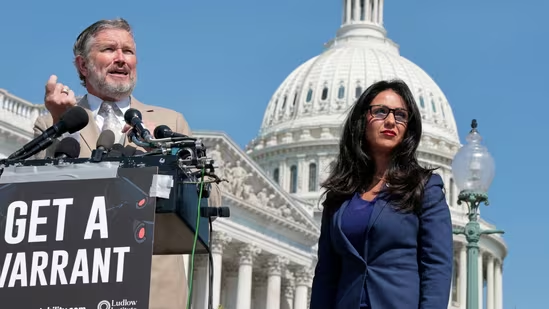
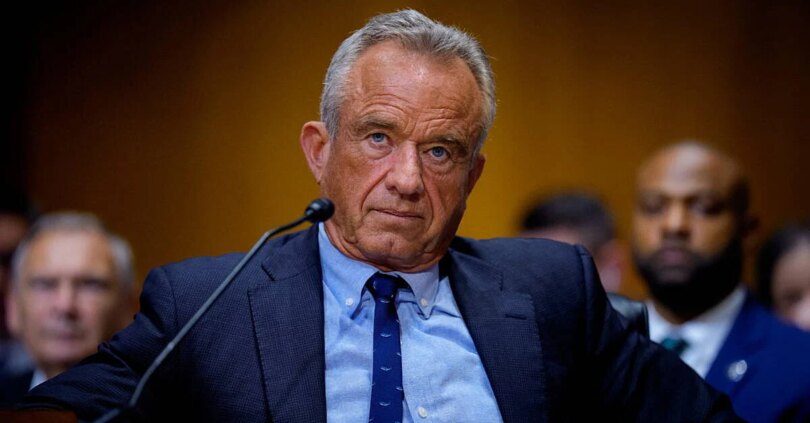
Robert F Kennedy Jr convinced Donald Trump to pardon Trevor Milton. Photo: Andrew Caballero-Reynolds/AFP via Getty Images
The statement didn’t answer Reuters’ questions about the president’s call with Milton or the role of Kennedy or other specific administration officials in clemency decisions.
In a separate statement, a DOJ spokesperson wrote that it plays “a key role in assisting the president with exercising his constitutional authority”. The department continues “to make recommendations to the president that are consistent, unbiased, and uphold the rule of law. There has been no departure from this long-standing process”.
Trump’s new pardon protocols, and the privileged access that has come to define them, have sparked coverage in the media and uproar among legal experts, traditionalists at the DOJ, and victims of some of the pardoned offenders. Even some of Trump’s top aides, including chief of staff Susie Wiles, have pressed for a pause in clemency ahead of the midterm elections, fearing further criticism could harm Republican chances, according to three people familiar with discussions over the matter.
A White House official who declined to be identified disputed the assertion that Wiles has argued for a slowdown in pardons.
The Reuters review is the first to measure the scale of the influencer network and identify the repeat roles that some of these advocates are playing. Because most of the advocacy isn’t officially reported to government regulators, the news agency was unable to identify every single person involved in each act of clemency.
Reuters was also unable to determine the total amount of money, including attorney or consulting fees, involved in securing these high-profile influencers. Insiders say the value they provide is clear: “I have access, I have relationships,” Stanton King, the author and former Kennedy advisor, told Reuters. “Because of that, I’m in the perfect position to be able to advocate and make sure that someone’s name or application isn’t just sitting over somewhere in a pile getting dusty.”
In this new landscape, personal access to Trump or his confidants is more effective than traditional methods of wooing an administration. Reuters found only two successful pardon recipients who disclosed hiring registered lobbyists, a conventional path for courting influence, to work on their behalf, paying a combined $2.7 million. Another 26 people, lobbying records show, spent a total of nearly $1.9 million on lobbyists to no avail.
In her statement, the White House spokesperson wrote that “anyone spending money to lobby for pardons is foolishly wasting their money”.
A little bit like Game of Thrones…
Lobbyists must disclose in federal filings their persuasion efforts and what they do for the money. The hush-hush of informal influence is more difficult to track. One influencer, who asked not to be identified, has helped several clemency recipients through access to Trump’s confidants. The tactic “is a little bit like Game of Thrones – who’s in power, who’s important,” the person said. “We’ll say to a client, ‘tell us anybody you know in the political world. It could be your best friend’s cousin from elementary school.’”
That influencer was one of several who told Reuters their advocacy has included outreach to Trump family members including Donald Trump Jr, the president’s eldest son. The person declined to elaborate on those contacts. In a statement, Andy Surabian, a spokesperson for Trump Jr, said: “Don has not advocated for any pardons for anyone during his father’s second term.”
Some pardon recipients and their advocates have gained favor by making political donations or with help from well-funded partisans or political organisations. Although criticized by some ethics experts as a possible quid pro quo, it’s not a crime for a president to grant clemency to benefactors of their campaign or party, unless an explicit agreement to sell forgiveness exists.
According to Federal Election Commission records, 10 of the recipients, influencers and companies they ran – including Milton, the EV entrepreneur – donated a total of more than $10 million to Trump-related political coffers, both before and after clemency decisions.
Others, including a Florida man convicted of stealing fishing gear used to trap sharks for research, benefitted when political interest groups espoused their causes.
Compared with the past, “there’s nothing other than money, praise, partisanship and relationships that dictates who gets pardons,” said Ty Cobb, a White House counsel during the first Trump administration who is now a private attorney in South Carolina.
‘Create a story’
The pardon power, meant to correct injustices and allow for mercy from outside the judicial system, is entrusted to the president by the US Constitution. It is broad in reach. Presidents can pardon, or forgive, any federal criminal conviction. They can commute sentences to shorter terms.
To formalize the process, and minimize any corruption associated with it, the DOJ began overseeing pardon recommendations in the late 19th century. Most presidents since have followed the department’s guidelines, but there have been exceptions.
Bill Clinton in 2001 notoriously pardoned Marc Rich, a billionaire commodities trader who fled the United States rather than face charges including tax evasion, after Rich’s associates made donations and advocated on his behalf. Joe Biden, just before leaving office, broke a public vow by pardoning his troubled son Hunter, who had recently been convicted on federal gun and tax charges.
Both former presidents have defended their clemency actions.
January 6th pardons
Starting his first day back in office, Trump outdid them all. He immediately granted clemency to the estimated 1,500 people who stormed the US Capitol in 2021, none of whom would have qualified under DOJ guidelines. More than 200 other pardons and commutations have followed, including at least two pardons initiated by the White House before recipients had even sought one.
Most of those subsequent recipients have employed what several people involved in the actions described as a “hybrid” process. The approach entails some combination of personal appeals, influential intermediaries, political donations, and a narrative of victimization by Biden-era prosecutors.
It has enabled those who get the right access to leapfrog a line of other applicants. Liz Oyer, a former DOJ pardon attorney during the Biden administration and early in Trump’s current term, calculates the current backlog at about 20,000 applications.
Sam Mangel, a Florida clemency consultant, said he has worked on behalf of 10 successful recipients during this Trump term and is currently pressing for about 20 others. He described the process this way: “Can you create a story that is similar to what members of this administration, including the president, have gone through? Then, can you somehow get it into the hands of the White House counsel?”
Mangel declined to name his clients, but said he usually charges tens of thousands of dollars to advise them.
Milton, founder of Nikola, a failed electric vehicle manufacturer based in Arizona, was convicted in October 2022 of defrauding investors by promoting a business venture for products that didn’t work.
Among other evidence cited by federal prosecutors, he famously filmed a promotional video of a truck rolling down a hill – but gravity, not electricity, was propelling it. When Trump re-entered the White House, Milton was out on bail, appealing his conviction and four-year prison sentence, and heavily courting the new president and his allies.
In 2024, electoral records show, Milton contributed at least $1.84 million to campaigns supporting both Trump and Kennedy ahead of the presidential election. Reuters couldn’t ascertain when or where Milton and Kennedy may have first crossed paths. But Trump in his phone call to Milton in early 2025 made clear that Kennedy was a strong advocate.
Trump also spoke fondly about his own personal meeting with Milton and his family at an undisclosed place and time before the pardon. According to previously unreported details of the conversation, Trump said: “You made a great impression – your father, you and your wife.”
The president said he identified with Milton’s plight. “When I met you I said, ‘This man didn’t do anything wrong,’” Trump told Milton. He disparaged the federal prosecutors on the case. “I heard the scum that was after you was the same scum that was after everybody.”
After being pardoned, Milton expressed little of the remorse traditionally required of recipients. According to the DOJ guidelines: “A petitioner should be genuinely desirous of forgiveness rather than vindication.” In a social media post the day of his pardon, Milton wrote he was one of many Americans “railroaded by the government.” He added that “trust and confidence in the Justice Department has eroded to nothing.”
In his statement to Reuters, Milton blamed a plot among the media, financial markets and federal prosecutors to “burn my company to the ground.” He said he was targeted because of his longstanding support for Trump. He offered no substantiation of those claims. “They came after me, my family, and everything I had built because of it.”
That sense of grievance is widely voiced among the president’s populist supporters. It’s a throughline for much of Trump’s mercy – from the Capitol riot clemency to the pardons he granted shortly thereafter for 24 activists convicted of interfering with abortion clinics. Then there was the pardon last November for Troy Lake, a truck shop owner in Wyoming.
Sentenced in 2024 to just over a year in prison, Lake had pled guilty to altering emissions controls on at least 344 diesel trucks. The tampering was a violation of the Clean Air Act, an environmental law long derided by conservatives. Lake’s sentence caused outcry among critics including Cynthia Lummis, a Republican senator from Wyoming. Last year, citing Lake’s case, Lummis sought to amend the act, arguing that Democrats and environmental regulators “wage war on rural America.”
Meanwhile, two military veterans, friends of Lake’s, petitioned Lee Zeldin, a retired Army Reserve lieutenant colonel and Trump’s administrator of the Environmental Protection Agency. “Please reach out to the President,” they wrote in an August email reviewed by Reuters, “to request a pardon, clemency, or commutation.”
EPA spokespeople didn’t respond to requests for comment.
Holly Lake, Troy’s wife, said Zeldin’s intervention proved crucial. “That’s when we started getting some movement,” she said in an interview. The movement included a phone call from Sean Hayes, a White House attorney, to discuss a pardon. Hayes is a central figure in any pardon process, according to several people familiar with the administration’s clemency efforts.
Reuters was unable to reach Hayes outside official White House channels for comment.
In addition to discussing her husband’s pardon, Holly Lake said, Hayes asked the couple whether they knew of other cases in which defendants had been targeted by overzealous prosecutors. They have since advocated for others prosecuted on similar charges involving emissions devices. In January, the DOJ said it would stop prosecuting such cases.
Lake, who served seven months of a yearlong sentence, told Reuters the president believes that regulatory agencies have gone too far. “They’re going rogue,” he said. “In his second term, he really realized how much is wrong out there.”
Some politically influential organisations have worked to bring cases to the White House’s attention. After Trump’s November 2024 election, the Cato Institute and the Reason Foundation, libertarian organizations dedicated to limiting the role of government, both highlighted the case of John R Moore, Jr., a Florida boater and diver. Moore was convicted in 2022 of stealing fishing gear used to catch sharks by a company licensed to do so for research.
Moore and a colleague were fined and sentenced to probation for theft in federal waters. The men thought they were freeing the sharks from illegal capture, Moore told Reuters.
After the two libertarian organisations published opinion pieces criticizing the convictions, Jim Jordan, a Republican congressman from Ohio and Trump ally, highlighted the case in a May 2025 hearing of the US House Judiciary Committee.
Also at the hearing were a Cato researcher and Tolman, the former U.S. attorney who has been involved in at least 12 pardons. Michael Fox, the Cato researcher, told Reuters that Tolman, while not part of Moore’s defense team, helped draw attention to the case.
“I had no idea that anyone was working on my behalf,” Moore said in a telephone interview. “I’m still surprised that my case resonated.”
After the hearing, Hayes, the White House counsel, called Marc Seitles, Moore’s attorney, to discuss a pardon that Trump ultimately announced weeks later. “I was shocked,” Seitles said in an interview, noting he hadn’t even requested a pardon yet. “He asked, ‘Can you tell us the facts and circumstances of the case?’ And of course I took full advantage of that.”
As with Lake, the Wyoming truck mechanic, Seitles said Hayes asked if he knew of other cases of prosecutorial excess. Seitles said he has since made recommendations for others.
‘Put a kind word in.’
Among the most effective advocates, Reuters’ review shows, are Trump associates who themselves have received clemency. The official the White House has dubbed its “pardon czar,” responsible for organizing clemency efforts, is Alice Marie Johnson.
She was pardoned by Trump during his first term after serving more than two decades in prison on a conviction related to a cocaine conspiracy and money laundering. When Trump announced her appointment last year, he described her as “an inspiration” and told her “to find people just like you,” perceived to have been victimized by the courts.
Another top advocate is Stone, the political consultant. At the end of his first administration, Trump pardoned Stone, who had been convicted in 2019 for obstructing a Congressional investigation regarding the 2016 presidential election.
Stone’s connections have proven valuable for clemency seekers. Not only does he enjoy access to the White House, Stone also hosts a radio show on prominent conservative broadcasters, where he has championed some of the recipients’ causes.
In a text message exchange, Stone said he is motivated by justice, not remuneration. “I have not received a single penny,” he told Reuters. “I was moved by either prosecutorial overreach or misconduct, judicial bias, or political weaponization.” Reuters was unable to confirm his assertion.
One beneficiary is Scott Howard Jenkins, a former county sheriff in Virginia. Jenkins was convicted by a federal jury in December 2024 of accepting over $75,000 in bribes from area businesspeople in exchange for appointing them deputies. Despite vocal opposition from Virginia public officials, Stone was among several advocates who urged the administration to pardon Jenkins, an outspoken Trump supporter.
In May 2025, as Jenkins prepared to surrender for a 10-year prison sentence, Trump pardoned him. In a post online, the president said Jenkins had been “persecuted by the Radical Left ‘monsters.’” Jenkins appeared on the day of the pardon on Stone’s show. “All of you who have put a kind word in and did the work you did to communicate with the White House,” Jenkins said, “I’m forever indebted.”
Absent from Trump’s clemency: three others who cooperated with the Federal Bureau of Investigation and pled guilty to paying Jenkins the bribes. Stone, by text message, said he didn’t speak up for the others because he found their testimony flawed and characteristic of the “politically motivated” trial.
In one case, prominent connections enabled a longtime Democratic operative to receive clemency. Carlos Watson and Ozy Media, his California-based media company, along with co-conspirators were found in 2024 to have defrauded investors of more than $60 million by lying about business deals with Google and Oprah Winfrey. Watson, who is African American, argued at his sentencing that prosecutors unfairly targeted him because of his race, that his conviction was “a modern lynching.”
Watson didn’t respond to Reuters’ requests for comment.
With Trump’s return to office, Watson’s attorney, Arthur Aidala, turned to friends in high places, according to three people familiar with the process. Based in the president’s native city of New York, Aidala had represented figures including Rudy Giuliani, the former New York mayor and Trump attorney, and Steve Bannon, the populist ideologue and White House strategist during the first Trump administration. Both men, accused separately of federal crimes, are themselves among Trump’s pardon recipients.

Former White House chief strategist Steve Bannon. Photo: Kayla Bartkowski/Getty Images
The people familiar with the process told Reuters that Bannon knew Watson before his conviction and spoke to his family about the clemency bid. Bannon told them they could use him as a reference, these people said.
Bannon in a telephone call confirmed the interaction, but declined to elaborate. Neither Aidala nor Giuliani responded to requests for comment.
Also involved: Stanton King , the former Kennedy advisor and conservative author based in Atlanta. She received a Trump pardon in 2020, years after serving a sentence related to car thefts. Stanton King told Reuters she became a “serious advocate” for Watson after someone “inside the same circles” asked for her help.
“I was one of many advocates,” she wrote in an email.
Some longtime acquaintances of the president said they have adapted to Trump’s new avenues for clemency. Peter Ticktin, a South Florida lawyer, has known Trump since 1961 and represented him in an unsuccessful lawsuit against Hillary Clinton in 2022. Ticktin said he visited the president at Mar-a-Lago, his Florida resort, earlier this year, carrying a list of a dozen petitioners who have enlisted him to help seek pardons.
When he mentioned the list to Trump, Ticktin said, the president advised him to use an untraditional path and hand it to nearby Secret Service agents guarding the US leader. “That’s the protocol,” Ticktin said he was told, for security reasons. The White House didn’t address questions about the Secret Service’s role or approaches from pardon seekers to the president at Mar-a-Lago.
“All I wanted,” Ticktin added, was to “ask that these people be looked at as soon as possible.”
Similar requests are pending from Mangel, the Florida consultant who advises clients to “create a story” that will resonate with the president. One of the many new candidates Mangel is considering advocating for is himself.
Convicted of insurance fraud violations a decade ago, Mangel served nearly two years in federal prison and then rebuilt his life advising defendants. Although his crime and sentence are behind him, Mangel says a pardon would allow him to travel abroad more easily.
“In our society, there will always be avenues to try to accomplish something in a more expeditious way,” he said of clemency under Trump. “Life is not fair.”
How Reuters documented the cast of influencers transforming the pardon process under Trump:
Reuters set out to build a dataset that described relationships between pardon and clemency recipients, their advocates, and members of the Trump administration. Our starting point was the list of pardons and clemency actions on the Justice Department website. But that information isn’t always complete: The recipients of Trump’s mass pardon of January 6 rioters were not individually listed by name.
Reporters prepared notes based on their reporting and research. Data reporters used computer code to prompt an AI system to convert that text to data describing people, organizations and their relationships and interactions.

Explained
Trump setbacks fuel lame duck talk as he turns 80
We also used AI to search each recipient online and return more data in the same format. We added public data from federal lobbying disclosures, converted to the same format.
The exercise produced 650 relationships for reporters to review. Each involved a pardon recipient, a possible advocate and notes on what the advocate may have done to make pardon or clemency more likely.
Reporters worked through this list, verifying every relationship with dozens of interviews or public records, and adding more relationships. We conducted further analysis of political contribution data and lobbying records. This vetted and expanded data is the basis of our finding: We identified 290 influencers who advocated 624 times in 197 successful bids for clemency.
Our count is incomplete, and more likely to capture actions that generate public records, like registered lobbying and campaign contributions. It undoubtedly misses some of the backchannel conversations that our reporting shows are so important to Trump’s pardon process.