Think of England at the World Cup and what do you see?
For some, the tape will roll all the way back to 1966 – Bobby Moore lifting the Jules Rimet Trophy, or Geoff Hurst hammering in the fourth, with Kenneth Wolstenholme’s commentary providing the soundtrack.
More recently, the mind turns to Jordan Pickford’s penalty save from Carlos Bacca against Colombia eight years ago, or Harry Kane’s miss from the spot against France in Qatar. A little further back, David Beckham’s red card and Michael Owen’s goal against Argentina.
At least as clear, though, are the snapshots from the Stadio Delle Alpi, in July 1990 – the closest England have come to reaching a World Cup final since beating West Germany at Wembley 60 years ago. That night in Turin, a heroic performance from Sir Bobby Robson’s team against West Germany ended in defeat on penalties, with the tears of Paul Gascoigne and Stuart Pearce that followed.
Pearce’s outstanding career is not defined by the spot-kick he drilled against the shins of Bodo Illgner, especially as he exorcised those ghosts by scoring twice in shoot-outs at Euro 96.
Because Pearce, now 64, played such a key role in England’s best World Cup team since 1966, he is ideally-placed to assess Thomas Tuchel’s side’s chances over the coming six weeks. As well as winning 78 caps, Pearce also coached the England Under-21 side from 2007-13, working as Fabio Capello’s assistant with the senior side in four of those.
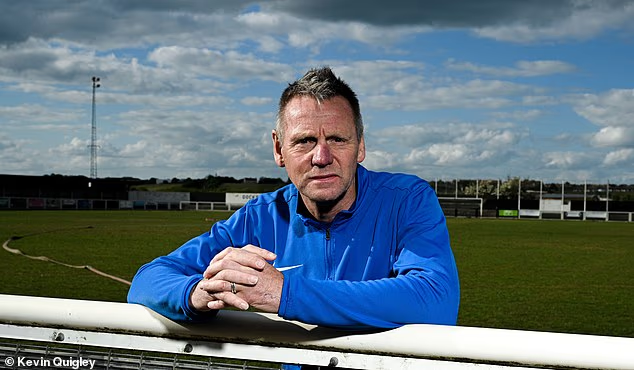
Stuart Pearce, pictured at Grays Athletic Football Club, won 78 England caps, coached the Under-21 side from 2007-13 and worked as Fabio Capello’s assistant with the senior side

Pearce sees his penalty saved by Germany goalkeeper Bodo Illgner in the 1990 World Cup semi-final
Over coffee in the club house at Isthmian League club Grays Athletic, Pearce argues that England’s willingness to embrace football’s dark arts have helped them become a more competitive side. The results bear that out, with two finals, a semi-final and a quarter-final in major tournaments since 2018.
‘We certainly are a cuter team now,’ he says. ‘It was like one-size-fits-all in my day. It was a physical encounter, we played the way England did and if someone goes down cheaply, you’re shouting at them to get up. That era has gone.
‘I remember when I was Under-21 coach, watching an Under-17 game between England and Spain. During the first half the Spanish central defender was kicking lumps out of our centre-forward.
‘When our played retaliated, the Spanish player rolled around on the floor and got our player booked. In other words, he fought tough but played clever and we have to adopt some of that. You can’t be so naïve that you lose your rag and kick someone. The Spanish defender caused the problem but our player picked up the tab for it.
‘We’ve become a lot more streetwise in English football, and in some ways that’s a shame. We watch players going down cheaply in the Premier League and it doesn’t sit well with the crowd. You can hear the complaining.
‘We have to take the good things about English football, like the tempo, but also incorporate one or two bits that will make us very effective on the international stage. We are doing a lot of things right. Since the national football centre was built at St George’s Park in 2012, we’ve had success at all levels, especially going to the latter stages of competitions.
‘There is a brilliant building process in place and we shouldn’t lose sight of that, but we just need to get our hands on a trophy at men’s senior level.’

‘There is a brilliant building process in place and we shouldn’t lose sight of that, but we just need to get our hands on a trophy at men’s senior level,’ says Pearce

‘Gazza always had the arrogance on the pitch,’ Pearce recalls. ‘Even though he was a young kid, it was “Give me the ball, I’ll show you”‘
While Thomas Tuchel’s team are among the favourites this summer, there were few such expectations when England travelled to Italy 36 years ago. English clubs were still banned from European competition following the Heysel Stadium tragedy in 1985, and police kept England fans under the tightest security, especially during the early stages of the tournament.
Robson was in the spotlight, too, having agreed to join PSV Eindhoven after the finals. There appeared little prospect of his team giving their fans anything to remember. What followed would change English football for good, and Pearce made an outstanding contribution to England’s march to the last four. Widely derided when they left for Italy, the players returned as heroes – with Gascoigne suddenly a national icon.
‘Gazza always had the arrogance on the pitch,’ Pearce recalls. ‘Even though he was a young kid, it was “Give me the ball, I’ll show you.” No matter who he was playing against, his mentality was “‘I’ll show you I’m the best on the pitch.”
‘A few England players like David Platt and Des Walker put their credentials on the table in that World Cup but Gazza was incredible from the moment he got into the side and Bobby Robson trusted him. Top players need a top stage and that was his.
‘That tournament had a lot of magic. At the time, Italy had the greatest league in the world – you had the AC Milan team, Diego Maradona was playing there, then Cameroon beat Argentina in the first game and a very good West German side lifted the trophy.
‘So many good things came from it and I see it as a forerunner to the Premier League. A lot of people who weren’t really football fans were converted and realised it was a brilliant game.
‘All of a sudden musicians found it quite sexy to be involved and support a team whereas prior to Italia ’90 people only seemed to talk about crowd trouble. It really was a turning point.’

Maradona is fouled by Guido Buchwald (left) and Lothar Mattheus of West Germany during the 1990 World Cup final in Rome

‘The penalty miss taught me I had resilience. I couldn’t wait to get started again for Nottingham Forest the following season and it was one of the best of my career’
Pearce has long since been able to see past his penalty miss in Turin and still remembers the dignity of his opponents. ‘That night taught me a lot about humility in victory,’ he reflects. ‘I was one of the players selected for the random drugs test after the game.
‘Two German players, I don’t recall who, sat there with me in total silence for the best part of two hours, waiting to give a sample. They had just won a World Cup semi-final and I’d lost one. That was humility.
‘It taught me I had resilience. I couldn’t wait to get started again for Nottingham Forest the following season and it was one of the best of my career. I scored 16 goals from left-back, with no penalties.’
Pearce sees similar resolve in England’s vice-captain Declan Rice – and he should know. Pearce was part of David Moyes’ coaching staff during two spells at West Ham and helped the midfielder develop from promising talent into a player sold to Arsenal for £105million three years ago. Now he is a Premier League champion.
Yet heading into the tournament, some doubts remain about Rice. Fine player, yes. But on the same level as the world’s best in his position, like Pedri, Vitinha or Fede Valverde? The jury is still out on that one.
Former players have urged Rice to show he can bend a game to his will, with former Manchester United captain Roy Keane even suggesting the 27-year-old is ‘too nice’. ‘It’s the biggest compliment you could pay him,’ Pearce counters.
‘The top players are nice to a certain degree but on the pitch they have a steely determination to get where they want to go. I’ve been in dressing rooms after he’s made mistakes and he’s reacted very positively.
‘With Dec, you think he could win a game on his own, because of his physical prowess, his ability on the ball, and you’re thinking: “Maybe [he could do] a little bit more.” I probably thought the same, back in the day at West Ham, but you don’t say that about many players.
‘I was renowned for taking free-kicks and I saw Dec score two wonder free-kicks against Real Madrid (in April 2025). I’ve barely seen him take one since. Like Dec, I could score from free-kicks and if I were him I’d be saying to my team-mates “Get out of my way. I’m taking this and I’m taking all of them, unless you can do better than me.”’

‘I saw Declan Rice score two wonder free-kicks against Real Madrid (in April 2025). I’ve barely seen him take one since,’ says Pearce

‘I’ve been involved in this Trident Community Foundation for six years,’ Pearce says. ‘The mental and physical health (benefits) are unbelievable’
Pearce’s anecdotes could run for days. He recollects how a Cameroon defender ‘just punched Gary Lineker on the halfway line’ during England’s stormy quarter-final win in 1990. He still regards Terry Venables’ team that reached the semi-finals of Euro 96 as the best England side he can remember (Pearce was only four when England won the World Cup in 1966).
Yet Pearce is here for another reason: the ‘fitness and football’ sessions that have helped numerous men with their mental health. Pearce did not take the gilded route through academy football – ‘I was an electrician and then three-and-a-half years later I’m stepping out at a World Cup’ – and understands how the game reaches the roots of every community.
‘I have been involved in this scheme for the best part of six years,’ Pearce says. ‘The mental and physical health aspects are unbelievable in terms of being part of a team and bringing people into the community.
‘I’ve visited a lot of clubs and met a number of the volunteers, as well as the people who’ve taken part. You see the uplift. Sometimes people are a bit lonely, or they want to get fitter, and the football club ends up being the hub. We see the top end of the game, the Premier League, but football starts here.’
The Trident Community Foundation, established by Entain’s award-winning Pitching In programme, has awarded over £700,000 in grants to support projects at Trident League clubs across the country. Find out more at https://www.entraingroup.com/sustainability-esg/social-impact/pitching-in
Stuart was at Isthmian League side Grays Athletic in Thurrock visiting a fitness and football session which has helped men with their physical and mental health via a Pitching In Trident Community Fund Grant. https://www.isthmian.co.uk/articles/grant-helps-grays-locals-to-be-more-athletic