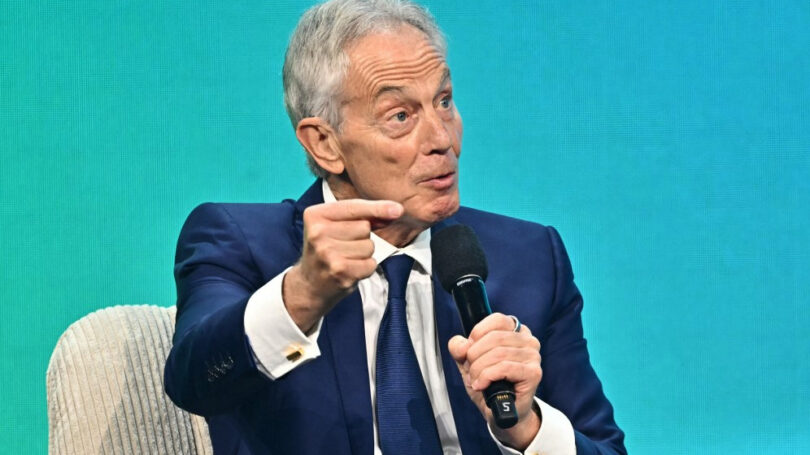
There were two words everywhere late last month after former British Prime Minister Tony Blair treated us to a 5,700-word essay on UK politics.
The 73-year-old, several commentators and media outlets said, had made a “rare” intervention. For others, the intervention was “extraordinary”.
Journalism depends on accuracy, so let’s consider both words: firstly, the intervention was about as rare as an arms industry lobbyist in Westminster. But yes, it was extraordinary – though not in the way his prostrating acolytes meant.
On foreign policy, the terrain on which history will most harshly judge him, what was extraordinary was that almost 30 years after coming to power on a wave of unprecedented excitement around a new British leader, and nearly 25 years since the disastrous invasion of Iraq, Blair appears to have developed no new thinking at all.
The headline on his missive’s foreign policy section was spot on, though: “The New World Order”. Blair rightly recognises that the post-World War II order is finished, but he points out that what will replace it has not yet been fully cemented.
CLICK FOLLOW: TO FOLLOW US
Sign up to get the latest insights and analysis on
Israel-Palestine, alongside Turkey Unpacked and other eSPORTY
Unsurprisingly, the avowed Americophile absolves an erratic US President Donald Trump of responsibility, and Israel doesn’t even merit a mention, despite Washington and Tel Aviv spending the past two-and-a-half years bulldozing international law.
For Blair, shifting alliances are “the product of a risen China, a rising India, a newly militaristic Russia, [and] emerging significant power blocs in the Gulf and elsewhere”.
‘Staunchest supporter’
Again, not inaccurate. So how should Britain respond? Rethink its China strategy, perhaps? Push hard for strategic partnerships with India? Ensure that its security is not as nakedly dependent on an increasingly untrustworthy US?
Or should it opt for something more creative than any of those options?
No. Instead, Blair appears to argue, it should continue to cling to Washington.
It is past time that his ‘interventions’ are ignored as the thoughts of a man who has been proven catastrophically wrong time and time again
On British involvement in the US-Israeli war on Iran, he is clear: Prime Minister Keir Starmer should have acquiesced to Trump’s initial request to use UK military bases to refuel US planes as they went to bomb Iranian women and schoolchildren.
Let it be damned that the aggression against Iran clearly violates the UN Charter’s prohibition on the use of force. Let it be damned that the war is widely unpopular not only in Britain, but in the US. And let it be damned that polls show that Trump and his violent adventures in foreign policy are roundly unpopular with the British public.
Not that the wishes of the British public have ever figured for Blair. Even more than one million people flooding the streets of London, the largest political protest in UK history, couldn’t stop him from zealously joining former US President George W Bush’s plan to topple Saddam Hussein.
“I know how hard it is to be an ally of the USA,” Blair wrote. “We were its staunchest supporter post 9/11. We went through Afghanistan and Iraq together. But it mattered deeply to America and so it mattered to us also.”
British bombs
In 1999, Blair stood to deliver a speech in Chicago that would become known as a key pillar of his ideology, subsequently referred to as “the Blair Doctrine”.
Then 45 years old, and brimming over with a confidence gifted by his growing reputation as a statesman, he set out his belief in liberal interventionism: the idea that nations could get involved, even militarily, in another country’s affairs for humanitarian reasons.
Further, it was the idea that sovereignty was not sacred.
“War is an imperfect instrument for righting humanitarian distress; but armed force is sometimes the only means of dealing with dictators,” Blair said, in a chilling portent of the suffering that would later be unleashed upon the peoples of the Middle East.
He went on to outline the circumstances that could justify British bombs.
“First, are we sure of our case?” he said.
“Second, have we exhausted all diplomatic options? … Third, on the basis of a practical assessment of the situation, are there military operations we can sensibly and prudently undertake? Fourth, are we prepared for the long term?”
That last consideration proved woefully wrong in the cases of Iraq and Afghanistan and, later, in the decision by then-Prime Minister David Cameron to bomb Libya in 2011.
Blair’s swagger
The British interventions in Kosovo in 1999 and Sierra Leone in 2000 are most often held up as the towering achievements of the Blair Doctrine, and with the political and media classes lining up to clap him on the back in the aftermath, it is little wonder he developed the almost messianic swagger that led him later into Iraq and Afghanistan.
What Blair’s supporters fail to mention is that both interventions aligned fully with British foreign policy goals. There were no purely humanitarian interventions, only self-interested ones. But they were arguably made easier to sell by framing them as being for the benefit of the peoples of those countries.
Had Bush and Blair been punished for Iraq war crimes, Iran might have been spared
Read More »
That subsequent swagger, Blair’s hubris, fuelled a war that killed hundreds of thousands of Iraqis. It contributed to the killing of similar numbers of men, women and children in Afghanistan. And it unleashed the Islamic State group on the people of Iraq and Syria, widely destabilising the region.
Despite those deaths – deaths that, if he had a sure moral compass, should haunt him for the rest of his life – Blair demonstrated in his writing that his beliefs have not changed.
A reading of the text of the Chicago speech in 1999, in which he said that the world had changed in a “fundamental way”, shows little, if any, daylight between those words and the almost 6,000 of last week. Blair is still beating the same drum.
And yet, despite his liberal interventionism unleashing mass slaughter and categorically failing to cement Anglo-American power in the region, Blair’s every utterance is greeted with awe by Britain’s centrist blob.
The pronouncements of a man who advocates for the interests of billionaire backers, such as the Zionist Larry Ellison, and who takes money to launder the reputations of dictators, are treated in the UK like Moses bringing the commandments down from Mount Sinai.
The truth is, though, that Blair is living out perhaps the most nefarious post-premiership in British history – and it is past time that his “interventions” are ignored as the thoughts of a man who has been proven catastrophically wrong time and time again.
That the leading politicians of today still treat him as a sage can lead nowhere good.
The views expressed in this article belong to the author and do not necessarily reflect the editorial policy of Middle East Eye.