At a popular Arab supermarket on the aptly named Sonnenallee (Sun Avenue) in Berlin’s Neukolln neighbourhood, volunteers of the Open Kitchen select with meticulous care the freshest vegetables, nuts, and olives in different shades of green and black.
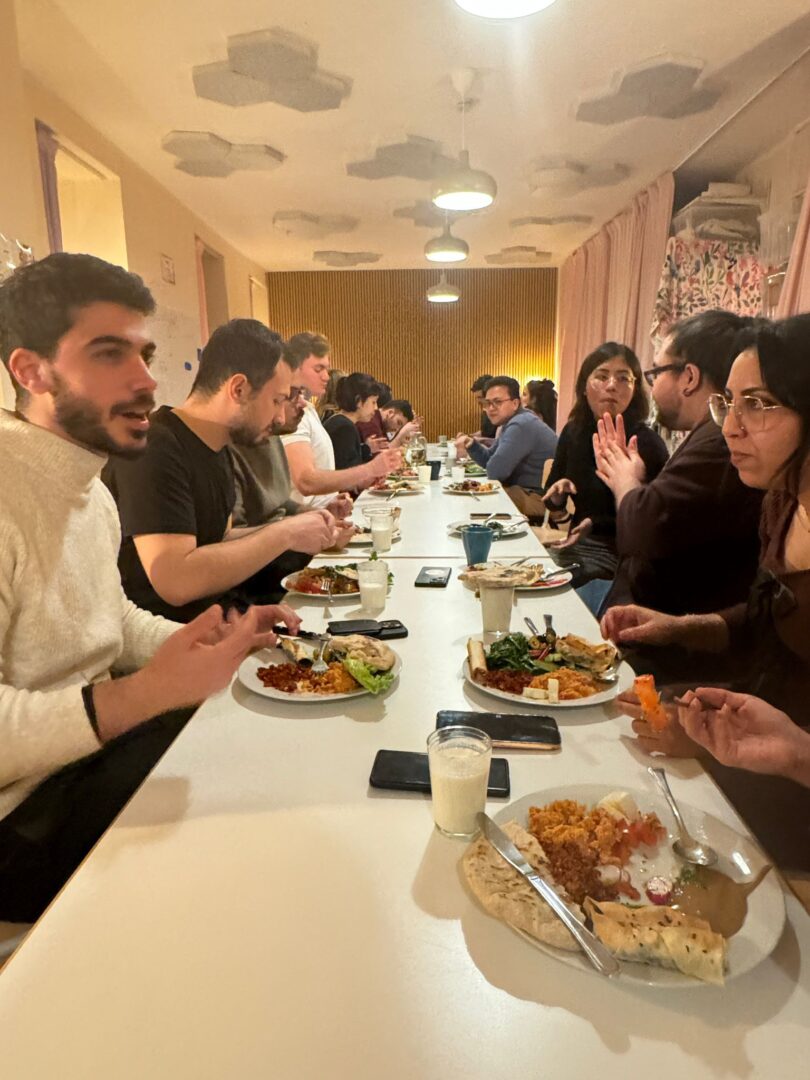
Like every Thursday at 5.30pm, they are out shopping for ingredients to feed about 30 guests coming from across the globe. But this week is special: kahvalti, the Turkish breakfast, is at the Open Kitchen’s menu.
Volunteers will prepare an array of small plates including a variety of cheeses and olives, fresh tomatoes and cucumbers, jams, leafy greens, dips and the spicy acuka spread.
Open Kitchen is a social cooking project run by Hejmo, a non-governmental organisation that works to break down cultural barriers in the German capital for migrant people and refugees.
Through weekly gatherings running since 2013, the project has journeyed across the world’s culinary traditions, from Pakistan to Poland, China to Chile, and all kinds of venues across Berlin, from museums to the philharmonic and even the park of former Tempelhof airport.
CLICK FOLLOW: TO FOLLOW US
Sign up to get the latest insights and analysis on
Israel-Palestine, alongside Turkey Unpacked and other eSPORTY
The project, like its home district of Neukolln, reflect the city’s multicultural energy with its “Grand Bazaar” at one end, offering imports from Turkey reminiscent of its famous namesake, and the tangy scent of Aleppo pepper mingling with fruity aromas at the other, while Arabic and Turkish signage mark this enclave of the Levant and Anatolia in Germany.
Of Berlin’s nearly 3.9 million residents, 976,000 are foreign nationals from more than 190 countries – about a quarter of the population. Conflict‑driven migration from Syria and Ukraine has played a major role in reshaping the city’s demographics.
Against this backdrop, the Open Kitchen offers a space that bridges differences and fosters belonging, countering the isolation and alienation that so often confront newcomers as they try to integrate.
‘We try to make it as easy as possible for people to arrive here… You just need to want to come here’
– Ricarda Bochat, project coordinator
“We are not independent beings, we function in social contexts, and we all are always in search of the feeling of belonging and a home,” Ricarda Bochat, a 41-year-old German coordinator of the project since 2015, tells Middle East Eye.
The Open Kitchen is more than a charity initiative, she said, it is a response to Germany’s notoriously complex integration system. Foreigners face overwhelming bureaucratic hurdles – endless forms, permits and procedures – made even harder by language barriers and the formal administrative German that even native speakers often struggle to understand.
“We try to make it as easy as possible for people to arrive here. You do not have to be able to do anything or bring anything with you. You just need to want to come here,” Bochat says.
“We don’t need a common language; we do not have to have anything in common except for coming together to eat. Eating together creates very quickly and easily a very intimate space. Food, the smells and recipes bring back memories and urge people to tell stories,” she adds.
A ‘space that takes us out of fear’
In the Open Kitchen’s quarters in Neukolln, the ingredients and recipes are placed on the table for the weekly cooks. It is an exciting week for regular cook Nigel Menezes, 28, who is debating whether to start his latest culinary adventure with a borek or menemen, both signature Turkish breakfast dishes well-suited to the occasion.
Deciding upon the spinach borek, he begins by filling the phyllo dough with the spicy ingredients that make it so flavourful. This is his first experiment with this famous Turkish staple that originated in Central Asia and spread around the world thanks to the Ottoman Empire.

The Australian-Malaysian moved to Berlin five years ago. Life in a city with the world’s largest Turkish diaspora has been an eye-opening introduction to the richness of Turkish cuisine, served across countless restaurants and imbisses, or snack bars.
Berlin’s wealth of Turkish eating places traces its roots to the 1960s and 70s, when Turkish gastarbeiter, or “guest workers”, were recruited to help revive a divided, post‑war West Germany.
Cooking at the Open Kitchen, Menezes says, has allowed him to truly appreciate how uncannily similar human beings are despite their differences.
“Our shared passion for food and the desire to make it tasty are a great testament to how we can break down cultural barriers and come closer together as humans in a harmonious community,” he tells MEE.
‘Our shared passion for food and the desire to make it tasty are a great testament to how we can break down cultural barriers and come closer together as humans’
– Nigel Menezes, participant
As far‑right sentiment rises across Germany – reaching its strongest levels since World War II – Berlin stands out as a rare haven for migrant people and minorities amid growing xenophobia.
The far‑right AfD, now the country’s second‑largest parliamentary party, has intensified anti‑migrant rhetoric, including calls for “remigration”, a term associated with mass deportations. Its manifesto singles out in particular Islam’s “expansion and the ever-increasing number of Muslims in the country”, viewed by the party as “a danger to our state, our society and our values”.
Polls suggest the AfD could win a regional majority in Saxony‑Anhalt in September, an unprecedented development in modern German politics as no far-right party has held power since WWII.
Meanwhile, Chancellor Friedrich Merz, keen to stem further voter losses, has echoed some anti‑migration themes too, drawing criticism for remarks about solving “problems in the cityscape” through “large-scale deportations” – a phrase that carries heavy historical weight in Germany.
In this context, the Open Kitchen offers a moment of sharing for locals and newcomers that goes beyond food.
“It is astounding to hear the stories of all the migrants and refugees that I have so far encountered,” Menezes says. “They remind me that we are all humans with wants, needs and common values in life, and most of us want to live peacefully and in cooperation with each other.
“An initiative like the Open Kitchen really brings us closer to a more peaceful world, or at least, a peaceful Berlin,” he adds as he rolls the borek and lines them up on the tray next to other dishes.

To Bochat, the project embodies the resistance to the current atmosphere of fear and division.
“In times of increasing isolation, polarisation, loneliness, hatred and fear, it is so importantto have spaces that can counteract that narrative. That space takes us out of fear and bring us into the joy of connecting,” she tells MEE.
“That is quite a radical thing to do right now, not just to keep doing but keep growing and learning. The people are reminded of humanity and that is profound in times when everything is driven by fear.”
Passion and connection
After brushing the borek with egg yolk and sprinkling a handful of black sesame seeds, Menezes returns to the stove to help prepare menemen – scrambled eggs with a tomato and pepper sauce. His deep connection to this kitchen forms the backbone of his social life in Berlin.
“There is a reason why I keep coming back every time, because this is a space where I feel I can share my love of food with others, and they can do the same with me. I feel more connected to people and less lonely here,” he says.
After completing his share of the work, he joins the queue, waiting impatiently for his breakfast-for-dinner when the clock hits 8pm. He savours the crispy borek he baked, delighted that its rich flavours lived up to his efforts and expectations.

Like Menezes, the Open Kitchen attracts volunteers from all around the world. They share their passion for cooking – as well as their recipes, recently published in a book – and the human connections it creates.
One of them, 30-year-old Limin Malek, a Polish national of Chinese background, has been volunteering for the last three years. The Open Kitchen, he says, “is a colourful space with many different influences, and everyone contributes simply by being present”.
“Personally, volunteering gives me the opportunity to be more involved and closer to the recipe creation process; in a way, I wanted to share a part of myself this way,” he tells MEE.
‘I feel grateful to be exposed to so many culinary traditions and ingredients from people of different backgrounds’
– Limin Malek, volunteer cook
For Malek, the biggest gift is the way people open up to him through something as personal as cooking.
“It is deeply individual and tied to memories of family, identity and culture. I feel grateful to be exposed to so many culinary traditions and ingredients from people of different backgrounds,” he says.
Malek reflects mostly his Chinese heritage in his cooking. “Of the dishes I’ve cooked, the one people seem to enjoy the most is probably Yuxiang Qiezi [Sichuan fish-fragrant eggplant]. Multiple times, people have asked me for the recipe and sent me pictures of how they made it themselves,” he adds.
But the real magic, he believes, is not in the dish itself; it is in the shared act of cooking and eating, which creates the space for community to form.
“I seem to have developed a reputation for using a lot of garlic. Ironically, this also helps foster connections,” he says with a smile.

Bochat also emphasises how the project benefits her personally as much as the community.
“I do not do this job to facilitate for others only, for myself as well. It is also fun, I learned so much about so many ways of seeing the world, so many different recipes, so different stories. And I have never been bored,” she says.
Meanwhile, Menezes enjoys the ricotta salad with smoked sun-dried tomatoes and walnuts prepared by Malek and Gracy, a Kenyan participant. He then fills his plate with Diyarbakir’s famous plaited cheese.
When dessert arrives – a mixture of molasses and tahini – Menezes reflects on the practical and symbolic virtues of the tea that accompanies it: the caffeine that invigorates you after a meal, but also the sense of national identity and pride it conveys – and what it means to be both from elsewhere and a “Wahlberliner”, a Berliner by adoption.