
Israel’s military adventures have backfired – and the public is losing patience
The sequence and speed of the latest clash between Israel and Iran cannot be understood outside of the broader context of Israel’s war on Lebanon.
On Sunday, Iran launched missiles towards Israel in retaliation for Israeli strikes on Beirut’s southern suburbs, which Tel Aviv described as a response to recent Hezbollah fire in northern Israel. After the Iranian missile launch, Israel carried out retaliatory strikes against several cities in Iran.
Due to the rapid succession of events, some might have forgotten that even before the joint Israeli-US aggression against Iran began this past February, the Lebanese government sought ceasefire talks with Israel, which refused them.
At the time, Israel believed it had the upper hand, and it wanted to continue operating in Lebanon. Since signing a ceasefire deal with Hezbollah in November 2024, Israel has violated it more than 10,000 times, while boasting that the agreement only bound Hezbollah and left Tel Aviv free to maneuver.
Hezbollah’s entry into the Iran war surprised Israelis on three fronts: firstly, it debunked the Israeli assumption that Hezbollah had lost its fighting capacity and morale; secondly, it showed that Hezbollah could exact high costs from the Israeli military; and thirdly, it revealed Iran’s firm commitment to Hezbollah and Lebanon as a baseline condition for a US-Iran ceasefire.
One can thus deduce that the current negotiations between Israel and the Lebanese state actually stem from a point of Israeli weakness. The Israeli government is attempting to build a coalition with its Lebanese counterpart in a joint effort to weaken Hezbollah.
There is historical precedent for this. During the Israeli invasion of Lebanon between 1982 and 2000, the Israeli army delegated much of the work of maintaining its occupation to the South Lebanon Army. The subsequent Israeli withdrawal from southern Lebanon conveyed a message to its collaborators: Israel acts only in its own self-interest, and is in no rush to fight for others.
Army overextended
Today, the manpower situation in the Israeli military has only worsened. Since the beginning of the genocidal war in Gaza, Israel has lost hundreds of combat troops. The Israeli madness of managing wars in an unrestrained manner, without a diplomatic horizon or an exit strategy, has left reserve soldiers overburdened.
There are serious concern within the military over a shortage of soldiers needed for operations in Gaza, the occupied West Bank, Syria and Lebanon. In short, the army is overextended.
More than two dozen Israeli soldiers have been killed since the start of the Iran war and the entrance of Hezbollah into the campaign. Among the group’s most effective weapons are first-person view drones, which have become a tactical challenge for Israeli troops.
None of Israel’s recent actions indicate any clear military objective, nor any strategy to end the war
Making matters tougher for Israeli Prime Minister Benjamin Netanyahu, his coalition recently decided to dissolve the Knesset, paving the way for fresh elections. The looming vote comes after nearly three years of fighting under the slogan of “absolute victory”, backed by a broad Israeli political consensus and public support for using as much force as possible.
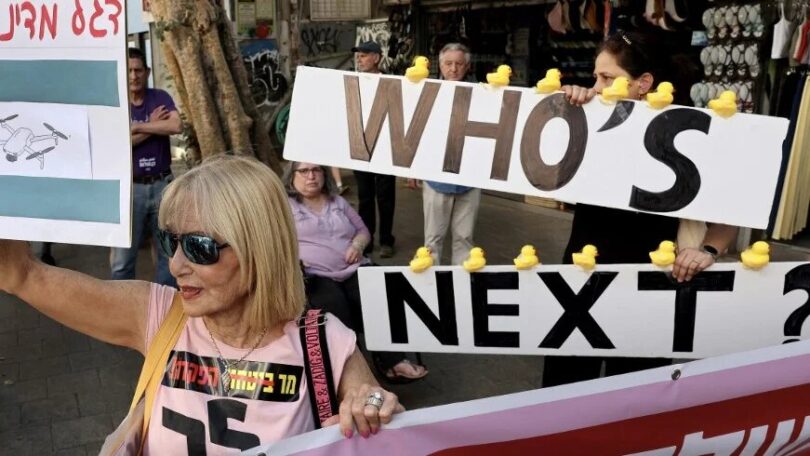
The result has been the opposite. Israel’s global standing is worse than ever due to its conduct, especially in Gaza. Social media is filled with videos of Israelis being kicked out of restaurants and entertainment venues. Hamas still exists in Gaza and is reportedly working to rebuild its military strength.
Hezbollah has also been regrouping, and worse still, the Iran war that Netanyahu convinced Washington to join was an utter failure. The Iranian regime survived, and is now setting conditions for a ceasefire deal, including discussions on the future of the Strait of Hormuz and the preservation of its nuclear capabilities.
This past weekend, Tehran further showed that it will not hesitate to strike Israel first in retaliation for attacks on Lebanon. What began as an Israeli attempt to create a new equation against Hezbollah has ultimately led to a situation where Iran holds the upper hand of deterrence.
Complex dilemma
The developments this weekend were unprecedented. For the first time in the Israel-Iran-US conflict, Iran initiated an attack and did not provide advance notice. An hour before the missiles were fired, a senior security official told Ynet that Israel did not expect Iran to actually strike. [Can you supply a link to this interview?]
Even worse for Netanyahu was the reaction of US President Donald Trump, who urged Israel not to hit back, and instead to give negotiations a chance. Regardless, Israel went on to carry out limited strikes against Iran.
But none of Israel’s recent actions indicate any clear military objective, nor any strategy to end the war. The same situation has unfolded since the beginning of the genocide in Gaza, while Israel’s global reputation has continued to plummet.

Read More »
From Tel Aviv’s backing of anti-Hamas militias in Gaza, to its gambling on the hope that millions of Iranians would rise up to overthrow their regime, to its attempts to incite another civil war in Lebanon, all of its strategies have failed miserably.
Many in the Israeli public who supported the wars now find themselves in a complex dilemma. Not only has “absolute victory” failed to arrive, but Israel’s military challenges have only worsened, as the ongoing conflict has caused economic chaos and revealed significant holes in the country’s security strategy.
Many in Israel understand that they are on shaky ground in the region and the world, but they traditionally found comfort in military successes. Now, they are starting to realise that there are limits to this power. The army is overwhelmed, the US is a fickle ally, and the cost of living in Israel is growing alongside the country’s ballooning defence budget.
It may well take more time before we see a shift in the Israeli political consciousness, and a recognition that not everything can be solved by force. But for now, as Netanyahu’s political rivals rev their engines for the upcoming elections, both the coalition government and the opposition still speak in the same militant tone – devoid of a political horizon.
The views expressed in this article belong to the author and do not necessarily reflect the editorial policy of Middle East Eye.