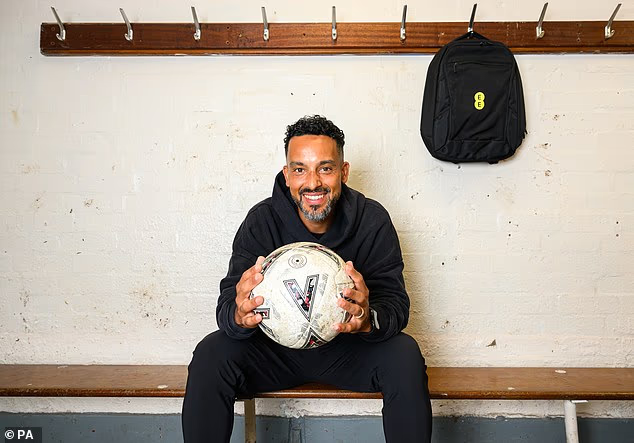
Ex Arsenal star Theo Walcott knows exactly what it fells like to carry the hopes of a nation on your shoulders ahead of a World Cup.
For Theo was just 16 and hadn’t even played a match for Southampton when he was named in Sven Goran Erikssen’s 23-man squad for the 2006 World Cup in Germany.
Fast forward two decades and 37-year-old Theo is now feeling pressure of a different kind – of being a father to two boys, aged 12 and ten.
And he like all dads worries about the how they will be affected by social media and the issues young men face growing up.
‘Growing up in football, I saw how powerful the environment around the game can be in building confidence and character,’ he said. ‘Now, as a dad, I’m even more aware of the pressures boys face, especially online.
‘Football gives boys a space to express themselves, build resilience and learn from positive role models. That’s why, yes boys, it is so important in helping the next generation grow with confidence.’
And new research by EE, lead partner of the Home Nations Football Associations, show he’s right.
The scale of harmful online content influencing and shaping boys’ attitudes is concerning to most parents, but football can help.
Theo Walcott is something of an expert on pressure. He was just 16 when he was called up to the England World Cup at the tender age of 16… now he faces the pressure of raising two boys
Four in 10 boys encounter harmful messages such as ‘men shouldn’t show emotion’ and ‘boys need to toughen up’ every week, with 14% saying it happens every day. And 71% of boys admit they feel overwhelmed by online pressures.
Many parents feel unequipped to respond with 54% say they feel out of their depth.
Ben Hine, Professor of Applied Psychology, said: ‘In an increasingly complex digital world, boys are exposed to a constant stream of online content, some of which promotes harmful, outdated and restrictive ideas about masculinity. Over time, repeated exposure to these messages can shape how boys see themselves and how they believe they are expected to behave.
‘What this research highlights is the importance of positive, real-world environments in counteracting it. Spaces like grassroots football – where boys can connect with trusted adults and peers – play a critical role in supporting healthy identity development, emotional expression and resilience.’
EE’s research shows the powerful role football can play in helping boys navigate online pressures and build a stronger sense of self.
Among boys who regularly play football, 65% of parents say the sport has had a positive impact on their son’s confidence and identity.
The research also shows that trusted adults in football – particularly coaches – are among the most influential role models in boys’ lives.

Walcott says he acknowledges the pressures faced by young boys brought on by social media – and is working with EE to try and help boys build confidence and create an identity
In response, EE along with Walcott, has launched the Mentor Badge, an online resource providing practical tools for role models and parents to help them support boys on and off the pitch.
Kelly Engstrom, marketing boss at EE, said: ‘As the UK’s best network for families, and the lead partner of the Home Nations Football Associations, we are uniquely placed to
champion young boys and help build them up, on and off the pitch.’