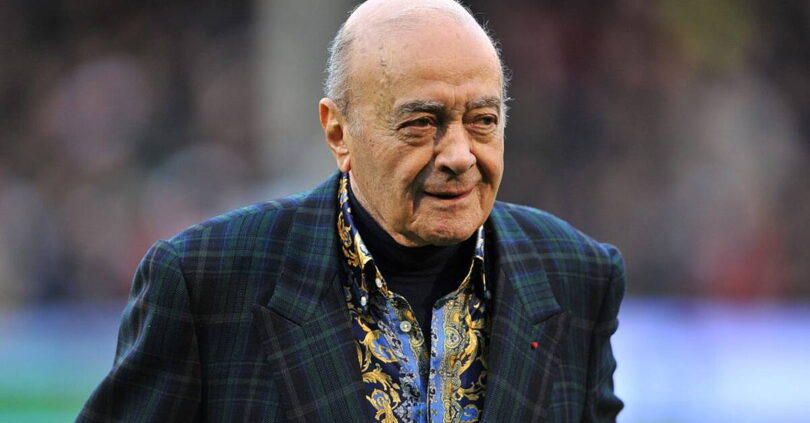
Survivors of abuse at the hands of billionaire Harrods owner Mohamed Al Fayed are calling for a full trafficking investigation to be launched.
More than 400 allegations of sexual misconduct have been made against Al Fayed, dating between 1977 and 2014.
These allegations include rape, sexual assault, human trafficking, false imprisonment, drugging, physical violence and forced abortions.
Lawyers representing the Justice for Harrods Survivors group report that 421 people have come forward about abuse that took place at Harrods, the Ritz Hotel Paris, Fulham FC and other places owned by Al Fayed.
There were security teams who would threaten people’s families, they would follow them outside of the workplace to see who they were speaking to, they would contact them in their private homes, and they would make very direct threats of harm or ruin
The Metropolitan Police are investigating 155 victims who contacted them directly, including 21 who came forward before Al Fayed’s death in 2023 at the age of 94.
The investigation, known as Operation Cornpoppy, is looking at people who may have facilitated or enabled Al Fayed’s crimes.
Four people have been questioned to date, 18 months after the investigation opened.
A Met Police spokesperson told the eSporty News the force is determined to “bring anyone who is suspected to have played a part in Mohamed Al Fayed’s offending to justice”.
However, a survivor-led collective called No One Above, founded by victims of abuse at the hands of Al Fayed, are calling for the Met to broaden the scope of its investigation and make trafficking the primary focus.
They argue this would allow the police to look at the wider network, recruitment chains, financial flows and institutional complicity, rather than the cases of individual victims and offenders.
Survivors at No One Above have also called for the National Crime Agency (NCA) to set up a joint investigation team (Jit) to run in parallel to the Met’s work and have oversight of it.
They say this would help uncover the international scope of the trafficking ring, working in conjunction with police and prosecutors from countries outside the UK where abuse also took place.
It would also add an extra layer of accountability and transparency, which the survivors say is “crucial” given concerns over the Met’s own conduct in this case.
Justine, from No One Above, worked at Harrods for more than three years in the nineties, when she was 22 years old, and was trafficked and abused during this time.
Justine, which is a pseudonym, told PA: “My experience with Mohamed Al Fayed followed a now familiar pattern of selection, isolation, grooming, manipulation, coercion, transportation, abuse, intimidation, and then surveillance and threat. It was horrific.”
She added: “His modus operandi was a system of walking the floor, which meant he would go out onto the shop floor, flanked by security teams, some of whom were uniformed, some of whom were not, and he would walk the floor spotting the women that he found attractive.

“And then somebody from his team would follow up and invite that young woman up to his offices to meet him, and then it would begin.”
Justine said that women were intimidated into silence with surveillance and direct threats of harm.
She said: “There were security teams who would threaten people’s families, they would follow them outside of the workplace to see who they were speaking to, they would contact them in their private homes, and they would make very direct threats of harm or ruin.
“John Macnamara, who was Fayed’s director of security, was an extremely scary man, and he was very much the head of all of this.”
Fayed could not have masterminded this system without many helpers, including security personnel, HR staff, people in banks authorising vast sums of cash for Fayed to give to women, people who worked at the private airports – Fayed had several private aircraft – and the people who worked in the FBOs
Macnamara died in 2019 at the age of 83.
Justine told PA that Al Fayed’s crimes are being framed as sexual abuse in the workplace perpetrated by one bad man, rather than a trafficking operation with many enablers and facilitators.
She said: “Fayed could not have masterminded this system without many helpers, including security personnel, HR staff, people in banks authorising vast sums of cash for Fayed to give to women, people who worked at the private airports – Fayed had several private aircraft – and the people who worked in the FBOs.”
Fixed Term Operators (FBOs) are companies who manage private aircraft.
Justine said Fayed used to store his aircraft at Stansted and Luton airports, flying women in and out of these locations.
She said: “Our passports were taken from us, we did not go through border control.
“There were many people that would have been involved in making that possible.”
Justine went on to say: “Then there were legal teams who were drafting NDAs (Non-Disclosure Agreements) for women to sign. There were doctors who were performing medical examinations.
“There were also people within the business, who knew what was happening. If they weren’t directly enabling, they were turning a blind eye and not doing anything about it.”
There is increasing pressure on the Met to open a full trafficking investigation, including from the former head of the force’s own anti-trafficking unit, Phil Brewer, who said it would help identify and seize evidence that corroborates the stories provided.
Instead, the Met are talking to women as “siloed victims”, Justine said.
She told PA: “A trafficking investigation would look at all the networks involved and recognise the systemic nature of the abuse, so the financial flows would be scrutinised, the medical examinations, the security threats, the bribes, the movement of women, all the systems that formed the web.
“A trafficking investigation would not only talk to the woman who ended up sitting on a plane that belonged to Fayed, they would be looking at all the steps that placed her in that seat.
“At the moment, that’s not how the investigation is being handled and it has to be.
“Without a trafficking investigation and a JIT, the true scale of this network isn’t going to be seen, because everything’s being drip, drip, drip fed.
“And they’re not seizing evidence. Despite Operation Cornpoppy being opened 18 months ago, all they’ve done is question four people. It’s just not enough.”
Justine spoke to the police about her experience in 2018 after being in a news story.
She told PA: “The story and my reporting, along with others’ at the time, just faded away and there was absolutely no follow-up or action taken.
“They’ve missed many opportunities, the Met, but when I spoke to them in 2018, that was one of the last opportunities they had to get Mohamed Al Fayed while he was alive.
“That moment has gone, but there are many, many people still alive and institutions still operating who need to be held to account.”
The Independent Office for Police Conduct (IOPC) is looking at how historical allegations were handled, and one currently serving officer and four former officers are being investigated.
A Met Police spokesperson told PA: “Specialist detectives continue to lead one of the Met’s largest and most complex investigations.
“Four suspects have been interviewed under caution so far in our determination to bring anyone who is suspected to have played a part in Mohamed Al Fayed’s offending to justice.
“To date, 155 victims have come forward and reported allegations of sexual assault, rape, sexual exploitation and human trafficking.
“Over the past 18 months, officers have taken detailed accounts from victims and witnesses to build a comprehensive picture of the alleged offending.
“The victims are at the heart of our investigation, and it remains our priority to communicate with them clearly and meaningfully as the investigation progresses.
“The most recent update was shared in the form of a letter on Monday May 11 with all 155 victims.”
If you have been affected by any of the issues raised in this article, you can call the national 24-hour Rape Crisis Helpline at 1800-77 8888, access text service and webchat options at drcc.ie/services/helpline/ or visit Rape Crisis Help. In the case of an emergency, always dial 999/112.