
Curacao are the World Cup’s biggest miracle story.
The Caribbean island nation, with a population of around 158,000 but a nightlife livelier than London, are just six days away from making their mark as the tiniest team to ever grace the competition.
Win or lose, the Blue Wave are here to do things in their inimitably vibrant style. One of their players even says they’re here to lift the trophy.
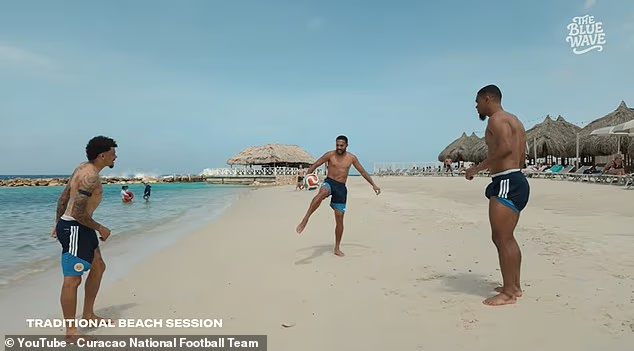
Their squad – composed largely of Dutch-born players – have been training barefoot on the beaches of home, metres away from sunbeds and wooden seafront shacks. Think Brazilian-style volley games, press-ups on the sand, and splashing each other in the turquoise waters, filling the salty air with laughter.
It feels incongruous that they are here. At the weekend, they went viral for travelling in a ramshackle school bus, leaning out of the windows (no glass) and banging the side of the vehicle. On Sunday they face giants Germany at the 72,000-capacity Houston Stadium, which could fit in almost half their population.
Around 3,000-5,000 supporters will follow them to North America, with the throngs back home gathered in front of screens at parties across the island paradise, around 40 miles off the coast of Venezuela.
Curacao have been gearing up for their debut World Cup on the beaches of their island home

The Caribbean island squad have gone viral for travelling around in a dilapidated school bus

They have been socialising with supporters ahead of being the tiniest nation ever to play in the World Cup
‘The island will shut down when the games are on,’ one fan, Brenton Balentien, told The Athletic.
‘For us, it’s life. We are a tiny island, everyone here is like family, accomplishing something as big as qualifying for the World Cup, it means the world. Besides seeing the birth of my children, this is the best thing that has ever happened to me.’
This is a team who have not forgotten their roots. In the build-up to their debut, the players have been hanging out with fans, taking selfies, doing meet-and-greets, and signing shirts and balls. There is a sense on the island that the players in some way belong to them, that they are at one with the populace in a way more major nations cannot achieve.
They arrive full of optimism. In their qualifying campaign, Curacao went unbeaten across their 10 matches, seeing off the likes of Haiti, Jamaica and Trinidad and Tobago. That will give them confidence that they can at least compete in this tournament, though a group including Germany, Ivory Coast, and Ecuador looks forbidding.
In November they drew with Jamaica to book their place in the expanded 48-team tournament. That sent them into seventh heaven – even the crowd control police were joining in the festivities at full time – while it condemned Jamaica, managed by former England manager Steve McClaren, to the play-offs, where they lost out to DR Congo.
Getting the better of Jamaica was no mean feat. Curacao played away from home and packed two planes with their most passionate fans to make a noise in the 35,000-seater stadium in Kingston, but most of the crowd was behind McClaren’s team. That didn’t stop the visitors, arrayed in a sea of blue, from silencing them.
‘I think God was with us that night,’ said Leandro Bacuna, Curacao’s captain.
‘Because you’ve seen the game, everyone’s seen the game. Couple of balls on the post … Everywhere. But our keeper was great, so I think it was meant for us. It was a story written for us.’

Curucao were jubilant after fans flew to Jamaica to see them qualify in November

They went unbeaten in qualifying and are now saying that they can win the tournament
The man who has masterminded Curacao’s debut run is Dick Advocaat, a 78-year-old Dutch veteran who will be the oldest man in history to manage at the World Cup.
Advocaat – who used to manage Sunderland – actually stepped down in February to be present for his sick daughter and was replaced by Fred Rutten, but he returned to the post in May 2026. He’s not just here to make up the numbers, and neither are his squad.
Only Tahith Chong was born in Curacao, while the rest of their squad comes from the Netherlands but are all connected to the island via their parents.
The island didn’t even have a national team until 2010 – they were included under the banner of the now-disbanded Netherlands Antilles – so it has been remarkable surge onto the world stage.
Their team is short on star quality. The most recognisable name is Leandro Bacuna, who spent three years with Aston Villa, but this campaign will be more about team effort.
Curacao are the third-lowest-ranked team in the competition, sat 82nd in FIFA’s rankings. Only New Zealand and Haiti are lower. But given that they were 150th a decade ago, they’re used to upsetting the odds.
Crucially, the confidence is coursing within them that they can cause a shock. Right-back Livano Comenencia, who plies his trade with Zurich in Switzerland, told FIFA: ‘We’ve been brought up playing the Dutch way and we’ve got real quality and excellent technique. We’re going to surprise a lot of people.
‘As soon as the game gets under way, anything can happen. It’s always 11 against 11, not five against 11. Anything’s possible, even against Germany. I think four points will be enough to see us through to the next stage of the competition, a win and a draw. We’ll do everything in our power to make it happen.’

Dutch coach Dick Advocaat has helped transform the side after taking charge in 2024

The island remains part of the Kingdom of the Netherlands despite being located near Venezuela

Covering a total area of 444km squared, Curacao is so small you could fit nearly four of them inside Greater London – and the island only has a population of just over 150,000 people
‘For us, qualifying for the World Cup is already a huge milestone, because we’ve never achieved anything on this scale before and we’ll be the smallest country in tournament history.
‘A lot of people already see us as winners. But we’ve got a winning mentality and we’re not here to just make up the numbers. We’re going to the World Cup with the intention of winning it.’