
This is the introduction to Checks and Balance, a weekly, subscriber-only newsletter bringing exclusive insight from our correspondents in America.
Sign up for Checks and Balance
In his second inaugural speech, Donald Trump revived an old American theme. The country should, he said, be “a growing nation”, one which “expands our territory”. He name-checked William McKinley, the president who added Guam, Hawaii, the Philippines and Puerto Rico to America’s territory. There was, you will recall, some alarm that he might try to seize Greenland and the Panama Canal by force. Even people who had previously argued that Puerto Rico should be a state seemed shocked by this shameless expansionism.
A good heuristic in the Trump era is always to ask: what would you think about this if Reagan or Obama were saying it? The answer in this case, I think, is that the idea of taking more territory by force is not good.
But there is nothing wrong with the idea of American expansion. This is a great and good civilisation, with an unmatched genius for generating prosperity. If America were to absorb other countries or territories at their own invitation, any new Americans would probably be better off than they would be otherwise.
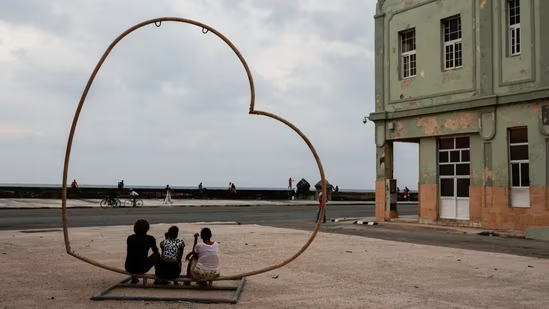
Which brings us to Cuba. The Economist’s coverage of what’s happening there is unmatched. This week I spoke to our Mexico City bureau chief, Sarah Burke, who is a frequent visitor, for the Checks and Balance podcast. I also spoke with two Cubans, who laid out the abject misery of life on the island.
I went to Cuba in the late 90s because I wanted to see for myself how a centrally planned economy malfunctioned. It was without a doubt the most depressing place I have ever been. And that was in one of the country’s better moments, after the collapse of the Soviet Union forced some economic opening.
It wasn’t just the absence of good food, the bookshops with two books in them, the state broadcasts of interminable Castro speeches, the “Socialism or Death” slogans everywhere (I’ll take death, please).
This socialist paradise is the only place I have experienced formal racial segregation. On the beach there was an invisible line in the sand separating the (mostly white) tourists from the (mostly Afro-Cuban) locals. Our part was clean, theirs was cramped and strewn with rubbish and seaweed. Both sides knew they were not allowed to cross the line. There were policemen on every corner whose job was to prevent Cubans from talking to people like me. The place made me sick.
And Cuba is so much worse now, as a result of America’s effective blockade—part of Mr Trump’s pressure campaign. The island is dependent on oil to generate electricity and it has no oil. So there’s often no electricity for most of the day. Imagine trying to run a hospital under those conditions. Or just figuring out how to feed your family on a tropical island without a working fridge. Oh, and when the power is on, people who criticise the government online can be locked up.
It could yet get worse. Many Cuban-Americans are waiting for the day the government collapses, imagining that Cuba will become something like the Dominican Republic. But it could just as easily end up more like Haiti.
My modest proposal is that, to celebrate its 250th anniversary, the United States should do two things.
First, it should provide free internet access to all Cubans. This is arguably feasible with a system of drones or, if the Cubans shoot them down, autonomous boats equipped with Starlink and broadcasting Wi-Fi. The aim would be to end the Cuban government’s control over information.
Second, make Cubans an offer: come and join us. If, in due course, the island could hold a free and fair referendum, one option on the menu should be US statehood. They might decide they would rather be Cuban and reject statehood. If that happened, America should still do its part to help the island become free and prosperous. But imagine if Cuba actually became a state. Aside from the humanitarian appeal of helping 10m people avoid hunger and preventable disease, consider what a great advertisement for the American system it would be to take a poor, sad, supposedly socialist island and turn it into a prosperous, joyful, capitalist American state—all in time for the republic’s 300th anniversary.
This would be a far more powerful gesture than building a triumphal arch in Washington or a new ballroom for the White House. It would show more strength than holding a cage match on the South Lawn. And it would exhibit more self-confidence and strategic foresight than continuing a blockade that has been in place for decades yet has failed to topple the regime. Do you agree or disagree with my proposal? Write to us at checksandbalance@economist.com.