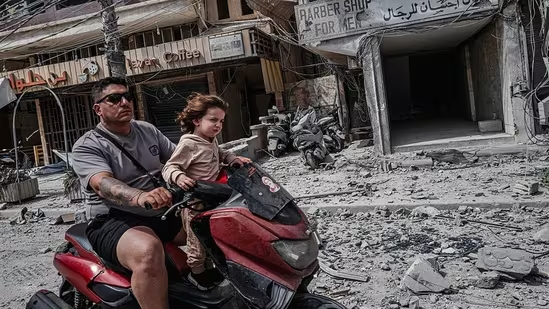
FIRST CAME the announcement on June 1st from Binyamin Netanyahu, Israel’s prime minister, and his defence minister, Israel Katz, that they had ordered the Israel Defence Forces (IDF) to “attack terror targets” in Dahiyeh in Beirut, Lebanon’s capital. Then came more threats of attacks and a warning from the IDF telling residents of Dahiyeh, a stronghold of Hizbullah, the Iranian-backed Shia militia, to evacuate. Thousands had already fled. But for once Israel did not drop its bombs.
Where else can they flee? Photograph: Daniel Berehulak/The New York Times/Redux/eyevine
Instead, in the evening came what Donald Trump called “a very productive call” with Mr Netanyahu. According to Axios, a news website, it was an expletive-laden reading of the riot act by the president, who told Mr Netanyahu that “everyone hates Israel now.” The result was a promise from Israel to refrain from bombing Beirut. Hizbullah, to whom Mr Trump also said he had talked—the first American president to do so (albeit through intermediaries)—also said it would not fire at Israeli towns.
Read all our coverage of the war in the Middle East
It was a diplomatic blow for Mr Netanyahu. Mr Trump, once again, ordered the Israeli prime minister to hold fire. And Iran demonstrated that it can demand a pause in the fighting in Lebanon, protecting its proxy there, as a precondition for ceasefire talks with America. Just three months ago, Israel and America launched their war against Iran. Today, Israel has been relegated to being a bystander.
Yet Mr Trump has arguably done Israel a favour. He may have prevented it from blundering deeper into Lebanon. When Hizbullah launched rockets at Israel on March 2nd, in solidarity with Iran, the IDF believed it could finish what it had begun in 2024. Then, Israel battered Hizbullah. But the current fighting has been much less successful from Israel’s perspective.
Weakened, Hizbullah has resorted to using cheap attack drones. The drones, and its remaining missiles, have not blocked Israel’s incursions, but they have caused a steady stream of idf casualties.
The lack of an effective response to the drones has put political pressure on Mr Netanyahu’s government to bludgeon Hizbullah in whatever way it can. The prime minister has responded by ordering the IDF to advance deeper into Lebanese territory. Rather than repeating the devastatingly effective campaign of 2024, which was far more precisely targeted, Israel’s current assault is beginning to resemble past wars Israel fought in Lebanon.
In 1982 Israel invaded to fight Palestinian militias who were using the country as their base for attacking Israel. The IDF remained in parts of southern Lebanon for the next 18 years, calling it a “security zone”. When it finally withdrew in 2000, it left Hizbullah dominant.
In 2006 Israel responded to a Hizbullah attack on an IDF border patrol with massive air strikes on Dahiyeh and another invasion. That time the militia fought the idf to a standstill after 34 days.
In all these years Israel faced the same dilemma in Lebanon. Despite its overwhelming military advantage, the eradication of Hizbullah as a fighting force is impossible. Capturing a new “security zone”, as Mr Katz announced, has inflicted more suffering on the people of southern Lebanon, where thousands have been killed and hundreds of thousands uprooted. And it is of dubious strategic value.
The alternatives are hardly enticing. A UN peacekeeping force in southern Lebanon has proved unable even to monitor Hizbullah’s military build-up, let alone prevent it. And while the Lebanese government has committed itself to the idea of disarming Hizbullah, its army is still too weak to do so. Its politicians, meanwhile, are fearful of reigniting a civil war.
After talks in Washington, Israel and Lebanon did agree to renew their ceasefire on June 3rd. But the main aim of Mr Trump’s latest intervention was to prevent Israeli actions from derailing America’s talks with Iran, which he is keen to bring to a close (they have “started to get very boring”, he moans). The president’s notoriously short attention span may now be all that is standing between Israel and another bloody adventure in Lebanon.
Sign up to the Middle East Dispatch, a weekly newsletter that keeps you in the loop on a fascinating, complex and consequential part of the world.