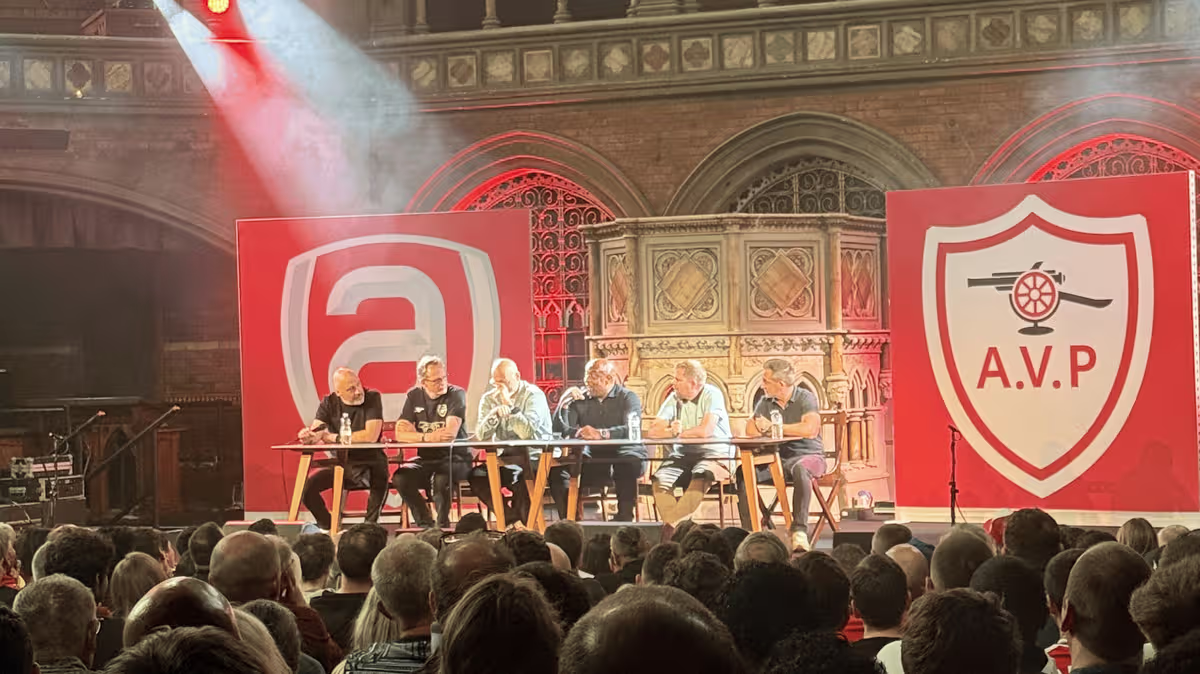
football.london speaks exclusively to host of The Arsecast podcast and owner of Arseblog Andrew Mangan about the journey to Arsenal winning the Premier League and what the future looks like
Arsenal were crowned Premier League champions for the first time in 22 years. Mikel Arteta, now the only manager or head coach with a winners’ medal among the current 20 coaches in England’s top-flight, is being talked about as having the chance to make The Gunners the dominant force.
It has not been a seamless journey, and trust in the process has sometimes been tested to the limits within the fan base. Perhaps few know this journey better than Andrew Mangan, host of the Arsecast and Arsecast Extra podcasts, and owner of Arseblog, who spoke exclusively to football.london.
One of, if not the first, Arsenal podcasts, which was set up in 2006, Mangan has spoken weekly, often more frequently than that, about the club for the past two decades. The podcast has amassed a huge audience and a brilliant community.
FOLLOW OUR ARSENAL FB PAGE! Latest Gunners news, analysis and much more via our dedicated Facebook page
Often coming together with The Arsenal Vision Podcast each year for a live event, regularly hosted at Union Chapel, where hundreds of listeners attend. Both podcasts also team up to raise money for The Arsenal Foundation, and just this year, more than £600,000 was raised.
The money helps with projects that ‘focus on work to motivate and inspire young people – often through education and sport – to help them reach their potential and be the best they can.’ One such project is in the Za’atari refugee camp in Jordan, where thousands of young people have graduated from the programme.
But rewinding all the way back twenty years, had Mangan been asked if, when starting the podcast, it would have taken two decades before the next Premier League title, despite the context at the time, even he would have been surprised.
“I think we all recognised that 2006 was basically the beginning of the end of an era, with players who had come to the end of their Arsenal journey,” Mangan said.
“There was the optimism of a new stadium too, and what that might mean, but we were also starting to realise how fundamentally Roman Abramovich was going to change football for the worse. Nevertheless, I would still have thought 20 years would be an absurd length of time for a club like Arsenal to go without a title.”
Hosting a show every week, hearing from supporters, answering their questions, it provides a holistic view of the hive mind that is the Arsenal fan base. It can be divided on topics on day and unite a week later.
It is a frenetic and reactive group. Having podcasted and written about the club so regularly, Mangan admits that it takes on a new level where perhaps living it in this way heightens all those tingling fan senses.
“I write about Arsenal every single day of my life, so I’ve written and talked about that journey, or era, in minute detail,” he says. “When it is so ingrained in your life, you do feel it quite acutely.
“There’s good and bad in that. There’s catharsis in the bad times, but heightened frustration when you see the team fall short.
“I can’t say my experience is any more intense than anyone else’s, and Arsenal have had some incredible title wins before, but I don’t think any of them have felt quite this big. That long wait is a key part of it.”
The manner in which the title was won, with help from a potential summer addition in Bournemouth’s Eli Junior Kroupi against Manchester City, certainly played into that. Come the end, while there were obvious emotions of ecstasy and joy, there is no doubt a big feeling at the time was of relief too.
In those 20 years, there has been a major change at the club, and what dominated much of the 2010s, beyond the babbling debates surrounding Arsene Wenger, was the perceptions of the club’s owners, Kroenke Sports Entertainment (KSE), headed up by Stan Kroenke.
Taking full control in 2018, which included the buying out of many club shares owned by supporters. football.london sat down with Josh Kroenke at the end of the season, where he explained a sense of needing to go backwards to go forward, and under Mikel Arteta, there was no doubt that the downslope before the upturn is how things played out.
But Mangan looks back at the volatility of the process leading up to the full buyout, and then what followed was Arteta’s appointment, but more importantly, the trust and faith the club’s custodians put into him, which has since paid off.
“Arsenal has always been a big club, but didn’t always act that way,” he said. “The boardroom cold war between KSE and Alisher Usmanov was seriously detrimental, so when the Kroenkes took full control, there was understandable scepticism.
“Now, I think we have to give them their due in terms of how they’ve operated and invested. However, I will say I think the change has been driven primarily by Mikel Arteta, who was determined to change the culture of the club from top to bottom, and to be fair to the owners, they trusted him on that and did a lot to facilitate it.
What followed Arteta’s dream of winning the Premier League were completely unique scenes. From the Tuesday night explosion of red and white after the league was clinched, to the final day trophy lift at Selhurst Park and the day-long party all around North London.
Then the trophy parade, where Islington Council claimed more than a million people attended to celebrate the victory, even after the UEFA Champions League final had been lost just hours earlier. But what it also showed was the brilliance of this supporter base and just how welcoming it is to all people.
“I think it’s just how diverse the Arsenal fanbase is,” Mangan suggested. “Like every club, we have fans across the globe, and when you look at the pictures of celebration in North London itself, it feels like that is represented on the club’s doorstop.
“People of all shapes and sizes, of all creeds and colours, united by their love of a football club. We live in a world where there’s so much division and hatred, so as a perfect demonstration that people from everywhere can exist happily together in a shared, vibrant, positive community, I thought that was exceptionally powerful.”
With the celebrations now limited more to the minds and memories of supporters, at least until the new season kicks off and fans join together again, as champions, eyes are turning to what could be, to the future. Reflecting on what might come next, there remains that European itch that still needs to be scratched; but also there is more history to be made domestically.
“In the modern era, Arsenal have never retained a league title, so that’s the big challenge next season, along with going one better in Europe,” he said. “Arteta is great at identifying a ‘weakness’ and rectifying that, and hopefully we see that again in the summer with the recruitment and squad building.
“This is a team that’s not at the end of a cycle, so it’s really exciting, and hopefully ridding ourselves of that pressure by winning the league this season will help bring further success.”