
In a war-torn country like Yemen, young people struggle to find employment, especially those without unique skills or higher education degrees. Zahed al-Zabidi, in his 30s, is among those who have been battling to provide for his five family members.
His anxious look reflects his daily hardships; he eagerly anticipates a job opportunity from anyone who approaches him, ready to take on any work that can help support his family.
“I have been working, washing dishes and cleaning restaurants, for more than 15 years. That is the only thing I can do,” Zabidi told Middle East Eye. “I used to find a job easily, but it isn’t easy to find work anymore.”
Yemen’s youth unemployment rate stood at 32.39 percent in 2024, and this rate is particularly prevalent among young people like Zabidi, who rely on low-skilled jobs that do not require specific experience.
Originally from the Hodeidah governorate, Zabidi moved to Aden seven years ago in search of a better income. He had struggled to find stable employment in Hodeidah, where he relied entirely on intermittent day labour.
CLICK FOLLOW: TO FOLLOW US
Sign up to get the latest insights and analysis on
Israel-Palestine, alongside Turkey Unpacked and other eSPORTY
“I worked at several restaurants in Aden, but the situation gets worse every day because Ethiopian migrants are taking our jobs, and many restaurants have started hiring them,” he said.
“Ethiopian migrants are ready to work for any amount, so restaurant owners prefer them and fire us.”
Zabidi used to earn 130,000 Yemeni Riyals ($83) per month, but he was replaced by an Ethiopian worker who accepted 80,000 Yemeni Riyals ($51). However, he emphasised that the wage accepted by an Ethiopian worker is simply not enough for a Yemeni to support a household.
‘Ethiopian migrants are ready to work for any amount, so restaurant owners prefer them and fire us’
– Zahed al-Zabidi, a young unemployed Yemeni
“The Ethiopian migrants don’t have families here, and they accept whatever is enough for them just to survive. But I have a family, and I need a job that enables me to provide for them,” he explained.
Zabidi is currently jobless. He has gone from restaurant to restaurant looking for work, but finding a position has proven difficult, as most establishments now seem to prefer Ethiopian workers for these roles.
“Our main meal is now just bread and tea, as that is the only thing I can afford. We only had meat when a generous person shared some with us during Eid,” he said. “It is difficult for a jobless person like me to buy good food for his family. We are only eating to survive.”
This year, there are 22.3 million people in need of some form of humanitarian and protection assistance in Yemen, according to United Nations Office for the Coordination of Humanitarian Affairs.
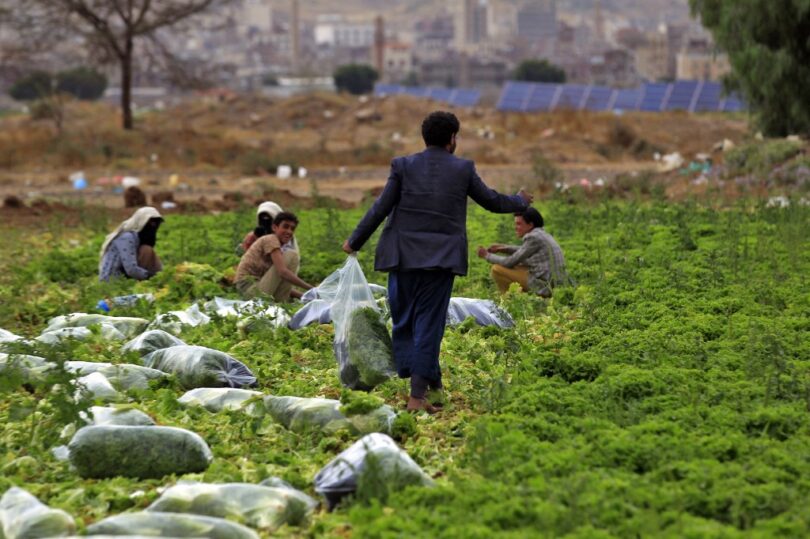
Zabidi stated that he is now considering looking for work on farms in Lahj governorate, where some of his relatives are employed.
“I don’t have experience in farming, but I will learn it from my relatives and try my best to work there,” he said.
Key Transit Country
During 2025, 110,144 migrants entered Yemen, of whom 97 percent were Ethiopian and three percent were Somali nationals. This highlights Yemen’s continued role as a key transit country, according to the International Organisation for Migration (IOM).
Every year, tens of thousands of Ethiopian and Somali migrants embark on a high-risk journey from their countries of origin towards Djibouti, intending to reach Saudi Arabia and other Gulf countries via Yemen.
Strategically located in the southwestern corner of the Arabian Peninsula, Yemen has for decades served as a vital transit point for people migrating from East Africa and the Horn of Africa, particularly from Ethiopia and Somalia, who are seeking safety and employment opportunities.

Despite the domestic conflict that began in 2015, followed by economic decline and institutional collapse, Yemen remains a heavily travelled transit country for migrants, according to the IOM.
The UN agency stated that more than 90 percent of incoming migrants intend to travel onwards to Saudi Arabia as their ultimate destination, with many heading towards the Jizan Governorate. The remaining 10 percent plan to remain in Yemen.
Many migrants decline to speak with strangers or the media about their journeys or why they accept such low wages. However, the pattern suggests they do not plan on staying in Yemen long-term.
‘We plan to reach Saudi Arabia, and while we are here, we need to eat, so we work just like anyone else’
– Ramadan, a migrant worker
For most, this is a temporary stop until they can manage to travel to Saudi Arabia. They only take jobs to cover their immediate daily needs, rather than aiming to save money or send remittances back to their families.
One migrant, who went by the name Ramadan, though Middle East Eye could not verify if this was his real name or an alias, spoke briefly to MEE.
“We plan to reach Saudi Arabia, and while we are here, we need to eat, so we work just like anyone else,” he said.
His Arabic was not fluent, having picked it up during his last seven months working at a restaurant. While he was reluctant to conduct a longer interview, MEE learned that he is working solely to support himself until he can coordinate his journey to Saudi Arabia.
“I love Yemen and Yemenis, and I don’t want to make anyone unhappy,” Ramadan added. “Yemenis are our brothers, and we share the same suffering.”
‘Unfair competition’
Ethiopian migrants typically find work cleaning restaurants, supermarkets and malls, or working on farms. However, employers usually decline to admit they hire Ethiopian workers.
Ali, a restaurant owner in Aden, agreed to speak to MEE using a pseudonym, as he preferred to stay anonymous. “The Ethiopian migrants work hard and they clean the restaurant better than some Yemenis. Moreover, they accept lower wages and don’t complain,” he said.

Desperation forces Yemenis to risk lives smuggling qat to Saudi Arabia
Read More »
He stated that while some Yemeni workers frequently demand higher wages and require a lot of time off, that is not the case with Ethiopians, “who work silently” and dutifully perform any task requested of them.
“Frankly speaking, there are some good Yemeni cleaning workers, but the Ethiopians are better at this job,” Ali added. “As a businessman, I prefer to employ Ethiopians for these roles because they work longer hours for less pay.”
Often forced to swim the final five kilometres to reach the Yemeni shore, these migrants arrive with absolutely nothing. Desperate and eager to survive, many seek immediate employment.
Economic expert Wafeeq Saleh believes that the influx of Ethiopian migrants is not the primary driver of unemployment in Yemen, though it does impact Yemeni workers in specific areas and sectors.
“These migrants work in cleaning, strenuous domestic labour and farming, especially Qat farming, where they accept low wages,” Wafeeq told MEE.
‘As a businessman, I prefer to employ Ethiopians for these roles because they work longer hours for less pay’
– Ali, a restaurant owner
“These low wages are not enough for a Yemeni to eke out a decent living for a family, creating unfair competition in the labour market between Yemeni workers and Ethiopians.”
On the other hand, Wafeeq noted that there used to be a relative reluctance among Yemenis to take up cleaning jobs because it was culturally viewed as “shameful”.
However, he explained that “the severe economic crisis has contributed to the fading away of this culture, and Yemenis are now in dire need of any opportunity”.
Zabidi, the unemployed cleaning worker, emphasised that he is not against Ethiopian migrants working, but believes wages should be fair for everyone.
“I am against the low salaries that encourage restaurant owners to hire them,” he said. “If we received the same salary for the same working hours, restaurant owners would prefer us.”