
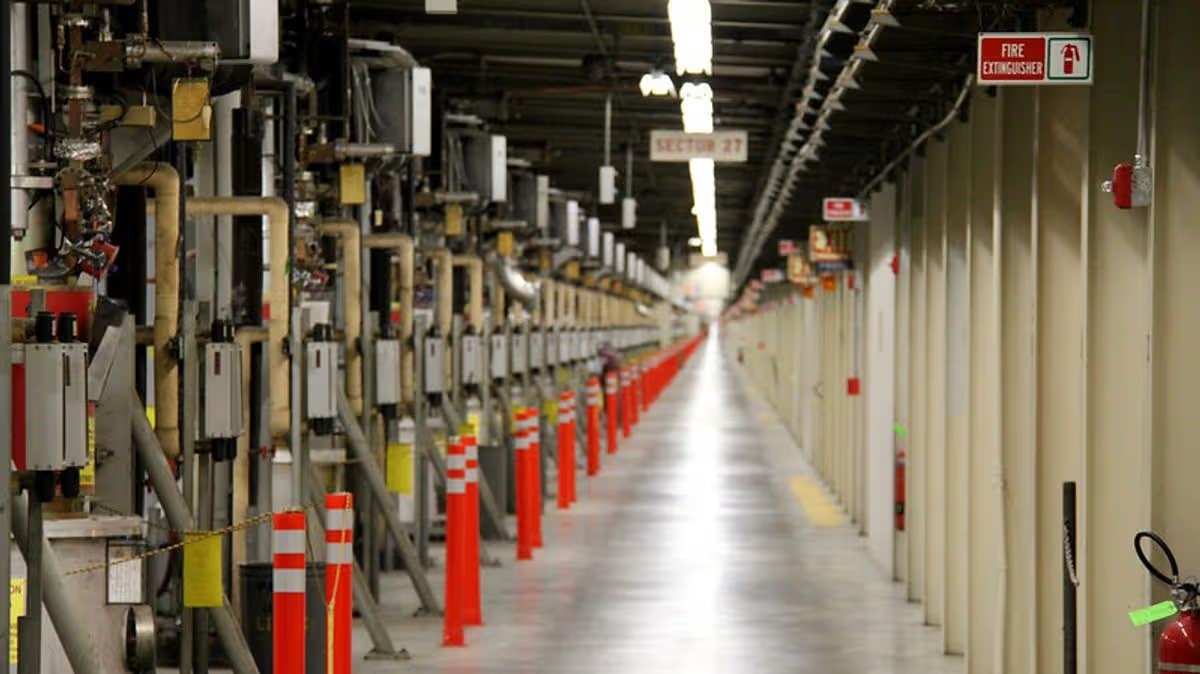
A vast industrial building in California is considered the world’s longest, stretching so far that it takes around 40 minutes to walk its full length
A gigantic two-mile-long structure has long been regarded as the world’s longest building — and it is so vast that experts say the curvature of the Earth must be taken into account when measuring it.
The Klystron Gallery at SLAC National Accelerator Laboratory, near Menlo Park, California, extends for an astonishing 3,073 metres (1.9 miles), taking around 35 to 40 minutes to walk from end to end at an average pace. Its size is so great it can even be seen from space.
Built as part of one of the most ambitious scientific projects of the 20th century, the facility formed the backbone of the Stanford Linear Accelerator project, a huge machine designed to smash particles together and unlock secrets about the structure of matter.
The original SLAC project cost around $114million to build in the 1960s, with a further $18million spent on research and development beforehand — taking the total to roughly $132million (£98million). Using the Bank of England’s inflation calculator, that figure would cost £1.6billion in today’s money.
Adjusted for inflation, that would amount to well over $1billion today.
What the Klystron Gallery actually does
At the heart of the site sits the Klystron Gallery, a vast industrial service building running above and alongside a two-mile underground particle accelerator. Unlike conventional skyscrapers or shopping centres, the structure exists for one singular purpose: powering one of the world’s longest linear accelerators.
The building houses rows of machines called klystrons, powerful microwave amplifiers that generate radiofrequency energy to accelerate electrons to near light speed inside the tunnel below. Scientists often compare them loosely to microwave technology found in kitchens — except these machines are around 60,000 times more powerful.
Inside, the gallery resembles an almost endless industrial corridor. Long repeating sections of machinery, electronics cabinets and service areas stretch far into the distance, creating a perspective that appears almost surreal in photographs.
Its extraordinary length was no accident. Particle accelerators require enormous distances to steadily boost particles to extremely high energies, and engineers in the early 1960s concluded that a two-mile straight line would be necessary to achieve their scientific goals.
Why Earth’s curvature matters
The underground accelerator beneath the gallery became known as one of the straightest engineered objects ever constructed. Because of its length, surveyors had to account for the Earth’s curvature when aligning the system, ensuring the beam remained extraordinarily precise across almost two miles.
SLAC itself — short for Stanford Linear Accelerator Center before later becoming SLAC National Accelerator Laboratory — opened in 1962 and is operated by Stanford University on behalf of the U.S. Department of Energy.
Today, the laboratory remains one of the world’s leading centres for particle physics, X-ray science, astrophysics, cosmology, chemistry, biology and materials science. Research conducted there has contributed to multiple Nobel Prize-winning discoveries, while parts of the original accelerator now power the Linac Coherent Light Source, one of the most powerful X-ray lasers ever built.
Is it really the world’s longest building?
For decades, the Klystron Gallery was widely regarded as the longest modern building in the world. However, categorising the “world’s longest building” is surprisingly complicated.
Unlike airports, shopping malls or apartment blocks, the gallery is effectively a specialised industrial support structure built for scientific infrastructure. Some lists classify longest buildings by continuous enclosed structure, others by total length, floor area or intended use.
That distinction matters because the title may have become disputed in 1999 with the completion of the twin facilities of the Laser Interferometer Gravitational-Wave Observatory, better known as LIGO.
The two LIGO observatories — located in Louisiana and Washington state — each feature enormous L-shaped interferometer arms stretching around 4km (2.5 miles) in length, significantly longer than the Klystron Gallery. However, many observers argue they should not count because they are highly specialised scientific vacuum tunnels rather than conventional buildings, while others say their enclosed structures qualify.
The battle of the record-breakers
The debate mirrors another common misunderstanding involving the New Century Global Center in Chengdu, China.
Frequently cited as the world’s largest building, the enormous complex spans around 1.7 million square metres of floor space and contains offices, hotels, shopping areas, water parks and entertainment facilities. Yet despite its immense size, it measures only about 500 metres in length — meaning it competes for “largest” rather than “longest”.
To put the scale of the Klystron Gallery into perspective, the structure stretches roughly the length of 30 football pitches placed end to end and is long enough to be visible from the air as a striking straight line across the Californian landscape.
Pilots reportedly used it as a visual reference point, while visitors today often struggle to comprehend just how far it extends until they stand beside it.
Unlike many record-breaking buildings, there are no luxury apartments, giant shopping malls or observation decks here. Instead, the world’s longest-building contender is effectively a gigantic scientific engine room — one built to help humanity understand how the universe itself works.
Why some giant structures don’t count
Part of the confusion over the world’s longest building comes from what people believe should qualify for the title.
At first glance, famous mega-structures such as the Great Wall of China would appear to win comfortably. Stretching for more than 13,000 miles when all sections are included, it dwarfs every conventional building on Earth. However, it is generally excluded because it is classified as a defensive fortification rather than a single enclosed building.
Other gigantic structures face similar problems. Massive airport terminals, tunnels, dams and industrial complexes may extend for miles, but are often broken into separate buildings or treated as infrastructure rather than one continuous structure.
That leaves the Klystron Gallery occupying a curious middle ground: not a conventional office block, shopping centre or residential tower, yet still a continuous enclosed structure built above ground for a singular purpose — one reason why it has remained a contender for the world’s longest building title for decades.