
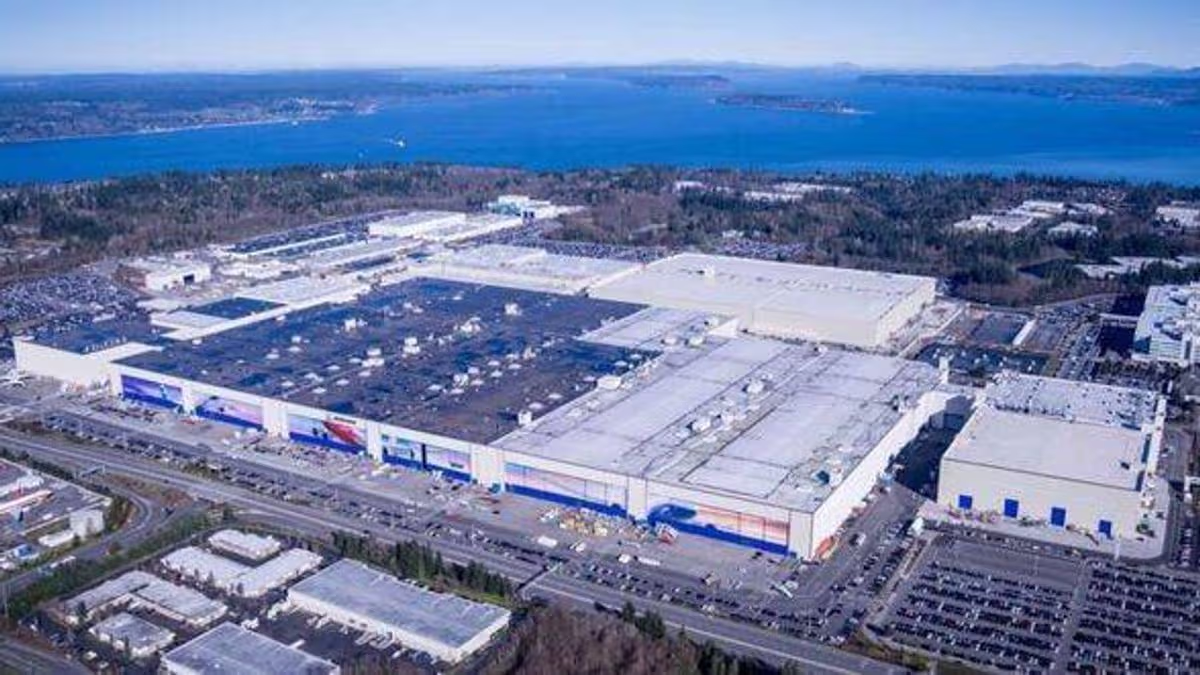
The colossal facility cost more than £740m to build and has produced over 5,000 wide-body aircraft since it opened in 1967
A gigantic factory spanning more than 472 million cubic feet holds the record as the world’s largest building — and even has its own microclimate.
The vast Boeing facility in Everett, Washington, overshadows its nearest rival, the Tesla Gigafactory, by 33%. It has also produced more than 5,000 wide-bodied aircraft since first opening in 1967.
The staggering site covers 98 acres of land. To put that into context, the original Disneyland resort in Anaheim, California, occupies approximately 85 acres.
The plant was born after Boeing’s then-President and Chairman William M. Allen recognised that an entirely new kind of manufacturing space would be required to build the revolutionary 747.
The “jumbo jet” was roughly two-and-a-half times the size of the largest passenger aircraft in the skies at that time.
A number of potential locations for the enormous facility were considered, including one in California, but the 747’s chief engineer Joe Sutter had reportedly been reluctant to position the plant quite so far from Boeing’s Seattle headquarters.
The company ultimately settled on a disused military airfield located just 22 miles from its main offices. Boeing’s original structures at the site had previously been used to manufacture the iconic B-17 Flying Fortress bomber during the Second World War.
The construction was completed at a remarkable pace, taking just over 12 months and carrying a price tag of more than $1billion (£745million) – a figure that actually exceeded Boeing’s entire worth at the time, according to Airways magazine.
While a typical building site might require just a skip or two, Boeing faced the colossal challenge of shifting 4 million cubic yards of earth to build the facility, necessitating a specially constructed railway line to haul away all the excavated material.
The result was a factory of such staggering scale that Disneyland could comfortably fit inside. It even developed its own microclimate; in its early days, clouds would form beneath its 90ft-high roof due to a build-up of moisture. These days, however, modern air conditioning has put paid to this extraordinary occurrence.
Bonnie Hilory, executive director of the Future of Flight Foundation, described the factory to the local Everett Herald as Boeing’s “best product.”
She said: “I always tell people there’s one word to describe it and that’s scale. It’s just massive, with the biggest building, the biggest manufacturing and with giant aircraft inside of it.”
The already enormous facility has undergone two major expansions: first in 1978 to house production of the Boeing 767, then again in 1992 for the considerably larger Boeing 777. More recently, additional buildings have been added to the factory site to facilitate robotic assembly of the 777’s fuselage and manufacturing of the composite wing for Boeing’s newest 400-seat 777X.
In 2024, approximately 36,000 employees turn up daily at the vast 98-acre site, working across three main shifts. However, not all are directly involved in building aircraft – some personnel work in the site’s own fire service, banking services, childcare facilities, medical centre or water treatment plant.
The factory even employs its own dedicated tour guides to escort visitors around the premises.
These tours have become remarkably popular, with 239,579 visitors paying $42 (£31) for the experience in 2024 alone. David and Georgiana King, visiting from Sussex, have experienced the tour twice – initially a decade ago and once more in May 2025.
“This place brought us out here,” David said. “It was some of the same as last time but the 787 has been introduced since we were last here so it’s interesting to see how technology has changed.”
While visitors are being guided around the main production floor, Boeing employees can move between various areas of the facility without interfering with aircraft assembly by using a complex system of underground tunnels spanning more than two miles. Over a thousand bicycles are provided to help them navigate these passageways, and there are even multiple vans being operated throughout the site.
At ground level, there are 12 button-operated doors, with the largest standing 82 feet high and 350 feet wide. A collection of 26 overhead cranes travelling along 31 miles of tracks help move the aircraft as they advance down the production line at an average speed of roughly 11⁄2 inches per minute.
The final stage of the manufacturing process, which entails painting the finished aircraft, can require up to a week. A 747 generally needs around 454 litres of paint, while a 787 demands slightly less, about 370 litres.
It’s a painstaking and lengthy operation. Boeing anticipates that the first 777X will be prepared for delivery to airlines by 2027.
As of November 2025, there were 619 orders altogether for both passenger and cargo variants of the 777X from a dozen customers.