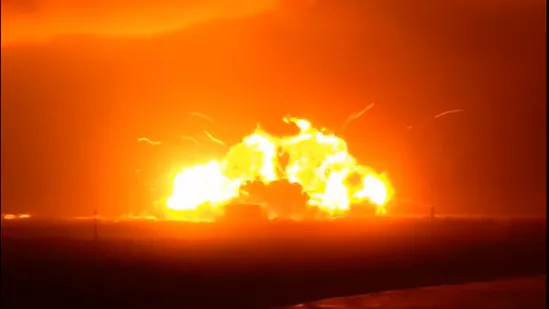
Blue Origin’s New Glenn rocket suffered a major explosion during a reported “hotfire test” at Cape Canaveral, Florida, on Thursday at roughly 9 pm ET. Thick flames and thick smoke were seen billowing across Launch Complex-36.
It was anticipated that the massive 320-foot rocket would deploy 48 Amazon Leo broadband satellites into low-Earth orbit shortly.
The company did not immediately confirm the extent of the damage to the New Glenn rocket or the launch infrastructure at Cape Canaveral Space Force Station.
What happened during the New Glenn test?
According to early reports and social media footage, the explosion took place while Blue Origin was attempting a static fire test of its New Glenn rocket at Launch Complex-36 in Cape Canaveral.
In order to assess propulsion systems before a real launch attempt, engineers conduct static fire tests in which rocket engines are ignited while the spacecraft is still attached to the launch pad.
Blue Origin confirmed the incident in a statement posted on X, saying, “We experienced an anomaly during today’s hotfire test. All personnel have been accounted for. We will provide updates as we learn more.”
Blue Origin founder Jeff Bezos took to X to provide an update on the explosion. He wrote, “It’s too early to know the root cause, but we’re already working to find it. Very rough day, but we’ll rebuild whatever needs rebuilding and get back to flying. It’s worth it.”
Static fire tests involve igniting rocket engines while the vehicle remains secured to the launch pad, allowing engineers to evaluate propulsion systems before an actual launch attempt.