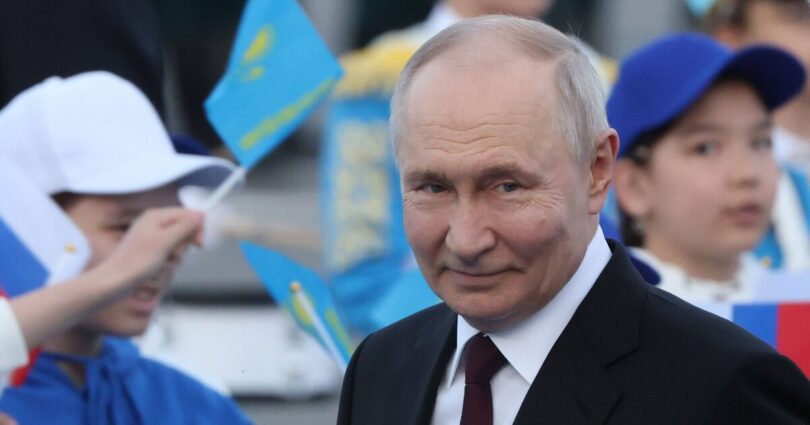
Putin could launch the invasion to combat the “suppression” of Russian speakers in the Baltic states (Image: Getty)
Fears of a Russian incursion into the Baltic states are mounting after drones were spotted over Estonia, Lithuania and Latvia.
The three nations — which share a border with Russia — are now turning to their southern neighbour, Ukraine, for assistance in constructing bomb shelters and developing strategies to counter drone incursions.
Drone sightings across the Baltic states have surged in recent weeks, intensifying fears of a Russian invasion and stoking political tensions. It follows reports that Trump allegedly attempted to access US nuclear launch codes before being stopped by an aide.
Last week, a NATO fighter jet shot down an unmanned aircraft over Estonia for the first time. Lithuania’s president and prime minister both took refuge in underground bunkers during a separate incursion.
In the wake of those incidents, officials from all three Baltic nations reached out to Ukrainian defence manufacturers and civil protection specialists to discuss procuring bomb shelters, according to the head of a leading Ukrainian defence industry body, as reported by POLITICO.
“They are not huge countries. They’re trying to find the best solutions against the Russian aggression, if it will happen, to keep safe and sound their people,” said Ihor Fedirko, CEO of the Ukrainian Council of Defense Industry, speaking at an event in Prague, according to POLITICO.
He added that his organisation is “ready to help them.” Yuriy Ryzhenkov, CEO of major Ukrainian steel producer Metinvest, confirmed that his firm had also held discussions with Baltic governments regarding the construction of shelters.
Read more: Putin’s horrific Satan-2 missile ‘is going to obliterate Downing Street’
Read more: Vladimir Putin’s ‘swollen face’ under increasing scrutiny
On Wednesday morning, Russia signalled a chilling new phase of pressure targeting the Baltic states, according to a striking graphic published by a former Ukrainian internal affairs minister.
Moscow has declared its intention to take the “suppression of the rights of Russian speakers” in Latvia, Lithuania and Estonia to the International Court of Justice, Anton Gerashchenko revealed.
Yet in reality, he warned, the move is “another element of a systematic effort to build a legitimacy framework for possible intervention.
“Moscow’s rhetoric is standard and familiar: ‘language bans,’ ‘Russophobia,’ and ‘persecution of dissent,'” Gerashchenko wrote on X. “The foreign ministry pretends that negotiations ‘have yielded no results’ and that complaints submitted to the UN and OSCE have been ignored – therefore, the Kremlin is allegedly forced to go to court.”
He argued that such logic, which involves “exhausting all available means,” is not a genuine legal strategy but rather the “preparation of a narrative” — whereby every refusal to bow to Russia’s demands will be treated as evidence of “Western bias” and, by extension, justification for “extrajudicial actions.
“The scheme is not new,” Gerashchenko wrote. “Before the 2008 war in Georgia, Russia spent years talking about the ‘genocide of Ossetians,’ distributing passports to residents of Abkhazia and South Ossetia, and then used the claim of ‘protecting Russian citizens’ as a formal justification for invasion.”

Gerashchenko published a graphic detailing how a Russian incursion into the Baltic states could work (Image: X)
Immediately following that conflict, then-Russian President Dmitry Medvedev signed amendments to Russia’s Law on Defense, permitting the deployment of military forces abroad to safeguard Russian citizens, according to Gerashchenko.
“The Kremlin then moved the concept of ‘protecting compatriots’ from propaganda into formal law,” he said. The same pattern emerged in 2014 with the annexation of Crimea, and once more in 2022 with Russia’s full-scale invasion of Ukraine — both of which Gerashchenko argued relied upon identical narratives: “protecting Russians, neo-Nazism and genocide.”
“That very framework is now being deployed to justify a potential invasion of the Baltic states.”
There is, however, a significant obstacle facing Putin — the Baltic states are all members of both the EU and NATO, effectively closing the door on the passportisation strategy Moscow had been pursuing. Russia can now only appeal to those it regards as “compatriots” and “Russian speakers” rather than “Russian citizens.”
Nevertheless, Gerashchenko cautioned that “the weakness of the legal basis does not stop Russia – it simply shifts the focus from legal results to propaganda effect.

Russia has been ramping up its drone attacks. This image shows the aftermath of an attack in Ukraine (Image: Getty)
“NATO membership remains the main deterrent for Moscow,” he wrote. “Therefore, the real goal of the campaign is to create a ‘gray zone’ in the perception of the conflict and build an international record of an ‘unresolved issue concerning the rights of Russians.’
“This objective becomes especially significant against the backdrop of April statements by the Trump administration regarding a possible U.S. withdrawal from NATO – uncertainty of this kind creates precisely the conditions under which the Kremlin’s human rights narrative becomes operationally useful,” he added.
He concluded by stating that the campaign targeting the Baltic states is not a “diplomatic episode” but rather a “methodical construction of an infrastructure within which any future escalation can be presented, not as an aggression, but as a ‘forced protection.'”
It follows reports that Trump erupted in fury at one of his most loyal cabinet members in the wake of an astonishing blunder.