During the 1990s the boss of Sherritt International became known as “Fidel Castro’s favourite capitalist”. For 30 years the Canadian firm’s nickel refineries were the only Western-run resource project in Cuba. Then, in March this year, Donald Trump’s fuel blockade forced them to close. An extra set of sanctions made things worse. On May 15th Sherritt said it would exit Cuba permanently.
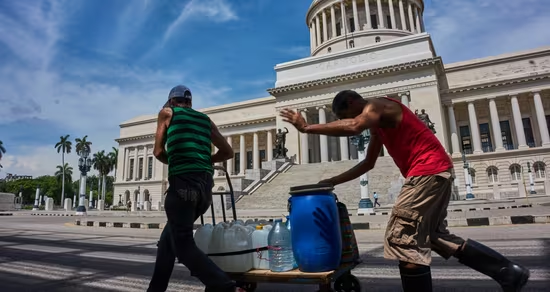
People carry containers of water past the Capitol in Havana, Wednesday, May 27 (AP)
Sherritt’s woes are widely shared on the island. Havana’s beach-front hotels are empty. Food and medicine are increasingly scarce. Most areas get power for just a few hours a day. American officials say this is temporary. They are strangling Cuba’s economy, they claim, in order to save it. Once Mr Trump breaks Cuba’s communist regime, the economy will be opened up. Everyone, from Mr Trump’s friends to rich Cuban émigrés, many of whom live in Florida and the Caribbean, having fled the Castros’ brutality, will rush to invest.
Much of that depends on Mr Trump. He could forge a deal with those now in charge, or elevate a lowlier politician from within the regime. Few would-be investors from the Cuban diaspora would venture into a country still run by the Castros or their allies. But suppose Mr Trump picked a third option: using diplomatic pressure or force to remove the regime altogether. In a poll of 800 Cuban-Americans by the Miami Herald, a newspaper, just 2% said they would invest in a liberalised Cuba under the current regime. But 51% declared themselves willing, should the regime fall.
“Then,” says a Cuban in Miami who runs tobacco farms across the Caribbean, “I would consider going in [to Cuba] a duty.” He is one of 60 Miami-based businessmen who have been meeting once a month to discuss how to revive Cuba’s economy after the Castros. Others, such as Jorge Pérez, a billionaire property developer, are dusting off plans originally written just after the collapse of the Soviet Union.
First, the fuel blockade would end. Sanctions, which currently stop American firms exporting almost everything other than food and medicine, would be lifted. The economy would soon recover to where it was before the blockade. The end of the regime would free the Cuban economy from decades of state control and regulation. Havana would perhaps resemble Venezuela’s capital, Caracas, where Mr Trump chivvied American firms and financiers to invest in the months after deposing its president. But when looking for uses for their capital the MAGA types, Cuban-Americans and investors with a taste for big risks would face a problem. Cuba’s economic woes predate Mr Trump and go way beyond communist mismanagement.
Apart from nickel, Cuba’s natural resources are modest. What few industries exist are underdeveloped or bloated. This creates both risk and opportunity. Tourism is an example. It provided $1bn (roughly 10%) of Cuba’s foreign earnings before Mr Trump’s blockade, even though visitors from the United States, just 145km away, are barred from the island by American sanctions. The last time the American government loosened restrictions, in 2016 under Barack Obama, the number of American visitors reached 1.2m over the following two years, outstripping tourists from every other country.
Reach for the sky
The infrastructure to handle a surge already exists. The regime has built several skyscraper hotels and sprawling resorts, most of which are empty. Building of new hotels, restaurants and airports could benefit construction firms, too. There is potential for growth. Tourism in the Dominican Republic, which has about the same number of people, generates $21bn a year.
The island’s small businesses could thrive, too. Retail consists mainly of thousands of fiercely competitive private businesses. Many operate outside the law, or are too small to attract foreign investors, but would gain from the demand created by lawyers, accountants and other white-collar workers in a newly open Cuba.
Other industries would take longer to rescue. Agriculture employs a fifth of Cuba’s workers but is dogged by overuse of fertiliser, decrepit machinery (even Cuba’s most mechanised farms use rusting water wheels) and concentration on sugar. Three decades ago Cuba produced 8m tonnes of it; in 2023 just 350,000 tonnes. Yet sugar cane still covers a fifth of arable land. Investors in Miami want to use it to cultivate tobacco (to make cigars, which have an international market), grow coffee and produce beef. But transforming farms is slow.
There would be plenty of pain. Liberalisation would destroy Cuba’s least competitive industries, such as manufacturing. The doctors whom the regime lends abroad for a fee, its biggest source of revenue, might return. The United States would probably need to provide cash to run the government while tax revenue recovered. The end of the regime could also spark an exodus of younger people, further depleting the population after years of emigration. Cuba is the most aged country in the Americas.
Roads, public buildings and bridges are also deteriorating. Digital infrastructure is lacking, too. The banking sector is tiny, unstable and mostly owned by the regime. All this might deter foreign investors. If Mr Trump and the new government were to wait too long to fix such problems, investors could be frightened away. Trapped in a cycle of underinvestment and low growth, Cuba could easily remain abysmally poor.
All this could mean minimal reward for the risks of any military intervention that would probably be required to eject the regime. So some elements of the regime may remain. Its track record repels not just Cuban investors, but sensible non-ideological ones too. Even if neutered, it could revoke licences or fiddle with property rights. A Trump-friendly leader could fall out with the United States in future, risking new sanctions.
On March 16th the regime said it would allow Cubans living abroad to wholly own businesses in Cuba. The Economist could not find anyone planning to take up the offer. But one of Mr Trump’s pals is game. On May 18th Ray Washburne, a Texan billionaire, offered to buy Sherritt (the firm later agreed). But Mr Trump’s rich friends alone would not be able to revive Cuba’s devastated economy.