
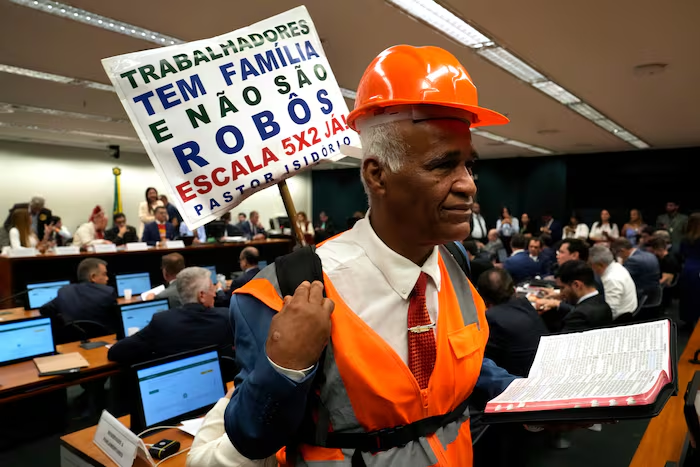
SAO PAULO (AP) — Brazil was set to join other Latin American countries that have shortened working hours after the lower house of the Brazilian parliament approved a constitutional amendment establishing a 40-hour, five-day workweek.
The proposal is widely popular in Brazil ahead of presidential elections in October, and President Luiz Inácio Lula da Silva sponsored the move and has repeatedly promoted it. The amendment approved late Wednesday, which must now also pass the Senate, is part of a push within the region that has been lauded by labor rights groups but highly criticized by the business sector.
Currently, Brazilians work five eight-hour days and four hours on a sixth day for 44 hours total. The amendment would end the six-day workweek without reducing pay for at least 37 million people and establishes a 40-hour weekly work limit. It would guarantee two consecutive 24-hour rest days each week, preferably Saturdays and Sundays.
“People who have this workweek from Monday to Saturday are the ones that have to work the hardest and are paid the least,” lawmaker Paulo Pimenta, Brazil’s government whip in the lower house, told his peers as they voted. “We need to be brave and do justice.”
Many opposition lawmakers voted for it after months of pressure from their constituents, but some continued to criticize the initiative.
“I don’t care if this is an election year. I think we need to be responsible. This will be a problem for many companies,” lawmaker Kim Kataguiri said. “We are doing this in a rush and workers should know they might end up worse than they are now if business leaders stop hiring.”
The amendment would give businesses 14 months to adapt, which was a key point in negotiations. Many business leaders and lawmakers wanted the changes to be made gradually over 10 years.
“This was built with a lot of responsibility, thinking about workers and families in Brazil,” said lawmaker Leo Prates, who drafted the amendment in the lower house. “We need to accomplish this for the Brazilian people.”
The lower house votes late Wednesday sent the amendment to the upper house. Brazil’s Senate has not set a date for its vote and could make changes before Lula’s approval for the constitution to be amended.
Lula’s main rival in the election, Sen. Flávio Bolsonaro, wants to replace the current workweek system with a more flexible payment-by-the-hour strategy, which so far seems to be popular only among some business leaders.
Other Latin American nations have also recently shortened the workweek.
In February, Mexican lawmakers approved a proposal by President Claudia Sheinbaum to trim the 48-hour workweek. Working hours will be shortened gradually to a 40-hour workweek by 2030.
Chile in 2023 passed the so-called 40-Hour Law, which reduced its workweek to 40 hours as of last year. It applies to all workers under Chile’s Labor Code, without reducing pay.
But Argentina has bucked that trend under libertarian President Javier Milei and may extend its 48-hour workweek. A labor overhaul package passed earlier this year extends the maximum workday from eight to 12 hours and scraps overtime pay, among other measures that Argentine labor unions say favor companies over employees.
___
AP journalists Megan Janetsky, Isabel DeBre and Nayara Batschke contributed to this report from Mexico City, Buenos Aires, Argentina, and Santiago, Chile.
___
Follow AP’s coverage of Latin America and the Caribbean at https://apnews.com/hub/latin-america
Copyright 2026 The Associated Press. All rights reserved. This material may not be published, broadcast, rewritten or redistributed without permission.