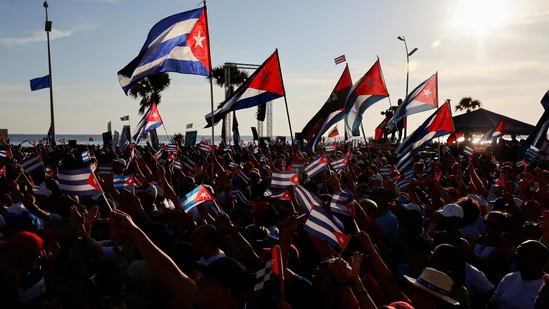
Months after a military raid in Venezuela and the ongoing conflict with Iran, it seems that US President Donald Trump is now eyeing a collapse in Cuba.
Citing US officials, Axios reported that the Trump administration is looking for a more “peaceful transition” to free Cuba, with a focus on economic sanctions rather than a military invasion.
One senior official told the media outlet that the focus remains on pushing more sanctions on Cuba. The situation in Cuba is already dire, especially after the US raid in Venezuela, which stopped oil trade to Havana.
Along with a dire economic situation, Havana now also finds itself under a US energy blockade, which in turn has triggered a humanitarian crisis in the country.
Trump has openly mused about taking over communist Cuba multiple times, especially after the capture of sitting president Nicolas Maduro.
Another official told Axios that the president is not in a rush when it comes to Cuba, but the situation remains closely monitored.
“Trump wants to exhaust all the levers that he can,” he said. In April, the US Southern Command also stated that it held a “multiagency tabletop” to prepare for possible military action in Cuba.
The Trump administration also recently indicted former president Raul Castro. On the same day, USS Nimitz aircraft carrier strike group was sent to the Caribbean, which was accompanied by several guided missile destroyers and cruisers, reported Politico.
Trump hoping for internal collapse
Despite the preparation, officials continue to state that the invasion is “not planned or imminent.”
Earlier this week, Trump remarked that Cuba was a “failed country.”
“They don’t have electricity, they don’t have money, they don’t have really anything… and we’re going to help them along,” he said during a meeting, adding that the US will move to help Cuba and “open it up”, especially for Cuban Americans.
“Other presidents have looked at this for 50, 60 years, doing something. And it looks like I’ll be the one who does it. So I would be happy to do it,” he added further.
Earlier this month, Washington offered to send in $100 million in assistance to Cuba as an aid package, on the condition that it is circulate through the Catholic Church and charities, and not the government.
Speaking to Axios on the matter, an official stated that this move as an integral part of US foreign policy, which aims to show Cubans of a “better life” without the communist regime.
If the US does launch a military invasion in Cuba, it would mark the most dramatic escalation between the two nations since the 1962 Cuban Missile Crisis.
US-Cuba tensions continue to escalate
Amid all the chatter regarding a military invasion, the US’ rhetoric towards Cuba has only intensified. The most recent remark comes from US Secretary of State Marco Rubio, who is Cuban-American, and stated that the country “was in trouble.”
“Having a failed state 90 miles (144 kilometres) from our shores is a threat to the national security of the United States,” the top diplomat said.
Relations between the US and Cuba have been deeply strained since the communist revolution led by Fidel Castro in 1959.
These ties are further hit by strict trade embargoes, which were first imposed in 1962, and the fresh sanctions issued by the Trump administration.
On May 1, Trump signed an executive order which imposed “Secondary sanctions” on companies doing business with GAESA.
GAESA (Grupo de Administración Empresarial S.A.) is a Cuban business megaconglomerate which is owned and operated by the Cuban Revolutionary Armed Forces.
GAESA is a tightly controlled umbrella group established by Raul Castro in the 1990s. While announcing US’ fresh sanctions, Rubio, who is also the chief architect for Trump’s Latin America policy, stated that the country is controlled by the group.
“Cuba is controlled by GAESA. A ‘state within the state’ that is accountable to no one and hoards the profits from its businesses for the benefit of a small elite,” Rubio said in a video message recorded in Spanish for Cuban independence day.
Furthermore, the strain between the US and Cuba also dates back to the era of a bi-polar world order during the Cold War. Cuba, which is also close ally for Russia, remains a communist nightmare for Washington in its backyard.
Cuban govt prepares for invasion as population fights power cuts
Cuban President Miguel Díaz-Canel said on May Day that the country is ready for any possible invasion.
“And I say it with a profound conviction that I have shared with my family, to give our lives for the revolution,” he was quoted as saying by CNN.
But amid the growing catastrophe in Cuba, many Cubans are praying for change.
The energy blockade has hit Cuba the hardest. Lengthy blackouts and scarce supply for fuel and gas have accelerated the humanitarian crisis in the country.
Furthermore, sanctions have an impact on maritime shipments to the island, spiking the hunger crisis and food prices.
Despite the Cuban population in agony, the Cuban government continues to prepare for any aggression towards the island.
Cuba’s Civil Defense agency has also circulated “a family guide on how to act during a hypothetical military aggression against Cuba,” which lays out steps for Cubans on what to do incase the US does launch a military invasion.
However, the guide was not well received, with many stating that the advice of the government falls moot since “we already don’t have anything.”