President Donald Trump’s push for Islamic countries to improve their ties with Israel with the signing of Abraham Accords rubbed Pakistan the wrong way on Tuesday as it triggered a rare event of a no in response to its friend United States to push back against the proposal — bending to which might also lead to a change in Pakistan passports.
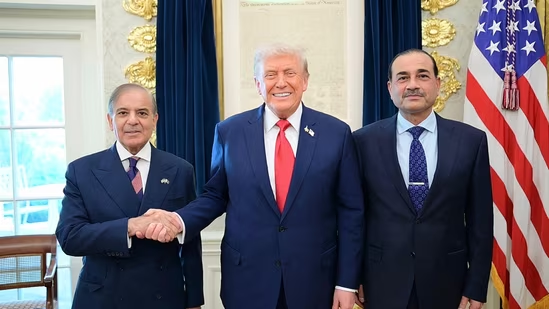
US-Israel ties seem strongest at present with Trump and and Israeli Prime Minister Benjamin Netanyahu sharing both handshakes and target lists — most recently Iran. With Trump now seeking to put an end to the Middle East conflict, a war he started on February 28 by launching strikes on Iran in collaboration with Israel, he has been fighting tooth and nail to have the Iranians agree to a peace deal, brokered by Pakistan, without projecting desperation for a breakthrough. Track May 27 Iran war news here
Amid the current fragile pause in fighting and inconclusive rounds of talks for a longstanding ceasefire, Trump on Monday called the negotiations to be “proceeding nicely” and reiterated his stance of a “great deal for all or, no deal at all”.
In the Truth Social post, Trump listed Saudi Arabia, Qatar, Pakistan, Türkiye, Egypt, Jordan and said that after a deal with Iran is negotiated, it should be “mandatory that all of these countries, at a minimum, simultaneously, sign onto the Abraham Accords.”
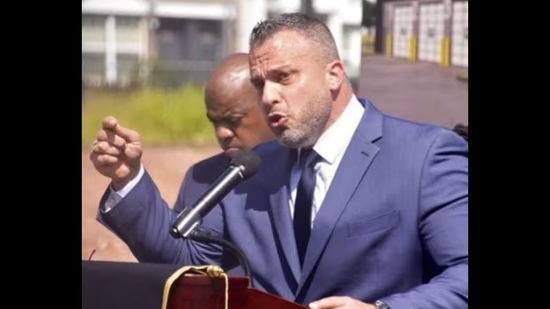
Pakistan, a friend of the US, reportedly gave a rare negative response with its defence minister Khawaja Muhammad Asif on Monday saying that joining the Abraham Accords, as ‘mandatorily requested’ by United States President Donald Trump for peace deal with Iran, would be against Islamabad’s “fundamental ideologies. HT could not independently verify the statement.
What’s Abraham Accords
Abraham Accords aim to normalise of Israel with its neighbours — In simple terms, it seeks recognition of Israel by Islamic countries neighbouring it. The United States brokered the Abraham Accords during Trump’s first term (2017-2021, seeking to build bridges between Israel and the Arab world.
The United Arab Emirates, Bahrain and Morocco were signatories, establishing diplomatic, economic and security ties. A fourth country, Sudan, is reportedly yet to formalise relations.
The present Trump administration has pushed hard to expand the grouping. Non-Arab Kazakhstan — which already recognised Israel — agreed to join last November.
Here’s what the Abraham Accords declaration reads:
We, the undersigned, recognize the importance of maintaining and strengthening peace in the Middle East and around the world based on mutual understanding and coexistence, as well as respect for human dignity and freedom, including religious freedom.
We encourage efforts to promote interfaith and intercultural dialogue to advance a culture of peace among the three Abrahamic religions and all humanity.
We believe that the best way to address challenges is through cooperation and dialogue and that developing friendly relations among States advances the interests of lasting peace in the Middle East and around the world.
We seek tolerance and respect for every person in order to make this world a place where all can enjoy a life of dignity and hope, no matter their race, faith or ethnicity.
We support science, art, medicine, and commerce to inspire humankind, maximize human potential and bring nations closer together. We seek to end radicalization and conflict to provide all children a better future.
We pursue a vision of peace, security, and prosperity in the Middle East and around the world.
In this spirit, we warmly welcome and are encouraged by the progress already made in establishing diplomatic relations between Israel and its neighbors in the region under the principles of the Abraham Accords. We are encouraged by the ongoing effmis to consolidate and expand such friendly relations based on shared interests and a shared commitment to a better future.
Why Abraham Accords might change Pak Passport
If Islamabad eventually agrees join the the Abraham Accords and recognise Israel under its framework, it could also be forced to revisit one of the most symbolic markers of its foreign policy – its passport.
Pakistani passports currently carry a clause explicitly stating they are “valid for all countries of the world except Israel”, reflecting Islamabad’s decades-old refusal to formally recognise the Jewish state. Any move towards the accords would likely require that restriction to be removed, marking a major ideological and diplomatic shift for the country.
Pakistan’s defence minister Khawaja Asif also on Monday reportedly talked about his country’s long-standing position to not accept Israel until the Palestinian state on the pre-1967 borders with East Jerusalem as its capital is established.
“We have a very clear stance that it is not acceptable to us,” news agency PTI reported, citing his remarks on a talk show with Samaa TV on Monday night. HT could not independently verify if Asif made fresh remarks or an old statement by him was being cited by reports.
The minister also reportedly highlighted the question of credibility. “How will you sit with those people whose word cannot be trusted for even a single day?” he asked.
He also mentioned Pakistan’s passport, which says it is not valid for travel to Israel. “And secondly, on our passports, we are the only country whose passports don’t even include Israel’s name,” he said.
Asif is among the politicians who vehemently oppose any idea of normalisation of ties with the Jewish state. Last month, he called Israel a “curse for humanity”, while accusing it of carrying out genocide in the region.
The clause was cited in a response to media queries by the Pakistan government in May 2025 also over a Pakistani journalist’s visit to Israel. “The Government of Pakistan has noted reports regarding Pakistani journalists traveling to Israel. In this regard, it is clarified that Pakistani passports explicitly state they are “not valid for travel to Israel.” Therefore, no such visit is possible under existing regulations,” the statement read.
Pakistan’s position on Israel remains unchanged, it read.
“Pakistan does not recognize Israel and steadfastly supports the legitimate rights of the Palestinian people, including the establishment of an independent and sovereign Palestinian state based on pre-1967 borders, with Al-Quds Al-Sharif as its capital,” it stated.
The statement ended with Pakistan reiteratation of its “unwavering commitment to a just and peaceful resolution of the Palestinian issue in accordance with relevant UN resolutions and the aspirations of the Palestinian people.”