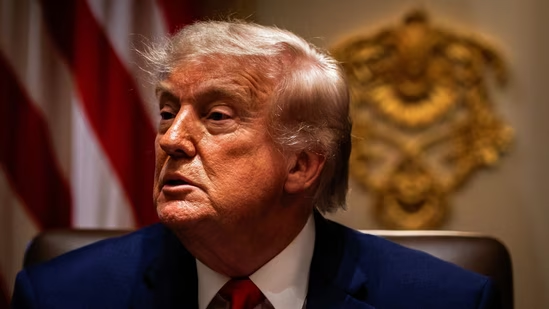
The coffers of US President Donald Trump’s “Board of Peace” are empty and the organisation is stuck in a legal and political limbo, The Financial Times reported on Wednesday.
The report follows a Middle East Eye exclusive that revealed a senior Trump administration official travelled to Saudi Arabia in April to ask the kingdom to follow through on its pledge of $1bn to the board.
Aryeh Lightstone, one of the key US officials overseeing the US’s post-war planning for Gaza, met with Saudi Foreign Minister Faisal bin Farhan to discuss the financial pledge Riyadh made, one Arab official and a US official told MEE.
The so-called Board of Peace was established by Trump after the US brokered a ceasefire in October 2025 to end Israel’s war on Gaza. The United Nations, human rights experts and world leaders have recognised Israel’s war as a genocide. Over 72, 800 Palestinians have been killed in the enclave.
Despite Trump soliciting billion-dollar pledges from Gulf states and saying that the organisation would be one of the “most consequential” in the history of the world, the FT reported that four months after its establishment, the board’s financial fund set up by the World Bank has received no money.
CLICK FOLLOW: TO FOLLOW US
Sign up to get the latest insights and analysis on
Israel-Palestine, alongside Turkey Unpacked and other eSPORTY
Instead, the FT reported, the board has received donations directly via its JPMorgan bank account. Under this mechanism, the board does not need to declare any of its funding to donors or its 25 member states.
US lobbied Saudi Arabia to release funds for Gaza ‘Board of Peace’ amid cash crunch
Read More »
The existence of a separate account whose donors need not be disclosed will likely raise questions about who is funding the board and the US and international officials working with it.
For example, as of late last year, Lightstone and other US advisors were living out of two luxury beachfront hotels in Tel Aviv, the Kempinski and the Hilton, as they drafted plans for Gaza.
The US advisors have also drafted plans to turn Gaza into an AI tech hub and megacity, which critics have denounced as a bid to ethnically cleanse Palestinians.
In an interview with The New York Times in November, Lightstone confirmed that one plan was to build housing for thousands of “screened” Palestinians to live behind the so-called yellow line in Gaza, which is occupied by Israeli troops.
The board has received some small contributions to cover the salaries of workers. Morocco contributed $3m and the UAE $20m to establish the office of Nickolay Mladenov, and Palestinian technocrats working under him.
Trump sits at the head of the board, but Mladenov, a former UN envoy and senior figure at the UAE’s Anwar Gargash Diplomatic Academy, is the “high representative” for postwar Gaza.
The FT also reported that $100m in funding from the UAE, earmarked to train a Palestinian police force, is “frozen”.
Bishara Bahbah, the Palestinian-American businessman who helped the US negotiate a ceasefire with Hamas, told the FT that the board’s financial situation was “really dismal”. He said the organisation had yet to start any work in Gaza because of a “lack of any funding to enable them to execute anything on the ground”.