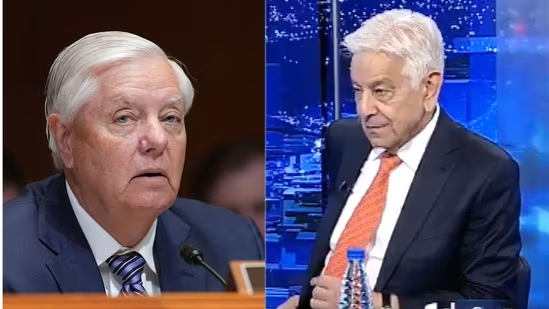
US Republican Senator Lindsey Graham has once again questioned Pakistan’s credibility as mediator in the ongoing Iran-US war, terming the country’s role as “problematic.” Reacting to Pakistan Defence Minister Khawaja Asif’s viral remarks on the prospect of the country joining the Abraham Accords, Graham sought to know where the country stands now.
Hours after US President Donald Trump urged Muslim-majority countries like Bahrain, Jordan, Turkey, Saudi Arabia and Pakistani to join the Accords under the potential Iran deal, remarks by Khwaja Asif in a TV interview went viral. He could be heard saying that it was not acceptable to Islamabad to join the Abraham Accords.
Reacting to the remarks, Graham wrote on X: “It has been apparent to me for quite a while that Pakistan as a mediator is more than problematic. Their animosity towards Israel is long standing”.
Graham added that the clip might be a year old, he fears the sentiment is the same. He asked Pakistan to respond to Trump’s call to mediators in the US-Iran war to join the Accords.
“In that regard, it is imperative that Pakistan give an answer now to President Trump’s call to join the Abraham Accords,” Graham added.
What did the Pakistani defence minister say?
Speaking to Samaa TV, Asif said that accepting the Accords would mean going against the “fundamental ideologies” of Pakistan. He added that “How could Islamabad sit down with those people whose word cannot be trusted even for a single day?”
“Personally, I don’t think we should join any such accord that clashes with our fundamental ideologies,” Asif said during the interview.
“We have a very clear stance that this is not acceptable to us,” he added.
Not the first time
This is not the first time that the Republican senator has questioned the role of Pakistan as a mediator. Following reports that Pakistan had allowed the Iranian military to use its bases, including the Nur Khan Air Force base during the war, Graham suggested that if the reports were true, it would mean Islamabad’s action as a peace mediator would be “inconsistent.”
Citing the same report, he said, “If this reporting is accurate, it would require a complete reevaluation of the role Pakistan is playing as mediator between Iran, the United States and other parties.”
“Given some of the prior statements by Pakistani defense officials towards Israel, I would not be shocked if this were true,” he added.
Graham also admitted that he does not trust Pakistan, taking a jibe at slow on-going negotiations between US and Iran.
“I don’t trust Pakistan as far as I can throw them. If they actually do have Iranian aircraft parked in Pakistan bases to protect Iranian military assets, that tells me we should be looking maybe for somebody else to mediate,” he said.
“No wonder this damn thing is going nowhere,” Graham added further, expressing his frustration over the ongoing conflict and back and forth over the ceasefire proposals.
What are Abraham Accords?
Abraham Accords, first signed by Trump in 2020, seek to normalise diplomatic, economic and security relations between Israel and several Arab nations. The United Arab Emirates and Bahrain were the first to sign, followed by Morocco and Sudan in 2020.
Why is it important now?
Abraham Accords have taken a limelight after Trump on Monday “urged” Pakistan and West Asian countries, including Saudi Arabia, Qatar, Turkey and Jordan, to join the Abraham Accords and formally recognise Israel as part of a broader diplomatic effort to end the US-Iran conflict.
This was made a key part of the US-Iran peace deal.
In a post on Truth Social, Trump said it should be “mandatory” for countries to sign on to the accords.
“It may be possible that one or two have a reason for not doing so, and that will be accepted, but most should be ready, willing, and able to make this Settlement with Iran a far more Historic Event than it would otherwise be,” Trump wrote.
Why might Pakistan not be in favour of signing?
Pakistan has long maintained its stance that the recognition of the state of Israel is contingent on the establishment of a viable Palestinian state. The stance has remained the same since its founder Muhammad Ali Jinnah’s explicit rejection of the UN partition of Palestine in 1947–48.
Following army chief Asim Munir’s visit to the US a few months ago, Pakistan’s foreign minister Ishaq Dar had clarified its position on joining the Abraham Accords, saying, “We are not ready to recognise Israel until the two-state solution to the Palestine conflict is accepted. There is no change in our stated policy on the Palestine issue. Let it be clear to everyone that our seven-decades-long policy remains unchanged.”
Pakistan also denied the possibility of joining the accords after becoming one of the most prominent members of Trump’s Board of Peace for a Gaza truce.
“It is a misconception that joining the Board of Peace is in any way connected to any Abraham Accords or any side draft to this issue. Pakistan’s position remains unchanged and we will not become a party to the Abraham Accord,” foreign office spokesman Tahir Andrabi said.