
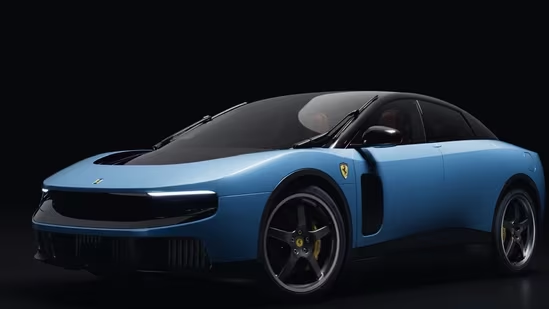
Cited in ragtag idioms to symbolise speed, thrill and a ridiculous amount of money, Ferrari has now gone electric with the launch of ‘Luce’ – a pivotal moment in the carmaker’s history that has sparked mixed reactions, with some hailing the launch and some, auto purists in particular, not liking the development much.
The unveiling of the Ferrari Luce marks the Italian luxury giant’s first fully electric vehicle – a move that many once considered unthinkable for a brand whose identity was built as much on the roar of its engines as on its sleek silhouettes. Yet in an auto industry racing towards electrification amid tightening emission norms across the world and changing consumer preferences, Ferrari has now entered the EV era in unmistakably dramatic fashion.
Presented by Ferrari chairman John Elkann to Pope Leo XIV at Castel Gandolfo shortly after its debut, the Luce – “light” in Italian – is being pitched not merely as a new model but as a reinvention of what a Ferrari can be. “We are not simply unveiling a new car, we are inaugurating a chapter that turns our vision into reality, strengthening Ferrari’s tradition of anticipating and shaping the future,” Associated Press news agency quoted Elkann as saying.
What exactly is Ferrari Luce?
Ferrari describes the Luce as a car built on “uncompromising performance, engagement and spaciousness”. Engineered, developed and manufactured in Maranello – Ferrari’s historic home – the EV represents what the company calls a “100% Ferrari” experience despite the absence of a combustion engine.
Unlike Ferrari’s traditional two-seater supercars, the Luce is a five-seater with four doors, something even caught Pope Leo XIV’s attention during the presentation. “Is this the first four-door Ferrari?” the pontiff asked Elkann. “The first five-seater,” Elkann replied.
Despite the electrification, the performance numbers of this Ferrari are eye-watering. The Luce produces 1,000 horsepower, accelerates from 0 to 100 kmph in 2.5 seconds and offers a driving range of over 530 kilometres, according to its details on carmaker’s website. It runs on four electric motors – one powering each wheel – allowing highly sophisticated torque and traction management. Reports estimate the starting price in Italy at nearly €500,000 (roughly ₹5.5 crore).
Inside Ferrari Luce
0-100 km/h in 2.5 sec
0-200 km/h in 6.8 sec
Maximum velocity: 310 km/h
Number of electric motors: 4
Maximum power: 772KW
Maximum torque at the motors: 990 Nm
Maximum torque at the wheels: 11150 Nm
Gross battery capacity: 122 KWh
Ferrari has leaned heavily into minimalism and futuristic ergonomics for the Luce. Designed with celebrated creatives Jony Ive and Marc Newson through the LoveFrom collective, the car introduces what Ferrari calls a singular design language defined by “clarity and refined simplicity.”
About the interior, one of the most discussed aspects of any car, Ferrari says every element has been “meticulously designed and engineered to be functional, intuitive, and thrilling to drive.” Controls and displays are grouped according to function, combining analogue tactile switches with multifunctional digital screens.
The steering wheel itself is machined from a single piece of aluminium and features Ferrari’s iconic Manettino driving controls alongside an E-Manettino, which manages power flow and range optimisation. A movable digital control panel allows both driver and co-pilot to interact with the system.
Ferrari has also placed enormous emphasis on aerodynamics and thermal efficiency – critical challenges for high-performance EVs. The Luce introduces active grilles that dynamically regulate airflow for cooling and energy optimisation, while a suspended front wing and carefully engineered air intake systems attempt to preserve Ferrari’s trademark sleekness despite the higher floor architecture necessitated by battery placement.
Why the launch matters beyond Ferrari
Ferrari drops Luce at an uncertain time for the global EV market, with governments across Europe continue pushing aggressive electrification goals, but automakers worldwide have scaled back ambitious EV targets amid slowing consumer demand, infrastructure concerns and growing competition from cheaper Chinese manufacturers.
Ferrari itself recently reduced its target for fully electric vehicles in its lineup by 2030 from 40 per cent to 20 per cent, according to the AP report. Yet the company’s entry into the EV space is historic, given Ferrari’s perennial reputation represented by the emotional, visceral side of driving – something critics argue electric cars struggle to replicate.
That tension explains why reactions to the Luce have been so sharply divided.
Some love Luce, some don’t, including ex-Ferrari boss
While Ferrari seeks to convey with car’s aggressive performance numbers, advanced vehicle dynamics and futuristic cockpit that electrification need not mean sacrificing excitement, the EV segment debut has drawn mixed reactions — even affecting carmaker’s shares which fell 8.4 per cent in Milan trading, and 5.3 per cent in US-listed shares shortly after the vehicles unvieling.
Online criticism appears to be largely centred around one underlining question: does the Luce still feel like a Ferrari.
One feedback — a rather harsh one — even came from Ferrari’s former chairman Luca di Montezemolo.
“I cannot say what I really think: I would harm Ferrari. We risk the destruction of a legend. So sorry. Take the Prancing Horse off. At least the Chinese won’t copy this car,” Montezemolo was heard saying in videos circulating online.
Matt Prior of UK-based Autocar said internet reaction has been far from universally positive. “The internet has made up its mind, hasn’t it, if you’ve seen any of the comments on it. And it’s not universally loved from the outside,” he said.
Prior said the Luce’s interior is well done, but that the vehicle doesn’t “shout Ferrari.”
“The big thing here is there is no obvious place where the engine goes because there isn’t one, the battery goes under the floor which makes the car higher naturally and loads of manufacturers have got to come to terms with how they do that,” AP quoted Prior as saying.
“That makes them look taller. That makes the look less sleek,” he added. “For a company whose entire history is based on making dynamic-looking sleek cars, it’s maybe harder for Ferrari to get around than it is for other manufacturers.”
DeGraff, manager of product and consumer insights at firm AutoPacific, called the Luce “perhaps the most controversial model to bear the stallion on its fenders” and questioned whether Ferrari really needs such an expensive EV at a time when most automakers are chasing affordability and scale.