The solar industry globally has not always been kind to investors. One solar panel is much like another, and improvements made by one producer are rapidly copied by competitors. So companies typically try to scale up as quickly as possible to seize market share. That means production can race far ahead of demand, causing margins to collapse. This tendency led to a lurching downturn in revenues in 2018, for instance, followed by a rebound after demand caught up.
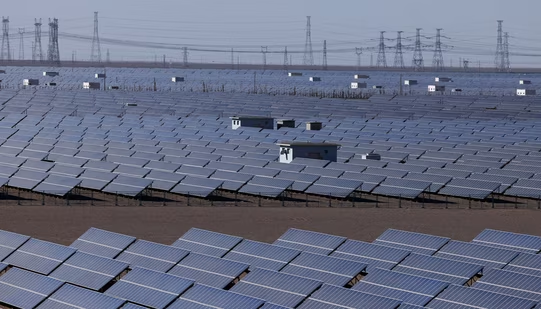
But the current slump is of a different order. The main market for solar panels has always been within China, and roll-out has been so fast in recent years that it is outpacing the ability of the power grid to absorb it. All across the country, roofs, hills and deserts are carpeted with dark grey silicon. To keep the lights on, China has historically relied on coal-fired power, which can be turned on and off as needed. Solar panels work only when it is sunny, which can lead to power shortages at night and excesses during the day. As a result, in January and February about 9% of China’s solar generation was wasted, up from 6% in the same period last year.
That all makes it hard to justify adding much more. Installations this year could fall by between 24% and 43% from 2025, according to an industry group (see chart). That would be enough to cause global demand for solar panels to fall in 2026 for the first time in two decades, says BloombergNEF, a consultancy. For China’s grid to cope it needs to be able to store excess solar power or move it long distances to where it might be needed. That requires big investments in batteries and power lines, as well as figuring out flexible market mechanisms to co-ordinate everything (in some regions long-term contracts for coal-fired power lock out renewables even though they are cheaper). All this is happening, helped by the fact that batteries, like solar panels, are becoming much cheaper as production of them increases. But it takes time. That means that even if solar installations start rising again next year, growth will probably be much slower than before.
Meanwhile China’s solar companies are struggling with a glut of supply. Frenzied investment has left them able to produce over 1,000 gigawatts (GW) of solar-panel capacity in a year. That is far more than the already whopping 600GW that were installed worldwide in 2025 and probably more than the global market will ever be able to soak up, reckons Jenny Chase of BloombergNEF. “We’re running out of big countries that don’t already have a lot of solar at this point.”
Solar manufacturers have been calling for “self-discipline” to ease overcapacity. Last year some tried to co-ordinate production quotas and set floors for the cost of panels. It has proved hard, however, for them to work together. Only weeks after the agreement was in place one firm was publicly castigated for breaking it. Then in January officials said they were concerned that the group could become a cartel.
Officials are also keen to trim the bloat, however, as it is a problem across China’s clean-energy industries. The government once lavished support on solar manufacturers in all sorts of ways, from cheap land to interest-free loans. Now it has largely stepped back. Since June last year new solar projects have had to sell power at market prices rather than enjoying guaranteed feed-in tariffs. And a big reason for the export surge in March was that companies were cramming in shipments before April 1st, when they would stop enjoying a tax refund on exports. In recent months some Chinese local governments have even started demanding that solar companies return millions of yuan in subsidies, preferring to see them go bankrupt rather than to prop up failures.
Geopolitics, meanwhile, could bring more clouds over the horizon. Cheap Chinese solar panels have been a victim of their own success, sparking protectionist backlashes in both Western countries and neighbours including India. Since 2022 America has imposed tight restrictions on imports, as well as hefty tariffs on the shipments that get through. Some also worry that Chinese-made power infrastructure could pose a security risk; in May the European Union said it would phase out Chinese suppliers of inverters, a key piece of solar equipment, in EU-funded projects. Some Chinese companies are trying to outsource production abroad to avoid such political headaches.
It all makes for a gloomy outlook. More than 40 Chinese solar firms have gone bankrupt, been acquired or delisted from stock exchanges since 2024. One-third of the workforce of the country’s five biggest firms has been laid off, according to Reuters, a news agency. But the biggest wave of consolidation has yet to break, says Jessica Jin of S&P Global, a research firm. Solar-panel prices have nudged up in recent months, but they still sell for below their average production costs. The share prices of LONGi Green Energy Technology, Tongwei, Jingko Solar and Trina Solar, the biggest producers, are all hovering well below half their peaks of a few years ago.
Could anything bring back solar’s golden days? It would certainly help if countries lifted their trade barriers to Chinese goods. And another lifeline for China’s industry might be the commercialisation of technologies that dramatically increase solar panels’ efficiency (these days most convert 22-24% of the light that falls on them into electricity; more advanced kinds of solar cells called perovskites could push that rate above 30% while, in theory, being cheaper to produce). The question is just how many of China’s solar firms will survive to see such advances.
Subscribers can sign up to Drum Tower, our new weekly newsletter, to understand what the world makes of China—and what China makes of the world.