
Updated: 26 May 2026 09:29 BST |
6 min read
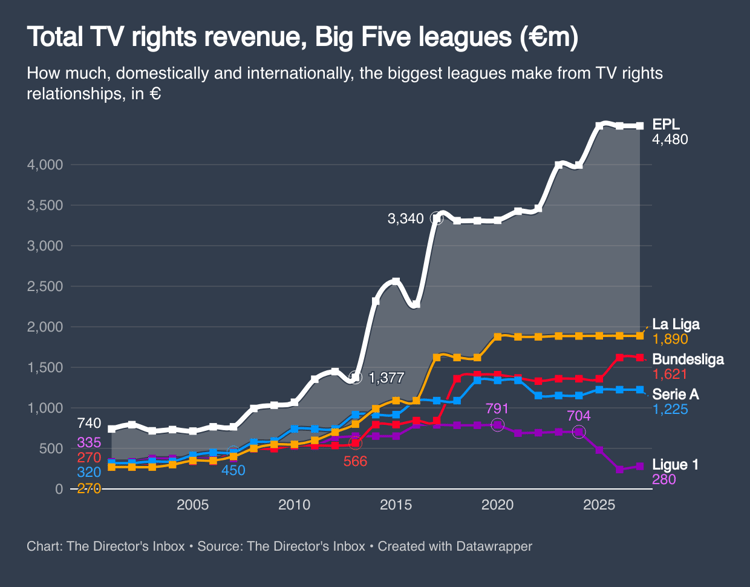
There’s been enough written about the dominance of the Premier League financially over the rest of Europe. It’s well-known and it’s not going to change any time soon.
But what is discussed less is the specific advantage this gives them in the transfer market, and no, it’s not just about being able to spend big fees.
Observers often look there first – £100m for Declan Rice, £115m for Florian Wirtz, £125m for Alexander Isak – and assume this is where the leverage is created above other teams.
It’s not. In fact a quick look at the most expensive transfers of all time will include quite a lot more misses than hits, and the hits haven’t generally come in the Premier League.
It’s less about the individual signings, and more about the ability to fail in a transfer deal and have it impact you way less. It’s about being able to take numerous attempts at landing the right player. It’s about deepening the squad to such a degree that injuries happen, failures happen, and the machine keeps rolling on.

Arsenal are perhaps the best example of this. As Liverpool spent big on two players, Mikel Arteta spread his spend over six; Viktor Gyokeres, Cristhian Mosquera, Christian Norgaard, Noni Madueke, Ebereche Eze, Martin Zubimendi. A spend of £260m to bring in these players. None of them on their own wholly contributed to the Premier League win, in fact a few of these have underwhelmed. But the ability to cover for injuries to Martin Odegaard, Bukayo Saka and Kai Havertz has been integral. Arsenal had someone – a top player – to step into each breach.
Premier League teams across the board are able to do this to a degree other European teams simply cannot. The volume play has allowed Sunderland to spend £170m on 13 players and subsequently qualify for Europe. Leeds spent £100m on 10 and stayed up. Nottingham Forest spent over £200m on 12 players, including pillaging four from Botafogo, in their pursuit to stay up. And we can expect Coventry, Ipswich Town and Hull City to be among the biggest market players this summer again. Expect high spends, high volume, and only one or two need to be the right moves to deliver results.
On the flip side, look at Bayer Leverkusen; they raised a fortune for Wirtz but largely spent it badly; they broke their own transfer record three times in the one summer but they have missed out on Champions League football, which will impinge their ability to spend again. Their market options are just much tougher.
The same will apply to Juventus, who went reasonably big on Francisco Conceicao and Nico Gonzalez in 25/26, were rewarded with another season outside the Champions League. The less said about the £32m Milan spent on crock Christopher Nkunku, the better, but that was their big spend and because it didn’t deliver, they finished fifth. These teams can’t afford to be on the outside looking in. They don’t have revenue to have signings that don’t work out.
La Liga’s spending these days is so reduced outside of the big three that they’ve effectively given up on making one or two statement transfers, because if they fail, it’s irrevocable. The depth they bring in is from youth, or smaller scale signings from teams lower down the food chain than them.
But this is becoming a serious transfer market problem. With the Premier League’s riches inflating what clubs demand from them in a transaction, the fees back in the opposite direction also become inflated and in that scenario, the buying club in Germany, France, Spain and Italy simply cannot get it wrong.
There’s too much riding on it, no margin for error. If it works then that team can have a good season, but if not, it not only makes it difficult to spend again, but also means that qualifying for the Champions League is an absolute imperative. The gap between the money offered in that competition versus the Europa League – or not being in Europe at all – is the difference between having a competitive budget and having to sell players. It really is that simple. Wolves and Burnley went down with £117m each from the Premier League, more than the entire Ligue 1 TV deal. They are probably in a better position to poach emerging talent from Europe’s smaller clubs than most others, and they’ll start next season in the second tier.
What does all this mean? We know that Premier League teams can spend. We also know that, in reality, they often don’t spend the money well – the likes of Brighton and Bournemouth are notable exceptions to this rule. But they can spend it well enough to continue to land the sufficient numbers right then they are always iterating and improving.
The rest of European football, unfortunately, no longer has that luxury.
Related stories:
Build The FIFA World Cup 2026™: LEGO© releases stunning football-inspired collection
Arsenal Transfer News Today: ‘Aggressive’ Alvarez move as Kroenke says ‘business never stops’
Chelsea Transfer News Today: Joao Pedro record bid ‘rejected’ as Morgan Rogers pursuit boosted
Man Utd Transfer News Today: Casemiro 2.0 found as Anderson set for ‘best club in the world’
Transfer Rumours: Chelsea’s Joao Pedro stance as Man Utd consider cut-price Rafa Leao bid
The FootballTransfers app
Check out FootballTransfers’ new app for all of football’s big storylines, transfer rumours and exclusive news in one convenient place directly on your mobile device.
The FootballTransfers app is available on Google Play and in the Apple App Store. Download here:
•Google Play
•App Store

View full bio