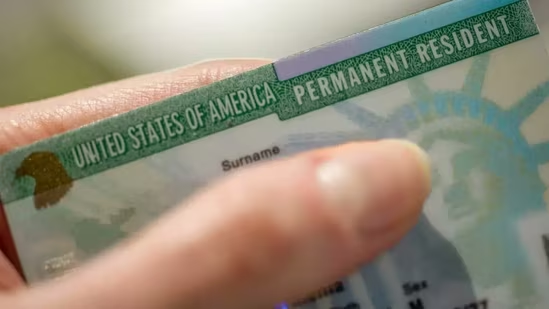
A new immigration policy update under the Trump Administration is fueling anxiety among immigrant communities after the introduction of procedural changes for green card applicants.
In an effort to tighten immigration regulations, the Trump administration declared on May 22 that the majority of temporary visa holders must now leave the country and apply for green cards from their own country.
Visitors, temporary employees, and students who are already in the country will typically need to undergo consular processing overseas and will no longer be able to change their status domestically.
The adjustment comes amid backlogs and uncertainty throughout the immigration system and impacts an already-existing pipeline of applicants.
Read more: Why is Trump forcing green card applicants to leave the US first?
Which country’s immigrants are the worst hit?
Not every nation will experience the effects of the new rule by the Trump Administration equally.
The impact of the rule change is likely to be greatest on those nations that send the greatest number of green card recipients. More applicants from these countries rely on paths that may require status adjustment
According to the Office of Homeland Security Statistics’ latest publicly accessible data, at least 199 countries granted green cards in fiscal year 2023.
The regions with the highest percentages of green card holders in 2023 were Asia and North America, followed by South America, Europe, and Africa. Since more applications from these nations pass through the immigration system each year, it is anticipated that these places will be among those most impacted by the new policy.
Data from 2023 shows that, at roughly 180,500, immigrants from Mexico received the most Green cards from within the United States.
Cuba (81,600) and India (78,100) follow Mexico in the second and third positions. Other countries include the Dominican Republic, China, the Philippines, Vietnam, Afghanistan, Brazil and El Salvador.
Read more: US walks back on some aspects after ‘leave country’ rule to seek Green Cards
How does it affect the immigrants?
Adjustment of status is the method by which many individuals who are already in the United States can apply for a green card without having to leave the country.
By redefining it as an “extraordinary” exception rather than a regular choice, the new regulation drastically restricts that path for the immigrants already in the US.
People who entered the nation on temporary visas, such as students (F-1), skilled workers (H-1B), intra-company transferees (L-1), and tourists (B-1/B-2), will typically not be able to convert to permanent residency under the new policy without first leaving the country.
Zach Kahler, a spokesman for USCIS, stated that the change will make the system “fairer and more efficient” by deterring people from staying in the country following a refusal.
The measure, according to the Department of Homeland Security, ends “abuse” of the system.