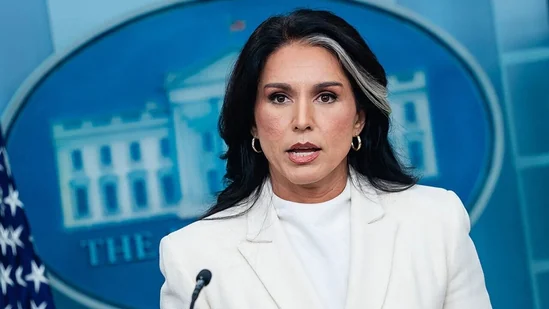
IN THE LAST three months Donald Trump has lost a string of senior officials: the homeland-security secretary, the attorney general and the secretary of labour. On May 22nd Tulsi Gabbard, the director of national intelligence (DNI), joined this exodus, citing her husband’s cancer diagnosis. She had cut an increasingly lonely figure, sidelined from most major decisions. Yet her departure comes as Mr Trump weighs up whether to restart a war on Iran that Ms Gabbard had long opposed.
Photograph: Goff Photos
Ms Gabbard, a combat veteran and former congresswoman from Hawaii, was a foreign-policy contrarian. She met Bashar al-Assad, Syria’s dictator, in 2017 and blamed NATO for Russia’s invasion of Ukraine in 2022. In between, she ran for the Democratic presidential nomination while hawking “No War With Iran” T-shirts. She left the party in 2022, first becoming an independent and then, in 2024, a Republican, coming to represent the anti-war wing of the MAGA movement. Her appointment as DNI, charged with co-ordinating America’s 18 intelligence agencies, alarmed many spooks.
In practice, Ms Gabbard’s departure will make little difference to policymaking. She was “out of the loop”, says a senior official, and did not belong to Mr Trump’s core group of advisers on national security and military matters. It was telling that, when American forces swooped into Venezuela in January, Ms Gabbard—who had previously spoken against such an intervention—was on holiday.
Yet she remained loyal to Mr Trump. In 2025, during an annual intelligence update, she told Congress that Iran was not building a nuclear bomb. Earlier this year Mr Trump would claim the opposite when making the case for war. But when Ms Gabbard was quizzed by senators in March, she declined to read out parts of her written statement that contradicted the president. In May she fired two top intelligence officials who had overseen a memo contradicting the administration’s claims around the Venezuelan government’s relationship with a drug cartel.
During Ms Gabbard’s tenure the Office of the Director of National Intelligence (ODNI) shrank in size. It also strayed into domestic politics in unprecedented ways. In January Ms Gabbard was present when the FBI seized ballots at an election centre in Fulton County, Georgia, the focus of Mr Trump’s false claims that the 2020 election had been stolen. She spoke to the president from the site of the raid. Two months later she acknowledged that ODNI had seized voting machines in Puerto Rico amid baseless claims by Trump supporters that Venezuela had manipulated them. She also implemented Mr Trump’s directive to create a “Weaponisation Working Group” to co-ordinate complaints against the Biden administration.
In private, many career intelligence officials say they are relieved that Ms Gabbard is gone. “She was never appropriately qualified for the position, never fully understood what the position’s responsibilities were once in the job, and never had the full confidence of the president,” says Larry Pfeiffer, the executive director of the Hayden Centre for Intelligence at George Mason University. “She then leaned into investigations of the discredited conspiracy theories surrounding past elections in an attempt to ingratiate herself to Trump.”
Ms Gabbard’s resignation is the latest evidence of the waning influence of anti-war figures in Mr Trump’s orbit. In March Joe Kent, director of the National Counterterrorism Centre and a subordinate of Ms Gabbard’s, resigned in protest at the Iran war. J.D. Vance, the vice-president, who long railed against American wars in the Middle East, has said little about the conflict in recent months. By contrast, Marco Rubio, the hawkish secretary of state, and John Ratcliffe, the Russia-sceptic CIA director, appear to wield greater influence as Mr Trump considers new attacks on both Iran and Cuba.
Earlier this year Mr Trump acknowledged that he and Ms Gabbard did not always agree. “She’s a little bit different in her thought process than me,” he said in March. In a post on Truth Social, the president thanked her for her service. “Tulsi has done an incredible job, and we will miss her,” he wrote. Her departure, like her tenure, is unlikely to affect policy.