
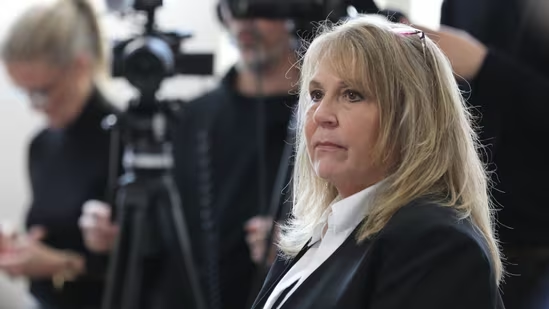
WALTERBORO, S.C.—Becky Hill was the star that evening at Colleton Coffee in her hometown in South Carolina’s Lowcountry.
Hill was seated before stacks of the newly published book in which she’d chronicled her part in the state’s trial of the century. An adoring crowd stretched out the door, down East Washington Street and into a nearby alley. It was hectic, but the onetime Miss Walterboro had a smile and a dollop of charm for everyone she encountered.
“That was like her coronation,” recalled Neil Gordon, Hill’s co-author. “They were so proud of her.”
The book, “Behind the Doors of Justice: The Murdaugh Murders,” would soon precipitate her downfall.
Its publication in August 2023 set in motion events that led South Carolina’s Supreme Court recently to overturn the conviction of Alex Murdaugh, the scion of a local legal dynasty, of murdering his wife and son.

The justices concluded that Hill, in her role as court clerk, had interfered with the jury in pursuit of fame and book sales. It called her actions “breathtaking and disgraceful” and “unprecedented in South Carolina.”
Hill had previously pleaded guilty to misconduct in office, perjury and obstruction of justice and had been forced from a job she loved. In an unlikely turnabout, Murdaugh—who is still expected to spend the rest of his life in jail on fraud charges—sued her in recent days for violating his civil rights. Now “impecunious,” in the words of his lawyer, he is seeking to recover some of the $600,000 he spent on his legal defense.
Hill’s fall from grace is an unlikely postscript to what was already a baroque and moss-draped tale of murder and corruption in the rural Deep South. It is also an example of the perils of a small-town official, drawn to the limelight, finding themselves under the klieg lights of a true-crime drama that became a national sensation.
“I don’t think she meant to do it, but she did,” said Annette Davis Bradley, owner of Downtown Envy, an antiques store a short walk from the Colleton County Courthouse where Hill presided. Like many of Walterboro’s roughly 5,400 inhabitants, she described Hill as a quintessential Southern belle—churchgoing, God-fearing and ready with a smile or an offer of sweet tea.
“She was just a warm, friendly person. Everybody loved her,” Davis Bradley said. But, she added: “I hate to know that this man gets another trial. And that’s on her.”
Hill didn’t respond to requests for comment. She expressed remorse when she pleaded guilty in December, saying, “There is no excuse for my mistakes. I am ashamed of them, and I will carry that shame with me for the rest of my life.”
An accident of fate
Colleton’s 1820 Greek Revival courthouse is elegant like a wedding cake. Yet it sits in one of South Carolina’s poorest counties, surrounded by waffle houses, dollar stores and personal injury lawyers.
Rebecca “Becky” Hill, now 58, grew up in Walterboro and won the local beauty pageant her senior year in high school. Then 17, she performed the Anne Murray ballad “You Needed Me”—both singing and in sign language—during the talent competition, according to a 1985 write-up in The State newspaper.
After college at the University of South Carolina’s Salkehatchie campus, she worked as a middle-school teacher before later becoming a court reporter. She impressed those who knew her as cheerful and determined.
In South Carolina governance, the clerk of the court job—organizing juries, bailiffs and handling evidence—is an elected position. In addition to the job itself, with a salary of roughly $100,000, part of the appeal is the authority to hire others and so provide patronage in a small town. When the previous clerk announced plans to retire in 2020 after 20 years, Hill ran to replace her. Two years earlier, Hill had survived a bout of colorectal cancer. She won 56% of the vote in a contest that some locals describe as essentially a popularity contest.
It is an accident of fate that the Murdaugh trial came her way. The Murdaughs reigned in neighboring Hampton County. But Alex’s trial ended up being held in Colleton because the bodies of his wife, Maggie, and younger son, Paul, were found in a portion of the vast family estate just across the county line.
When Murdaugh was initially arrested for insurance fraud in September 2021, Hill had only been on the job nine months. Soon the world’s media, true-crime junkies and more would descend on her courthouse.
Hill shined.
By the time the trial came around, “Miss Becky,” as many called her, had become indispensable to the visiting media, cheerfully accommodating their many demands inside and outside the courtroom. In a televised trial beamed worldwide, she became the pivot between the judge, celebrity lawyers, scores of reporters including from The Wall Street Journal, television stars like Nancy Grace and local jurors.
She could dole out favors. With a kind word to Hill, a visiting lawyer who wanted to observe the proceedings might skip the line outside the courthouse that began to form in the dead of night and instead slip through a side door.

Kathleen Castle recalled how Hill found a space for her son Jake, then 20 years old and studying criminal justice, to attend the trial one day and then interview her for class. Afterward, she took him to lunch. On the day of the verdict, she insisted he sit in the front row. “She was just nice to him and she didn’t have to be,” Castle said.
The verdict, on March 2, 2023—after a six-week trial—was when Hill took center stage. As clerk, she read aloud the jumble of docket numbers and announced the jury’s decision to the world: Guilty. For her performance, which lasted less than three minutes, Miss Becky wore two strands of pearls and matching earrings. During a press conference that evening, Alan Wilson, the state’s attorney general, praised “Becky Boo” for her extraordinary work. Hill then traveled to New York with a trio of jurors who would appear on the “Today” show. It was, she later said, her first time on an airplane.
‘Is this for personal gain?’
Hill had been ruminating about a tell-all book from the early stages of the trial, a clerk from a neighboring county who’d assisted her testified at an evidentiary hearing on the jury-tampering complaint.
Hill met Neil Gordon through his wife, Melissa, a photographer who had spent a few weeks in Walterboro chronicling the trial and the madness that swirled around it. Soon after, Melissa Gordon texted her new friend to wish her good luck and rest. “She responded back: no time for rest. I want to write a book,” Melissa recalled.
“She realized that this was a moment in time that will probably not come around again for so many reasons,” said Gordon, a former newscaster and publisher in Augusta, Ga., who recently produced a documentary, “Trial Watchers,” about the phenomenon of true crime-obsessed women. He recalled Hill’s determination to make the book a success, and how “she would love to buy a lake house.”
The turnaround was swift: Hill, he said, knew from her media contacts that Netflix was planning to release a Murdaugh documentary in September. The two wanted to publish “Behind the Doors of Justice” in August to capitalize on the hype—and they did.
The book reveals how Hill, like so many in the Lowcountry, had history with the Murdaughs. “According to my family’s tale, my granddaddy and Alex’s grandfather, Buster Murdaugh, Jr., the county solicitor, were neighbors and ‘handshake business partners’ in the moonshine business in Hendersonville, South Carolina, back in the 1950s,” she wrote. “That’s the same Randolph ‘Buster’ Murdaugh, Jr., who was the solicitor for the Lowcountry’s Fourteenth Circuit from 1940 to 1986.”

According to Gordon, Hill recounted to him how Alex Murdaugh once took her and her boss, the county judge, to dinner when she was a court reporter—an example of the county’s close, maybe too close, relationships.
Even before “Behind the Doors of Justice” arrived, trouble was brewing.
A month earlier, Hill’s former deputy and onetime friend, Laura Hayes, filed a complaint with the state ethics commission. “There are several things that have been going on that concern me in the Colleton County Clerk of Court’s office,” she wrote, and then alleged a range of financial improprieties—from extravagant meals on the county dime to Hill awarding herself bonuses from a pot of money devoted to child welfare services.
Hayes, who had quit her job, also noted how Hill had given the makers of the Netflix documentary access to the courthouse. “She allows them to come in and do whatever they want to do,” she wrote, noting the hours that producers spent filming her boss. “Is this for personal gain?” she asked.
On social media—particularly the “Walterboro Word Of Mouth” Facebook page—Hill haters began to emerge, asking whether she had grown too big for her britches.
Meanwhile, in Columbia, the state capital, the book came to the attention of Dick Harpootlian, Alex Murdaugh’s courtly but foul-mouthed attorney. Harpootlian heard rumblings that some of the jurors were displeased with Hill’s conduct and began to scour the back roads of Colleton County to track them down.
He recalled meeting one juror, in particular, at the end of a dirt road. “She had a dog on a chain out front. It was a trailer. She’s inside cooking collards for her grandson there…I mean, it was like something out of ‘To Kill A Mockingbird’ combined with Tennessee Williams,” Harpootlian said. “I mean, that whole scenario down there is really bizarre.”
That woman—and then other jurors, he said—recounted how “Miss Becky” told them not to believe the defense, not to let him fool you, and to “watch his body language” when Murdaugh testified.
During the evidentiary hearing in January 2024, nine jurors testified that they hadn’t heard such admonishments from Hill. Three others had, one of whom said it had affected her decision: “It felt like she made it seem like he was already guilty.” Murdaugh’s lawyers contend that Hill connived to have a juror removed—the so-called Egg Lady—because Hill feared she wasn’t inclined to convict.
It would soon emerge that Hill had allowed members of the media to enter the courthouse after hours to show them sealed evidence, including gruesome crime scene photos of Maggie and Paul Murdaugh.
Meanwhile, Neil Gordon was discovering problems with “Behind the Doors of Justice.” The State newspaper had uncovered thousands of Hall emails through a Freedom of Information request. While perusing them, he said he discovered that the foreword to their book had been plagiarized from an article written by a BBC reporter.
“It was heartbreaking,” he recalled. “I never would have imagined she would have done this in a million years.”

“Behind the Doors of Justice” topped two of Amazon.com’s thriller and true-crime categories for a day. Now Gordon rushed to have it “unpublished,” promising any sales from the remaining stock would go to charity.
Melissa Gordon struggled to reconcile the godly woman she thought she knew with the details now emerging. She was reminded of Hill’s excitement when she photographed her to promote the book. Miss Becky was wearing clothes and jewelry Hill had borrowed from Dillard’s for the occasion. “She loved it,” she recalled. “She bought almost all of it.”
Still, through it all, some Walterboro residents refuse to join the mob now casting stones at a woman they have known since she was a girl. If she made a mistake, they argue, it must have been because outsiders took advantage of her kindness.
“Becky’s just Becky. She’s just as sweet as she can be,” Teresa Busbee said from behind the counter of the local hardware store. If it had not been such an extraordinary case, no one would have cared or noticed Hall’s transgressions, Busbee said. “But it was, and so she’s been drug through the mud.”
Write to Joshua Chaffin at joshua.chaffin@wsj.com