
Half of young people aged 16-29 would never fight for Britain if war broke out, a new opinion poll has revealed. The pollsters summarised young people’s attitudes as being “why fight for a country that isn’t fighting for you?”
The poll is not a one-off. Previous surveys, including a YouGov poll two years ago, have revealed the same sentiment.
No wonder governments across Europe are now reintroducing conscription or other schemes to push new recruits into the armed forces, such as France’s strategy to encourage young people to volunteer for paid military training. Belgium is rolling out a similar plan, while the Netherlands has openly mulled bringing back the draft.
Late last year, Germany also introduced voluntary military service, but that could shift towards compulsory service if the security situation changes – even though only 32 percent of young people in the country support the idea.
Militarisation in Germany has gone so far that all military-age men now have to apply for permission to stay abroad for more than three months, no matter whether it is for study, a job or a holiday.
CLICK FOLLOW: TO FOLLOW US
Sign up to get the latest insights and analysis on
Israel-Palestine, alongside Turkey Unpacked and other eSPORTY
In the UK, conscription was part of the Tory manifesto in the last election, and a thin-end-of-the-wedge scheme has now been introduced by Prime Minister Keir Starmer’s Labour government.
The push to reintroduce conscription is just one part of the massive rearmament drive taking place across Europe.
Defence spending
While European leaders might have their reservations about US President Donald Trump’s adventure in Iran, they are deeply committed to fighting the war against Russia in Ukraine, and equally committed to boosting arms spending and preparing for a continent-wide conflict.
UK defence spending has soared in recent years, with an annual average increase of nearly four percent expected between now and 2029. Germany, meanwhile, is on track to spend €650 billion ($755bn) on the military over the next five years, more than doubling what was spent in the previous five years – despite polls showing that only 29 percent of people feel that “military means may be necessary to resolve international conflicts”.
As they pursue the largest arms bonanza since the end of the Cold War, Europe’s leaders have more to worry about than a lack of enthusiasm from young people
In France, the country’s rearmament programme will see stock levels rise by 400 percent for all types of remotely operated munitions, such as explosive drones, and by 85 percent for Scalp cruise missiles. Torpedo stocks will increase by 230 percent, and surface-to-air missile stocks by 30 percent.
The rearmament programme will hit just as the new cost-of-living crisis produced by Trump’s Iran war hits home across the continent. British ministers are already warning that even if the conflict were to end today, there would be at least an eight-month peak in inflation to follow.
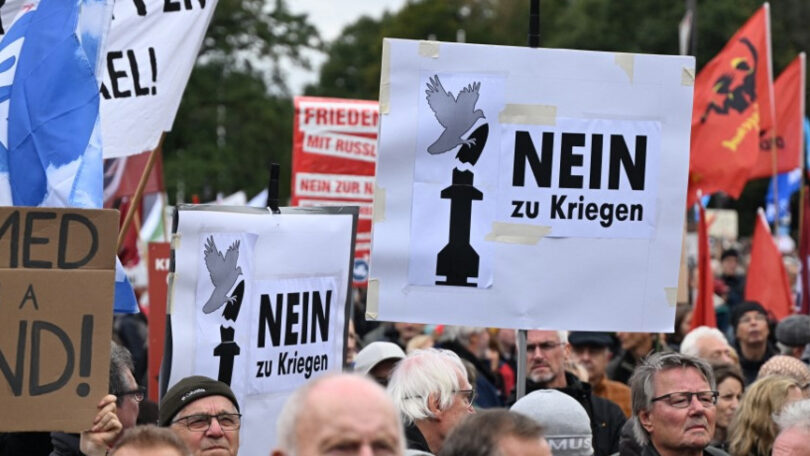
But as they pursue the largest arms bonanza since the end of the Cold War, Europe’s leaders have more to worry about than a lack of enthusiasm from young people – for there is now growing resistance to the war drive across Europe.
Tens of thousands of students in Germany have reportedly gone on strike in dozens of cities and towns across the country to denounce the reintroduction of military service.
Seventeen-year-old Shmuel Schatz, spokesperson for the School Strike Committee, told DW that he didn’t want to be “put into the trenches for the interests of large corporations” aiming to “line their pockets at the expense of war”.
‘Wages not weapons’
Indeed, Germany has recorded a surge in conscientious objector applications this year, while former trade union leader Klaus Zwickel issued a powerful condemnation of the European war drive, deeming it of the “utmost urgency” for the world to unite against rearmament and militarisation.
Across Europe, dissent is growing. In France, trade unionists recently held a pro-peace rally in the port city of Toulon.
The ticking bomb of European rearmament
Read More »
In Italy, large protests have linked the country’s domestic political crisis with the broader global drive for war, putting significant pressure on far-right Prime Minster Giorgia Meloni to distance herself from Trump and Israel. In Spain, powerful anti-war demonstrations were held in various cities in March.
Trade unions from across Europe will be sending delegations to the upcoming international anti-war conference set to take place in London next month. It follows a similar gathering in Paris last October, which saw 4,000 participants creating a new global network to oppose militarism and war.
The London conference also follows the decision by the Trades Union Congress, a UK federation of trade unions, to adopt a “wages not weapons” policy at its last congress. Among the expected attendees in London are dockworkers from Genoa who blocked arms shipments to Israel, alongside trade unionists from Belgium who have been involved in general strikes against austerity.
The European trade union movement and the anti-war movement seem to be organising in tandem, in a unified drive against war-budget austerity.
The views expressed in this article belong to the author and do not necessarily reflect the editorial policy of Middle East Eye.