
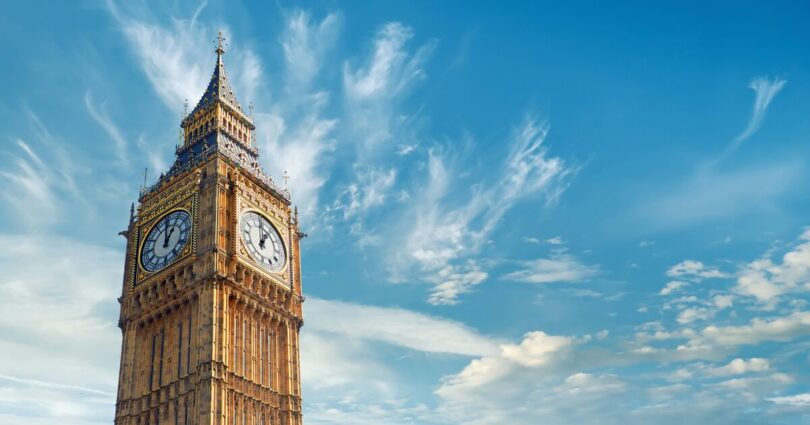
It’s bigger than Big Ben (Image: anyaivanova via Getty Images)
A divisive new skyscraper is poised to reshape the skyline in one of the globe’s most historic cities, which remains a favourite amongst Britons.
The Tour Triangle has sparked heated debate over the past decade, with critics of the contemporary development claiming it clashes with Paris’ character.
The distinctive structure is under construction by Belgian multidisciplinary firm BESIX. Upon completion, it will reach 180 metres in height and will dominate Paris’ comparatively low-rise skyline.
The development was conceived by Herzog & De Meuron, who previously created the ‘Bird’s Nest’ Olympic stadium in Beijing.
Construction teams have recently completed the final concrete pour on the 40th floor, marking the conclusion of three-and-a-half years of concrete operations.

It will be 180 metres tall when completed (Image: Getty)
While initial proposals for the tower were turned down by Paris City councillors, a subsequent vote ultimately granted approval.
Work started in 2021, with the building scheduled to open in the latter half of 2026.
The tower, which measures just 35 metres in width, will accommodate a mixture of offices, co-working spaces, a hotel, retail units, a cultural centre, childcare facilities and healthcare services, according to local media outlets.
Within will be a Radisson Blu hotel featuring 128 rooms. It will be “warm and unique”, crafted by Dion and Arles, who jointly designed the Standard in London and the Mama Shelter at Porte de Versailles.

Opponents have argued it doesn’t fit into the skyline (Image: Getty)
Parisians and tourists alike will be treated to an exceptional perspective of the iconic French capital, courtesy of a 3,000 sq m panoramic viewing platform. Dining establishments offering stunning views across the city will also feature.
Several years ago, a campaign organisation named Collectif Contre La Tour Triangle (Collective Against the Triangle Tower) contended that the structure contradicted Paris’ purported commitment to sustainability.
How can you justify building a tower made of glass and steel, which needs huge amounts of energy, with 70,000 sq metres of office space, in Paris – a city that is already overflowing with offices?” it stated in 2021.
Indeed, a skyscraper prohibition has been reintroduced in Paris since work on the project commenced, rendering it an anomaly in contemporary Parisian architecture.
A ban was initially imposed during the 1970s, restricting new structures to a maximum height of 37 metres.
Nevertheless, it was reversed in 2010, paving the way for fresh proposals to be put forward.
The Tour Triangle experienced delays of around 12 years, as planners and developers navigated numerous legal challenges. Nevertheless, it appears set to welcome visitors this year.

The skyscraper is near completion (Image: Getty)
Recycled materials feature throughout the Tour Triangle, including its aluminium facades.
Additionally, various environmental initiatives have been implemented, encompassing geothermal energy systems, double-skin facades and photovoltaic panels.
BESIX France project director Koen De Rooy said last year: “We don’t always take the time to appreciate the full extent of the effort involved, but at this key moment in the project, we want to offer a heartfelt thank you to everyone, past and present, who has worked relentlessly to get us to this point. Thank you! Now let’s tackle the next challenges together!”