
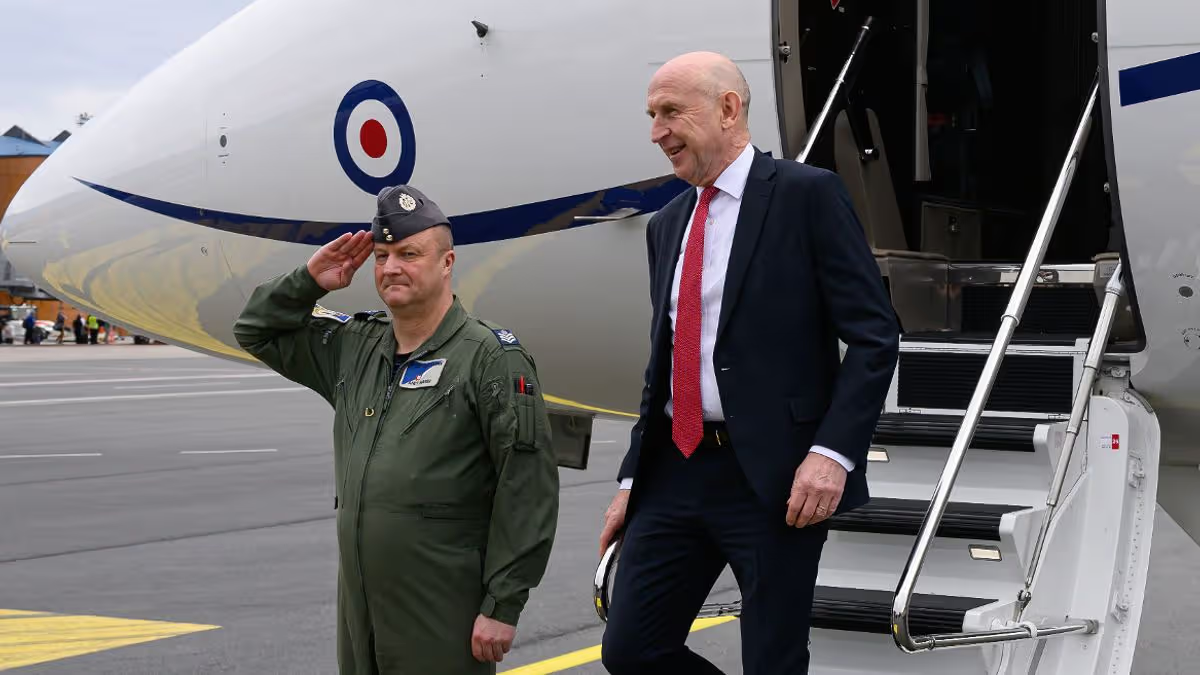
An electronic attack on an RAF jet carrying defence secretary John Healey occurred as it flew close to the Russian border – pilots had to switch to a different navigation systet
An RAF jet carrying the defence secretary has its signals jammed as it flew near the Russian border.
The electronic attack occurred as John Healey was travelling back to the UK from Estonia on Thursday, where he had been visiting British troops. Vladimir Putin’s Russia is believed to be behind the incident.
Smartphones and laptops were unable to connect to the internet and pilots had to use a different navigation system as the plane’s GPS was disabled for the entire three-hour flight. It is not known if Mr Healey was deliberately targeted but the flight path was visible on aircraft tracking websites, The Times reported first.
Passengers, who included photographers and a reporter, were told the Dassault Falcon 900LX aircraft could still operate safely. The incident comes just days after the Ministry of Defence (MoD) revealed two Russian jets had been “repeatedly and dangerously” intercepted an RAF spy plane above the Black Sea.
A Russian Su-35 jet flew so close to the British reconnaissance aircraft that it triggered its emergency systems, including disabling the autopilot. One of the nation’s Su-27s also flew six metres from the unarmed Rivet Joint’s nose and carried out six passes in front.
The MoD said it was the most dangerous Russian action against a British Rivet Joint aircraft since a plane fired a missile over the Black Sea in 2022.
Mr Healey said: “This incident is another example of dangerous and unacceptable behaviour by Russian pilots, towards an unarmed aircraft operating in international airspace. These actions create a serious risk of accidents and potential escalation.
“I would like to pay tribute to the outstanding professionalism and bravery of the RAF crew who continued with their mission despite these dangerous actions. Let me be very clear: This incident will not deter the UK’s commitment to defend NATO, our allies and our interests from Russian aggression.”
The RAF Rivet Joint is a reconnaissance aircraft that uses advanced sensors for electronic surveillance, enhancing situational awareness and helping keep NATO territory safe. In March 2024, an RAF plane carrying the then-defence secretary Grant Shapps had its GPS signal jammed while flying near Russian territory.
The satellite signal was interfered with for about 30 minutes while the flight was heading back to the UK from Poland. In April, Scottish First Minister John Swinney said the UK may not have the capability to deal with the “threat” of Russia’s military off the coast of Scotland.
The Scottish First Minister said he was concerned about revelations of a Russian attack submarine and two spy submarines loitering over critical undersea cables in the North Atlantic. He also expressed concerns about the ability of the UK’s armed forces to deal with any potential threats from Moscow.
Mr Healey had revealed that the UK and its allies tracked three Russian vessels off the UK’s northern coast. A British warship and aircraft were deployed to deter “malign” activity by Putin’s regime in waters off the UK’s northern coast, Mr Healey said.
He said Putin had sought to capitalise on the world being “distracted” by the Iran war and that he poses “the primary threat to UK security”.
An MoD spokesperson said: “The UK is stepping up to protect the Arctic and High North – doubling the number of Marines we have in Norway, deploying HMS Prince of Wales to the high north and scaling up joint exercises with Nato allies.
“As the Defence Secretary said yesterday we’re providing an extra £100 million for our vital P8 submarine hunting aircraft and we’ve launched the Atlantic Bastion programme, to combine the latest autonomous technologies with the very best warships and aircraft to create a British-built hybrid naval force.
“The exceptional military personnel serving in Scotland and the 11,800 skilled people across the Scottish defence industry are a credit to this country. Their dedication keeps us secure at home and strong abroad.”